

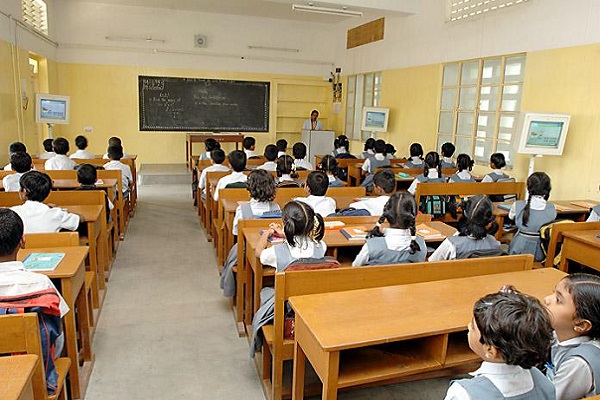
The Indian education system has since long been a subject of criticism for a variety of reasons. On one hand, it is accused of being a fiefdom of left-wing academicians who are highly intolerant towards contrarian views, and on the other, it is accused of severely lacking innovation. Another form of criticism includes the education system’s disconnect with the changing times, rendering the students incompatible with the industry’s needs.
Now the Prakash Javadekar led Human Resource Development (HRD) ministry has decided to conduct a novel experiment in order to possibly give education back to the masses by seeking suggestions regarding how to rationalise school curriculum from class I to XII.
Promoted under the Department of School Education and Literacy, the Ministry is inviting suggestions on rationalising curriculum, syllabus and subject contents for “all-round development of students”.
As per the release, in order to develop a more egalitarian society, besides cognitive and analytical skills, attention also needs to be paid on “life skills, experiential learning, health and physical education, sports, visual and performing arts, literary & creative skills, work-based education”. But as per the department, the workload on cognitive and analytical regions renders a student unable to focus on the latter areas.
Hence in order to solve this, the ministry is inviting suggestions from ” teachers, academics, students, parents and other stakeholders associated with school education”, to ensure that a balance is maintained between the aforementioned points for students following NCERT/CBSE syllabuses from classes I to XII.
The suggestions which will be accepted till 6th April are expected to be precise and can be sent via clicking at this link.
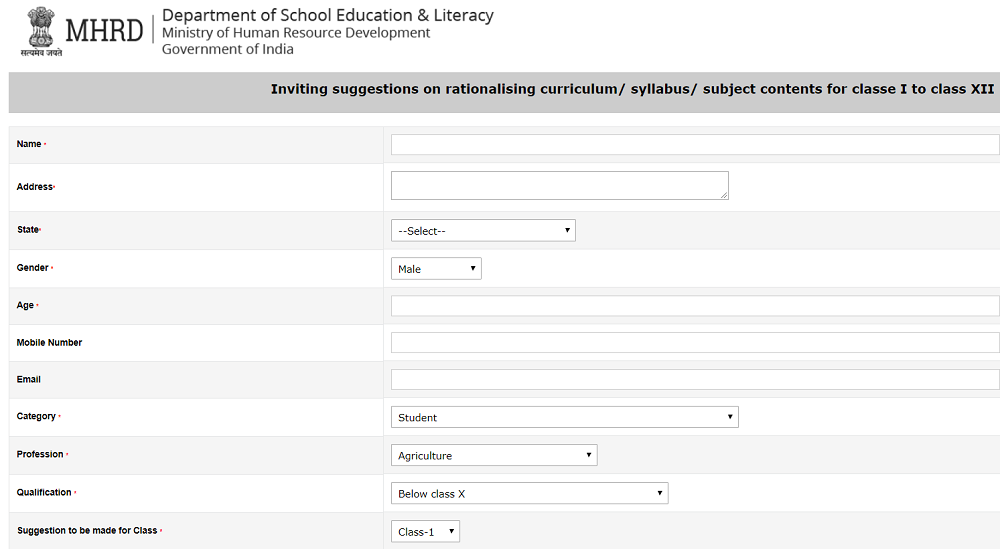
In the form provided by the ministry, one compulsorily needs to fill the details like one’s name, address, state, gender, age, occupation, category, qualifications and the class, subjects for which one wants to make the suggestions.
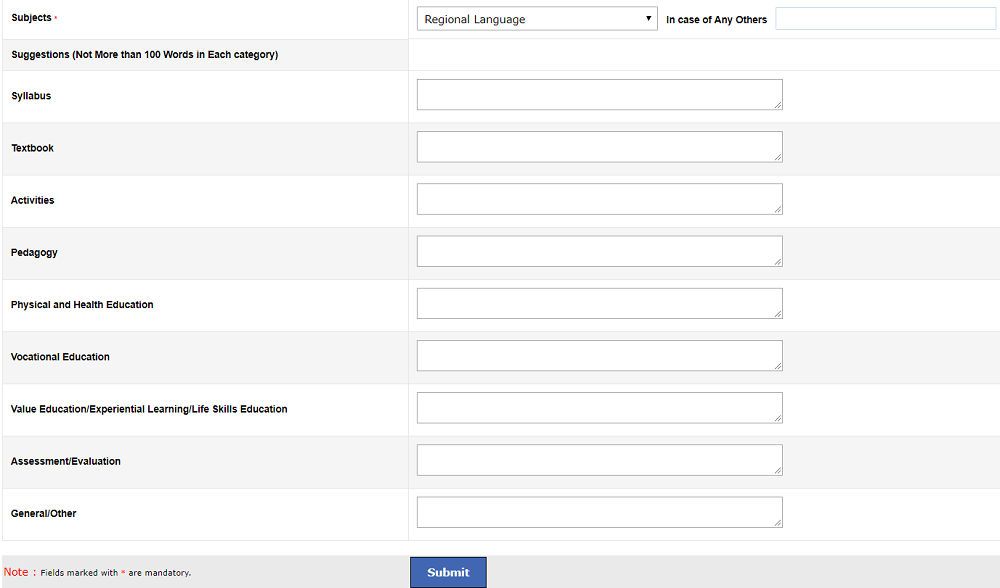
The area in which one can make the suggestions within a 100 words are:
- Syllabus
- Textbook
- Activities
- Pedagogy
- Physical and Health Education
- Vocational Education
- Value Education/Experiential Learning/Life Skills Education
- Assessment/Evaluation
- General/Other
This is a sample screenshot of an unfilled form:
It is certainly heartening to note that the HRD ministry has decided to take the opinion of the informed public regarding the designing of a rationalised curriculum. But it remains to be seen whether the effort translates into a genuine implementation of novel suggestions sent by the public which also importantly is bereft of interference by the leftist establishment and its “eminent thinkers”.


