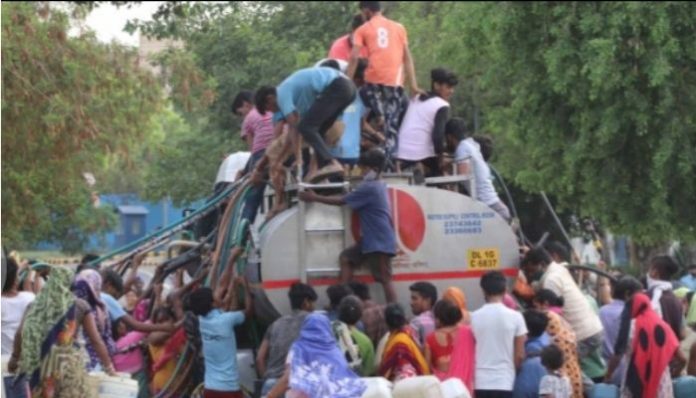
Residents of Delhi continue to face severe water crises as long lines of people around water tankers are seen in many areas of the national capital.
With piped supply affected in various residential areas, water is supplied to the people through tankers. Visuals from Mayur Vihar and Okhla Phase 2 showed on Sunday residents huddling around water tankers with buckets and cans in their hands to carry water. Delhi government blamed the water crisis on the Haryana government “blocking” its share of water.
“On one hand, the Supreme Court is trying to solve the water crisis in Delhi, and Himachal Pradesh is ready to give more water to Delhi. On the other hand, Haryana is blocking Delhi’s share of water,” Atishi, Delhi Minister, said while speaking to reporters in Delhi on Saturday.
“Under the agreement between Haryana, Delhi, and the entire Upper Yamuna region regarding water, 1050 cusecs of water come to Delhi through the Munak Canal. Two sub-canals of the Munak Canal supply water here. It is measured by the flow meter installed here. If we look at the data from the last five years, out of the 1,050 cusecs of water released by Haryana, 1000 to 980 cusecs of water reach Delhi. But for the last five days, this amount of water has been continuously decreasing. At least 1,000 cusecs of water should reach Delhi, but since June 1, it has decreased a lot. On June 7, only 840 cusecs of water reached Delhi,” she added.
For many residents in the city, their daily lives are being disrupted because of the water crisis.
Ambati, a resident of Delhi’s Geeta Colony, told ANI that she has to face a lot of trouble fetching water from the tankers. “We have to face a lot of trouble. We get only one tanker, from which we have to fetch water. We have no other option, though,” she said.
Another resident of Geeta Colony, Ghanshyam Jha, said, “We have to face the water crisis daily. We have to bear a lot of trouble while getting water from tankers. Sometimes, we skip work due to this. One tanker doesn’t seem to be enough for the entire population of this colony, but anyway, we only get one.”
The record-high temperatures and heatwave in Delhi, which has resulted in maximum temperatures rising to around 50 degrees Celsius in some places, have caused an extraordinary and excessive surge in water demand in the city.
(This news report is published from a syndicated feed. Except for the headline, the content has not been written or edited by OpIndia staff)