

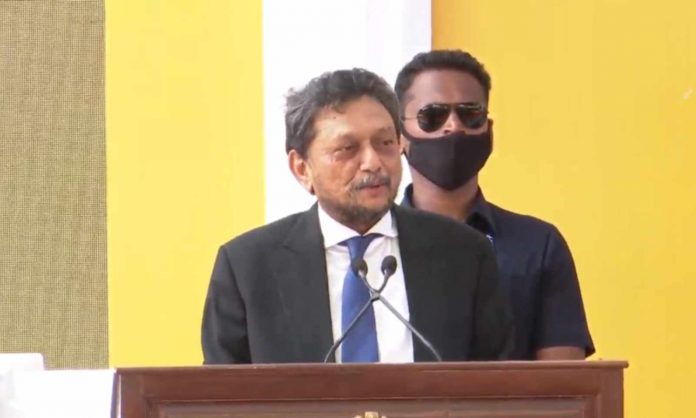
April 14th marked the 130th birth anniversary of Babasaheb Ambedkar. Remembering BR Ambedkar on this day, CJI Bobde remarked that Ambedkar had proposed Sanskrit as the official language of India however, the move did not make any headway.
Ambedkar had proposed Sanskrit as national language: CJI Bobde
— ANI Digital (@ani_digital) April 14, 2021
Read @ANI Story | https://t.co/CwArDIslxK pic.twitter.com/n9QCywDUeK
The CJI was called upon by the Maharashtra National Law University at Nagpur to deliver a speech at the inaugural ceremony of the academic building.
CJI Bobde began his speech by expressing his quandary to decide which language to deliver his speech in. “This dilemma is being witnessed in our country for a long time. I have seen this question cropping up frequently as to which language should the courts function in. We have High Courts with the official language as English and Hindi. Some want Tamil, some others want Telugu. I want to humbly submit that nobody is paying attention to this subject,” he said.
Dr Ambedkar thought that Sanskrit will be accepted by all Indians: CJI Bobde
He further stated that Ambedkar was of the opinion that Tamil won’t be accepted in north India and Hindi won’t be accepted in south India. Suggesting that Ambedkar believed Sanskrit is the only language that won’t be opposed in either north India or south India, he said, “Dr Ambedkar had proposed for formulating ‘Sanskrit’ as the official national language. It had signatures of some mullahs, pandits and priests and of Dr Ambedkar himself.”
“Ambedkar wasn’t an expert in only law but was seized of what was going on socially and politically too. He knew what people wanted, what the poor wanted. That’s why, I think, he had thought of this proposal. But finally, English was made the official language. So with your permission, this being the national law university, I will speak in English,” CJI Bobde remarked before continuing his speech in English.
The CJI also congratulated the university for introducing a course in ‘Nyaya Shastra’ and exclaimed, “there is no reason why we should not benefit from the geniuses of our ancestors.” Regarding Nyaya Shastra at par with Aristotelian and Persian system of logic, he said, “The Indian judiciary draws its jurisprudence from the Anglo-Saxon model which is based on Aristotelian and Persian logic. When I read about Nyaya Shastra, I found that it is not a bit inferior to the Aristotelian system.”
The event was also attended by the Union Minister Nitin Gadkari, former chief minister Devendra Fadnavis, Chief Justice of Bombay High Court Deepankar Dutta and Supreme Court Judge Justice Bhushan Gavai whereas Chief Minister Uddhav Thackeray joined the program online.


