

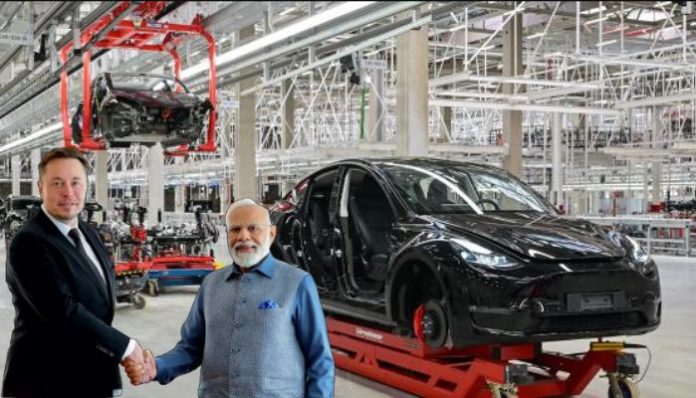
Billionaire Elon Musk-led Tesla Inc. has initiated its search to identify sites for building its proposed $2 billion to $3 billion Electric car plant in India. On Wednesday (3rd April), the UK’s Financial Times reported that the electric vehicle (EV) maker will send its team to India by late April to scout sites. As per the report, the team’s special focus is on states that already have automobile manufacturing hubs as well as ports to facilitate export. Reportedly, states like Maharashtra, Gujarat, and Tamil Nadu are on high priority for the company.
FT further reported, “Tesla might later also look at setting up its own battery plant, following the ‘gigafactory’ model it has followed at its plants in California, Texas, Berlin, and Shanghai, where suppliers have set up shop next to or near the mother plant.”
The development comes at a time when Tesla has reported a sharp decline in sales for the March quarter. The EV demand has plummeted in its main markets, the United States and China.
Meanwhile, the Indian government had in March reduced import taxes on certain electric vehicles produced by automakers that commit to invest at least $500 million (Rs 4,150 crores) and start commercial production in the country within three years.
Tesla CEO Elon Musk has been eyeing the Indian market for years but New Delhi has maintained that the EV maker has to commit to local manufacturing.
In June last year, Musk met Prime Minister Narendra Modi and the two held discussions on a range of issues including investment opportunities in India. After the meeting, Elon Musk said, “It was excellent and a very good conversation. I am confident Tesla will be in India and will do so as soon as humanly possible.”
Later in July of that year, the company said that it was interested in building a factory in India to produce an electric vehicle priced at $24,000. It had also sought lower taxes on more expensive models it wanted to sell in India, Reuters reported.
India’s electric vehicle (EV) market, though small, is on a growth trajectory and is currently dominated by domestic automaker Tata Motors. EVs accounted for approximately 2% of total car sales in India in 2023, with the government aiming to increase this to 30% by 2030.
Under the EV policy, it is mandated that companies achieve a localisation level of 25% by the third year and 50% by the fifth year of their entry into India to qualify for the lower customs duty of 15% on Completely Built Units (CBUs). This reduced duty applies to cars priced at a minimum value of $35,000 (approximately Rs 29 lakh), inclusive of costs such as insurance and freight charges.
Analysts in the automotive industry believe that this initiative will not only enable access to global technologies but also lead to an expansion of product range and improvement in cost competitiveness, ultimately driving increased adoption of EVs.


