

India’s economy is set to maintain steady growth next year even as global trade faces pressure from high US tariffs. The central government has projected India’s gross domestic product (GDP) growth at 7.4 % for FY26, highlighting the economy’s ability to withstand external pressures, including the absence of a formal trade deal with the United States.
#BREAKING | FY26 GDP first advance estimate pegs real growth at 7.4%#GDP #IndianEconomy #Growth #NominalGDP pic.twitter.com/ozTeHDfrev
— ET NOW (@ETNOWlive) January 7, 2026
The projection is marginally higher than the 7.3 % growth estimate given by the Reserve Bank of India and also edges past India’s GDP growth of 7.3 % recorded in FY25. However, it remains lower than the strong 9.2 % expansion seen in FY24.
Advance GDP estimates signal stability.
The first advance estimates were released by the Ministry of Statistics and Programme Implementation on Wednesday, 7th January and broadly match market expectations. The figures are close to the 7.5 % median forecast from a Bloomberg survey of economists.
Officials indicated that these numbers may be revised later, as the government plans to update the method used to calculate GDP. Any changes are expected to be reflected in the Union Budget for 2026, with final figures released after the financial year concludes.
In nominal terms, India’s GDP is expected to grow by 8 % in FY26, compared with 9.7 % in FY25. Real gross value added (GVA) is projected at 7.3 %, up from 6.4 % last year, while nominal GVA growth is estimated at 7.7 %.
Consumption, Investment, and Sector Performance
Private consumption, which accounts for nearly 60 % of India’s GDP, is expected to grow by 7 % year-on-year in FY26, slightly lower than last year’s pace. Government spending is projected to rise by 5.2 %, a sharp improvement from the 2.3 % growth seen in FY25. Private investment is also expected to strengthen, with growth estimated at 7.8 %.
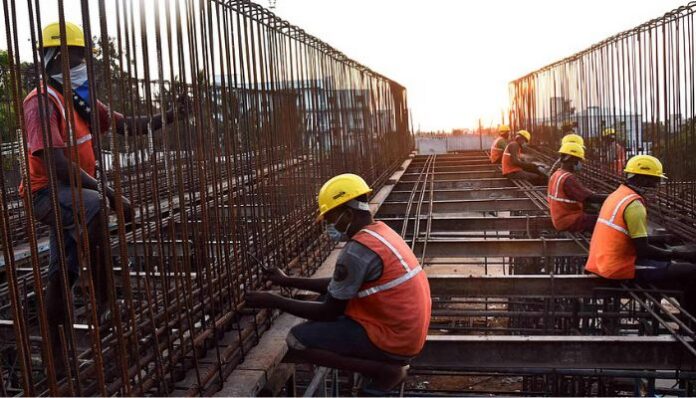
Manufacturing, which contributes about 13 % to GDP, is projected to grow by 7 %, a significant improvement from 4.5 % in the previous year. Construction activity is expected to expand by 7 %, slower than the 9.4 % growth recorded earlier. Agriculture growth is seen at 3.1 %, reflecting steady output in a sector that supports more than 40 % of India’s workforce.
Exports defy tariff pressure
Alongside domestic growth, India’s export performance has shown surprising strength. Goods exports rose by nearly 20 % year-on-year in November 2025, marking the fastest growth in three years, even as the US imposed tariffs of up to 50 % on Indian products earlier this year under former US President Donald Trump.
According to data from the Ministry of Commerce and Industry, India’s exports stood at $38.13 billion in November, reversing the sharp decline recorded in October. Imports fell by nearly 2 %, led by lower purchases of gold, oil, and coal, which helped narrow the trade deficit to about $24.5 billion, its lowest level since June.The
US and China drive export growth
Despite higher tariffs, exports to the United States, India’s largest single export market, rose by 22 % to around $7 billion in November. Engineering goods, electronics, gems and jewellery, and pharmaceuticals led the gains. Commerce Secretary Rajesh Agrawal said India had managed to maintain strong export momentum in the US market despite tariff barriers.
Exports to China also surged sharply, rising 90 % year-on-year to $2.2 billion, driven mainly by electronics and engineering goods. Shipments to countries such as Spain, the United Arab Emirates, and Tanzania also contributed to the overall export growth.
Diversification and Outlook
Economists say part of the export resilience comes from tariff exemptions on key Indian products such as electronics, pharmaceuticals, and certain food items. A weaker rupee has also helped make Indian goods more competitive overseas. In addition, exporters are benefiting from a low base last year, when global trade was disrupted by the Red Sea crisis.
India is also stepping up efforts to diversify its export markets. Trade agreements with the UK and European Free Trade Association countries are already in place, while talks are ongoing with Mexico and Oman. The government is also exploring opportunities in Eurasian and Central Asian markets.
Taken together, the GDP outlook and export data suggest that India’s economy remains on a stable growth path. Despite tariff pressure, global uncertainty, and shifting trade dynamics, both domestic demand and external trade are providing support to economic expansion heading into FY26.
