

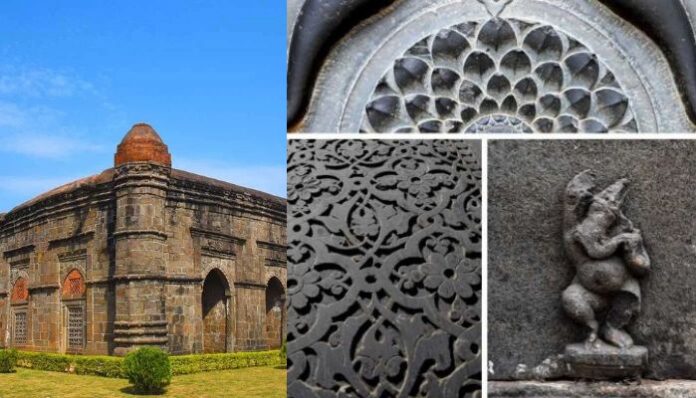
A major religious and political row is brewing in West Bengal as a Hindu group, backed by local BJP leaders, has begun conducting prayers near the 650-year-old Adina ‘Mosque’ in Malda district. The historic structure was built over an ancient Hindu temple. Leading the effort, the ‘Adinath Puratan Shiv Mandir’ organisation has announced plans to install a massive 3.6-foot-high Shiva Lingam, weighing around 1.5 tonnes, outside the ‘mosque’ premises. The Shiva Lingam is being transported from Tarakeshwar, located nearly 289 km away.
According to a report by The Indian Express, Kajal Goswami, chief patron of the group and a BJP leader, openly stated, “There are Hindu and Buddhist statues in the so-called mosque. The Adinath Temple was destroyed to build a mosque on it”. He added, “Our aim is to restore the temple and place the Shiva Lingam inside it”.
However, Goswami stressed that they intend to follow the law and avoid any law and order disruption, mentioning that officials from the Archaeological Survey of India (ASI) and the police instructed them to perform rituals outside the protected monument area.
A fresh dispute has emerged around West Bengal's 650-year-old Adina Masjid, with a BJP leader announcing plans to install a Shiva Lingam outside the protected monument while claiming it was originally a temple. The ASI has barred religious activity inside the monument, and… pic.twitter.com/nG5XlCDAL7
— Outlook India (@Outlookindia) July 25, 2026
Following these developments, the Malda district police issued a strict advisory, reminding the public that the Adina Monument is a Centrally Protected Monument under the AMASR Act of 1958, where unauthorised religious rituals inside the premises are strictly prohibited.
Political momentum has also picked up, with BJP Rajya Sabha MP Samik Bhattacharya raising the issue in Parliament, urging the Central Government and the ASI to look into protecting the original Adinath Temple. Meanwhile, opposition leaders like CPI(M) Politburo member Md Salim have accused the BJP of using a familiar political playbook to divide people ahead of upcoming elections.
Conversion of the ancient temple into a Mosque
Located in Pandua in Bengal’s Malda district, the Adina Mosque is officially recorded as being built between 1373 and 1375 CE by Sultan Sikandar Shah of the Ilyas Shahi dynasty. While historical narratives often label it the largest medieval mosque in the Indian subcontinent, extensive archaeological and architectural evidence reveals a much older history. The mosque was primarily constructed using materials, pillars, and carved stones salvaged from pre-existing Hindu and Buddhist structures belonging to the Pala-Sena era (8th to 12th century).
Sculptural remnants throughout the structure suggest that the site was originally home to the grand Adinath Temple, dedicated to Lord Shiva, alongside a shrine dedicated to Lord Vishnu. The pulpit of the mosque itself incorporates a doorway made of black basalt stone taken directly from the temple’s architectural ruins.
Furthermore, terracotta and stone carvings on walls, doors, arches and mihrabs or prayer niches depict Hindu deities like Lord Shiva and Ganesh. In addition, there is a significant presence of motifs like flowers, caitya arches, kiritmukha (face of glory) masks, beaded necklaces, and chain-and-bell designs. The Islamic architecture is devoid of this type of adornment, indicating that these motifs and carvings date back to the Pāla–Sena era.
The central mihrab of this mosque carries clear indications of the structure’s Hindu history. The front of this mihrab is placed in the curved wall decorated with a tri-foiled arch, and the spandrel on either side of the arch has been decorated with rosettes, and the panels inside the mihrab are also adorned with the designs of foiled arches and rosettes having chain and bell motifs hanging from the apex of the arches. These are Hindu decorative motifs, as these sorts of chain and bell motifs are noticed on the shaft of the columns engraved during the Hindu period.
Even today, broken Shivlings and overturned idols of Hindu deities remain visible within the walls and surrounding structures, pointing to a widespread destruction of Hindu heritage in the region during medieval invasions.
The issue gained significant legal and social attention when senior advocate Hari Shankar Jain appealed to Hindus to reclaim their right to worship at the site, writing letters to Prime Minister Narendra Modi and calling out the historic destruction caused during Sikandar Shah’s reign.
TMC MP Yusuf Pathan attempted to legitimise it as a mosque
The controversy caught national spotlight when Trinamool Congress (TMC) MP Yusuf Pathan visited the site and attempted to highlight it purely as an Islamic architectural feat.
Sharing pictures of his visit on social media, Pathan wrote: “The Adina Mosque in Malda, West Bengal, is a historic mosque built in the 14th century by Sultan Sikandar Shah, the second ruler of the Ilyas Shahi dynasty. Constructed in 1373–1375 CE, it was the largest mosque in the Indian subcontinent during its time, showcasing the region’s architectural grandeur.
The Adina Mosque in Malda, West Bengal, is a historic mosque built in the 14th century by Sultan Sikandar Shah, the second ruler of the Ilyas Shahi dynasty. Constructed in 1373-1375 CE, it was the largest mosque in the Indian subcontinent during its time, showcasing the region's… pic.twitter.com/EI0pBiQ9Og
— Yusuf Pathan (@iamyusufpathan) October 16, 2025
Netizens and political commentators quickly called out the TMC leader for ignoring the site’s rich Hindu heritage. Sharing detailed photographs of Hindu carvings inside the complex, social media users offered sharp fact-checks. Advocate Shekhar Kumar Jha posted an image showing a Lord Ganesh carving on the wall, commenting, “Historic: Adinath Mandir became Adina Mosque.”
Another X user, “PlanH,” replied directly to Pathan: “Dear Yusuf Pathan, you are standing in the campus of one of the largest Hindu Temples, Adinath Temple, which was desecrated and occupied by Islamic invaders. Attached are some images for your reference. It is time to undo the injustice and barbarity, and reestablish the temple’s glory.”
Dear Yusuf Pathan, you are standing in the campus of one of the largest Hindu Temples, Adinath Temple, which was desecrated and occupied by Islamic invaders. Attached are some images for your reference.
— PlanH (@planH_In) October 16, 2025
It is time to undo the injustice and barbarity, and reestablish the temple's… pic.twitter.com/CUc1z5lnHD
User “Abdul Kitabi” added: “As a true Muslim, we must give this mosque back to Hindus.”
Others raised fundamental questions about historical accountability, asking, “Have you people made anything of your own, or have you just taken over everything by demolishing others’ religious sites and claimed it as your own?”
Reclaiming rights and moving towards restoration under BJP government
For decades, local Hindus were strictly barred from offering prayers or carrying out any religious rituals at the disputed site. The area was placed under strict protection by the ASI, which effectively halted any attempts at worship or further archaeological excavation. However, the sentiment surrounding the site began shifting noticeably in early 2024.
A group of Hindu devotees led by a young priest, Hiranmoy Goswami, entered the premises, identified idols and a Shivling embedded in the architecture, and started chanting mantras and offering puja. Though local police intervened following the complaint by local Muslims and stopped the prayers at the time, the act marked a turning point for the local community.
Today, backed by BJP leaders pushing for historic justice, the effort to reclaim the site has reached a new high. Comparing the dispute to major historical re-evaluations like Ayodhya’s Ram Janmabhoomi, Gyanvapi, and Mathura, activists and political figures emphasise that public religious sentiment cannot be suppressed forever.
With plans to petition the Calcutta High Court for a complete ASI survey and the ongoing installation of a dedicated Shiva Lingam outside the complex, the Hindu community is taking decisive steps to legally and peacefully reclaim what they consider their rightful sacred heritage.


