

HomeSpecialsOpIndia ExplainsAs Skyroot’s Vikram 1 rocket reaches orbit, read how Modi govt’s policies and proactive...

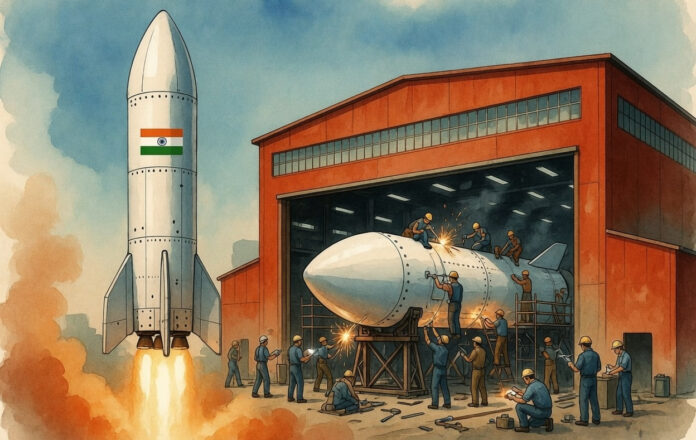
As Skyroot’s Vikram 1 rocket reaches orbit, read how Modi govt’s policies and proactive actions are creating India’s own SpaceXs

The milestone was made possible by the Central Government’s decision to open the space sector to private players through the 2020 reforms, the Indian Space Policy 2023, and the creation of IN-SPACe as a single-window agency.

On the afternoon of 18 July 2026, at the Satish Dhawan Space Centre on the barrier island of Sriharikota, a slender blue-and-white rocket named Vikram-1 rose from the First Launch Pad amid a plume of fire and smoke. The countdown was paused for roughly thirty-five minutes after a minor anomaly appeared in the automatic launch sequence, yet once the hold was cleared the vehicle climbed cleanly. Fifteen minutes after liftoff, the liquid upper stage completed its burn and injected a cluster of payloads into a 450-kilometre low-Earth orbit inclined at sixty degrees.

Mission Aagaman — Sanskrit for “arrival” — had succeeded on its very first attempt. Skyroot Aerospace, the Hyderabad company that designed, built and flew the rocket, became the first private Indian enterprise to place satellites into orbit. India joined the United States and China as only the third country whose private industry had independently achieved orbital launch capability.

The significance of that single flight cannot be overstated. More than sixty-five years after the first artificial satellite entered orbit and forty-six years after India’s own SLV-3 placed the Rohini satellite into space, the capacity to design, manufacture and operate an orbital-class launch vehicle remains the preserve of a very small number of nations. The number of private companies that have reached orbit under their own power is much smaller. Those that have done so on the maiden attempt form an even more exclusive group.

Most new entrants endure multiple failures before mastering the unforgiving combination of propulsion, guidance, structural integrity and range safety. That a company founded only in 2018 by two former ISRO engineers could accomplish the feat on its first try speaks both to the depth of Indian engineering talent and to the carefully constructed policy environment that made such rapid progress possible.

Exclusive club of a few members

Mankind has been launching rockets for over 80 years, beginning with Germany’s V-2, the first modern liquid-fuelled ballistic rocket, which first flew successfully in 1942 and entered operational service in 1944. In 1957 the Soviet Union achieved the first orbital launch with its R-7 rocket, placing Sputnik 1 into orbit and triggering the Space Race with the United States. Since then, a large number of rockets have been launched by several countries, and low Earth orbit is now filled with satellites and space debris.

Elon Musk’s SpaceX not only launches rockets with remarkable regularity; the company also recovers its giant Starship rocket using a pair of giant chopsticks known as Mechazilla. SpaceX further recovers its Falcon rockets and boosters by landing them directly on the ground or on its droneships named Of Course I Still Love You, Just Read the Instructions, and A Shortfall of Gravitas. Such accomplishments can create the impression that rocket science has become easy, but the fact remains that it is still an exclusive domain of only a few companies and countries.

At present, the global roster of private companies that have independently designed, built, and successfully flown orbital-class launch vehicles remains remarkably short. Only a handful of firms worldwide have demonstrated the full end-to-end capability of placing payloads into Earth orbit under their own power, and even fewer have done so with sustained operational cadence.

In the United States, SpaceX continues to dominate by an overwhelming margin. Its Falcon 9 family has executed well over a hundred successful orbital missions in recent years, delivering both commercial satellites and the company’s own Starlink constellation at unprecedented frequency and cost. Rocket Lab, operating from New Zealand and the United States, has established itself as the leading dedicated small-satellite launcher with its Electron vehicle, which has completed dozens of successful orbital flights since its first success in 2018 and continues to serve a diverse commercial and government customer base. Blue Origin joined this exclusive group in January 2025 when its New Glenn heavy-lift rocket reached orbit on its maiden flight, marking the company’s long-awaited entry into the orbital market after years of suborbital New Shepard operations. Firefly Aerospace has also achieved orbital successes with its Alpha vehicle, though its record remains more mixed.

China has produced the largest number of private orbital launch providers. i-Space became the first Chinese private company to reach orbit in 2019 with its solid-fuelled Hyperbola-1. Galactic Energy followed in 2020 with the Ceres-1 and has since built one of the more reliable commercial track records in the country, including sea launches. LandSpace achieved a historic milestone in 2023 when its Zhuque-2 became the world’s first methane-fuelled rocket to reach orbit, and the company continues to advance reusable variants. Space Pioneer, Orienspace and CAS Space have likewise demonstrated successful orbital insertion with their respective vehicles, giving China a growing commercial launch ecosystem that operates alongside the state-owned Long March family.

With the successful maiden flight of Vikram-1, Skyroot Aerospace has now added India to this short list, making the country only the third after the United States and China to possess a privately developed orbital launch capability. The exclusivity of this club underscores both the extraordinary technical and financial barriers involved and the strategic importance of the policy reforms that enabled Skyroot’s rapid progress.

The number of countries that have orbital launch capacity is also incredibly small, which include the United States, Russia, China, France, Japan, India, the UK, Israel, Iran, New Zealand, North Korea and South Korea.

Vikram-1 Rocket

Vikram-1 itself is a compact yet sophisticated machine. Standing twenty-four metres tall with a diameter of 1.7 metres, the vehicle is built almost entirely of carbon-fibre composite, a material choice that halves structural mass relative to conventional aluminium alloys while delivering exceptional stiffness. Its four stages follow a deliberate engineering philosophy optimised for a first-time orbital entrant. The first three stages are solid-propellant motors named after former President and aerospace engineer A.P.J. Abdul Kalam.

The Kalam-1200 first stage generates approximately 1,000 kilonewtons of thrust, roughly ten times that of a modern airliner engine, and lifts the rocket through the densest layers of the atmosphere. The Kalam-250 second stage, fitted with a flex-nozzle thrust-vector-control system, provides 250 kilonewtons and steers the vehicle during the critical ascent phase. The Kalam-100 third stage delivers a further 100 kilonewtons in the near-vacuum of space. The fourth stage, known as the Orbit Adjustment Module, is powered by a cluster of four Raman-I engines, named after the Nobel laureate C.V. Raman, burning the hypergolic combination of monomethylhydrazine and nitrogen tetroxide.

These 3D-printed engines produce a combined 3.4 kilonewtons and, crucially, can be restarted and throttled, allowing precise multi-orbit deployment of payloads. Vikram-1 is designed to deliver up to 350 kilograms to a 500-kilometre low-Earth orbit at forty-five degrees inclination, or 260 kilograms to a sun-synchronous polar orbit. On Mission Aagaman the rocket carried Skyroot’s own SCOPE satellite, Grahaa Space’s SOLARAS S3 nanosatellite, Cosmoserve Space’s Embrace soft-robotic debris-capture experiment, technology-demonstration payloads from Germany’s DCUBED, and symbolic items including a handwritten “Vande Mataram” postcard from the Prime Minister.

The Policy Shift of Modi Government

The path that brought this vehicle to the launch pad began with a decisive policy shift under the leadership of Prime Minister Narendra Modi. For decades India’s space programme had been the exclusive preserve of the Indian Space Research Organisation. Private firms participated largely as vendors manufacturing components to ISRO designs. That model delivered extraordinary national achievements – Chandrayaan, Mangalyaan, the record-breaking PSLV launches and others – but it also limited the pace of commercial innovation and constrained India’s share of a global space economy then estimated at roughly two per cent.

In May 2020, as part of the Aatmanirbhar Bharat stimulus package, Finance Minister Nirmala Sitharaman announced that the entire space value chain would be opened to non-governmental entities. On 24 June 2020, the Union Cabinet formalised the creation of the Indian National Space Promotion and Authorisation Centre, or IN-SPACe, as a single-window autonomous agency under the Department of Space. The existing public-sector company NewSpace India Limited, incorporated in 2019, was given an expanded mandate to shift from a supply-driven to a demand-driven commercial model. The reforms were designed to free ISRO to concentrate on frontier research, human spaceflight and deep-space exploration while allowing private enterprise to commercialise mature technologies, attract investment and expand India’s industrial base.

Prime Minister Modi articulated the vision with characteristic clarity when he inaugurated the IN-SPACe headquarters in Ahmedabad on 10 June 2022. “IN-SPACe is for space, IN-SPACe is for pace, IN-SPACe is for ace,” he declared. “The private sector will not just remain a vendor but will play the role of a big winner in the space sector.”

Union Minister of State for Space Dr Jitendra Singh described the opening of the sector as the biggest reform of the preceding eleven years, noting that it had unlocked entrepreneurial energy and transformed the landscape from a handful of companies into a vibrant ecosystem of more than four hundred active startups.

The Indian Space Policy 2023, approved by the Cabinet in April that year, provided the overarching legal and regulatory framework for non-government rocket launches. It explicitly authorised non-governmental entities to undertake end-to-end space activities, designing and operating launch vehicles, establishing ground stations, providing communication, remote-sensing and navigation services, subject to authorisation by IN-SPACe.

Subsequent liberalisation of foreign-direct-investment rules further eased capital inflows into the sector, permitting automatic approval up to seventy-four per cent in satellite manufacturing and operations and one hundred per cent in certain downstream segments. Complementary financial instruments, including a ₹1,000-crore Venture Capital Fund, a ₹500-crore Technology Adoption Fund and seed-funding schemes administered by IN-SPACe, reduced early-stage risk for startups.

The space agencies

IN-SPACe functions as both regulator and promoter. Headquartered in Ahmedabad and operating under the Department of Space, it evaluates proposals, issues authorisations, ensures compliance with national security and international treaty obligations, and facilitates access to ISRO facilities on transparent, level-playing-field terms. Till now, the agency has registered thousands of organisations, issued more than one hundred authorisations and signed over a hundred memoranda of understanding.

NewSpace India Limited, meanwhile, serves as the commercial arm that productises ISRO technologies, manages demand-driven satellite and launch-vehicle production through industry consortia, and markets space-based services. Together the two bodies form the institutional backbone of India’s new space architecture: ISRO focuses on research and development, IN-SPACe authorises and hand-holds private activity, and NSIL commercialises mature capabilities.

How Skyroot was aided by the govt

For Skyroot Aerospace, these institutional changes translated into concrete, stage-by-stage assistance that would have been prohibitively expensive, if not impossible, to replicate privately within the available timeframe. In September 2021, the company signed a Framework MoU with the Department of Space, enabling the company to undertake multiple tests and access facilities at various ISRO centres and also to avail technical expertise of ISRO for testing and qualifying their space launch vehicle systems and subsystems.

As a result, the company gained access to ISRO’s solid-propellant casting facilities at the Satish Dhawan Space Centre, where the large Kalam-1200 first-stage motor, loaded with approximately thirty tonnes of propellant, and the Kalam-250 second-stage motor were cast and statically fired on ISRO-designed test stands.

The Raman-I liquid engines underwent qualification testing at the Liquid Propulsion Systems Centre of ISRO. Trajectory analysis, vehicle-integration procedures, stage transportation and range-safety protocols, all drew on decades of ISRO expertise. Mission-readiness review committees comprising specialists from both ISRO and IN-SPACe subjected every subsystem to the same rigorous scrutiny applied to national missions.

During the flight itself, telemetry was captured by the ISRO Telemetry, Tracking and Command Network stations, with supplementary support from international partners in Indonesia and Australia. The launch-authorisation board was headed by ISRO veteran Dr B.N. Suresh. ISRO Chairman Dr V. Narayanan later characterised the relationship in familial terms: “When someone studies well and grows, the parents have certainly done their job well.”

IN-SPACe Chairman Dr Pawan Goenka observed that the mission objective had originally been merely to clear the tower, about one hundred metres, yet the rocket reached 450 kilometres and deployed every planned payload, describing the outcome as “absolutely perfect” and the company itself as a “zero-to-hero story.”

Without this shared national infrastructure, the barriers for Skyroot Aerospace would have been formidable. Constructing private casting plants capable of handling multi-tonne solid motors, building instrumented high-thrust static-test stands, establishing a fully certified launch complex and creating a global tracking network would have required investments running into thousands of crores of rupees and many additional years of development.

By opening existing facilities on a commercial yet supportive basis, the government compressed what might have been a decade-long struggle into an eight-year progression from company formation to orbital success. Skyroot’s own innovations — carbon-composite structures, 3D-printed engines, rapid iteration and modular avionics — remained private, but they depended on a foundation of public capability that no startup could have built alone.

Prime Minister Modi telephoned the founders, Pawan Kumar Chandana and Naga Bharath Daka, within minutes of orbital confirmation. “You have not only planted a new tree in space, but a new root has also been strengthened on the ground to inspire the new generation,” he told them, noting with particular satisfaction that the average age of the Skyroot team was only twenty-eight. Chandana later emphasised that the rocket was “100 per cent designed in India, 100 per cent manufactured in India, built by 100 per cent Indian people.” The achievement, he said, proved that India possessed the talent, technology and industrial strength to meet global standards and to serve the world from Indian soil.

Expanding private space sector

The Indian Space Policy has opened the entire space value chain to private participation, fostering innovation, investment and enterprise across the space ecosystem. Indian industry is now participating in satellite manufacturing, launch services, space applications and downstream services. The impact of these reforms is already visible in the numbers. India’s space startup ecosystem has grown from just one startup in 2014 to over 400 in 2026, reflecting the rapid expansion of private participation and innovation across the space sector.

The enabling architecture is now supporting a large constellation of private enterprises. Agnikul Cosmos, which conducted a successful sub-orbital demonstration in 2024 from India’s first private launch pad at Sriharikota, continues to refine its 3D-printed Agnibaan vehicle with ISRO and IN-SPACe facilitation. Satellite manufacturers such as Pixxel, already operating hyperspectral constellations used by international customers including NASA, Digantara working on space situational awareness, Dhruva Space providing deployers and ground-station services, and GalaxEye developing synthetic-aperture radar systems have all received authorisations, technology transfers and access to testing infrastructure.

More than four hundred active space startups now operate across the country, having collectively attracted private investment exceeding six hundred million dollars. Many have benefited from the same single-window clearances, discounted facility use, seed funding and technology-transfer agreements that accelerated Skyroot’s path. NSIL has signed more than seventy technology-transfer agreements, enabling industry to commercialise ISRO-developed systems ranging from satellite buses to launch-vehicle subsystems.

Skyroot Aerospace itself is expanding its operations. Following the historic success of Vikram-1, the company has announced plans to construct its own dedicated launch pad. Co-founder and CEO Pawan Kumar Chandana stated that while the company’s initial missions will continue to use ISRO facilities at the Satish Dhawan Space Centre, Skyroot intends to develop an independent pad to gain greater operational flexibility, schedule launches more freely, and reduce reliance on shared national infrastructure. Although the exact location and timeline have not yet been disclosed, Chandana indicated that the facility would be ready as early as possible to support the higher launch cadence planned from next year onwards, enabling the company to scale its services and compete more effectively in the global small-satellite market.

The Rise of a Global Space Power

The successful first-flight orbital insertion of Vikram-1 therefore represents far more than the triumph of one company. It is the visible culmination of a deliberate national strategy that recognised the limits of a purely government-led model and chose instead to harness private energy within a carefully regulated public framework. In doing so, India has not only expanded its own launch capacity but has also demonstrated that a developing economy with strong scientific institutions can create the conditions for private enterprise to compete at the highest levels of a technology-intensive global industry.

Driven by Aatmanirbhar Bharat, Make in India and the vision of Viksit Bharat 2047, the nation has emerged as a leading space power. Over the last twelve years, India’s space programme has emerged as a symbol of national confidence, technological self-reliance, and global ambition. What began as a scientific endeavour has evolved into a strategic national asset that supports development, strengthens security, drives innovation, and enhances India’s standing in the world.

Three defining pillars have shaped this transformation. Firstly, India’s Space Capability has extended the nation’s reach beyond Earth through landmark missions, advanced launch systems, and indigenous technologies. Additionally, building National Capacity has leveraged space-based applications to strengthen governance, connectivity, disaster management, agriculture, healthcare, education, and economic growth. Moreover, the global partnerships and collaborative leadership have enhanced India’s credibility as a trusted space partner, expanding international cooperation and reinforcing its role in the peaceful and responsible use of space.

Today, India is pursuing ambitious goals across deep-space exploration, space science, human spaceflight, and orbital infrastructure. These achievements reflect growing confidence, technological maturity, and a long-term vision for India’s role in the global space ecosystem.

Valued at approximately USD 8.4 billion today, the sector is projected to grow fivefold to USD 40–45 billion by 2030. It is further aimed to reach USD 100 billion by 2040. Sustained Government support, enabling regulations and strong public-private partnerships continue to drive this growth, positioning India as a global hub for space technology, manufacturing, innovation and commercial space activities.

Join OpIndia's official WhatsApp channel

  Support Us  

For likes of 'The Wire' who consider 'nationalism' a bad word, there is never paucity of funds. They have a well-oiled international ecosystem that keeps their business running. We need your support to fight them. Please contribute whatever you can afford

Raju Das
Raju Das
Editor and Analyst | Facts first. Bharat above all.

Related Articles

Trending now

Meet Abhinav Pandey: The vocal ‘activist’ of Jantar Mantar protest missing in intensity over Jharkhand paper leak

While Abhinav Pandey did talk about the Jharkhand student protest, there was a marked change in intensity. There were no campaigns seeking resignation or pressure on the Hemant Soren government to remove its Education Minister. The overall coverage and the 'call for accountability' was borderline non-existent.

Days after rushing to appropriate Hindu civilisation, Pakistan DG ISPR invokes Quran to reject Afghan Taliban’s friendship with ‘Kafir’ India

In a fresh demonstration of the Hindu hatred Pakistan harbours, Ahmed Sharif Chaudhry, DG ISPR, invoked a Quranic verse to delegitimise the Afghan Taliban’s Islamic credentials over the "India-Afghan shared DNA" remark by a Taliban minister, and growing friendship between ‘Kafir India’ and ‘Islamic Afghanistan’.
- Advertisement -

