

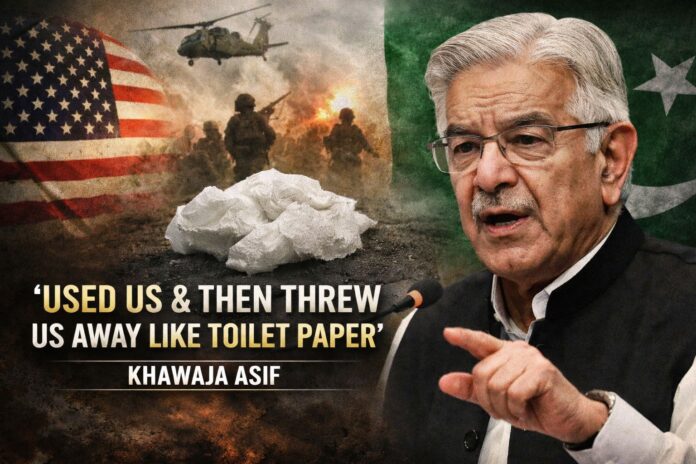
Pakistan’s Defence Minister Khawaja Asif has delivered one of the bluntest official acknowledgements yet of Islamabad’s troubled history with the United States, accusing Washington of exploiting Pakistan for strategic goals and then discarding it once those objectives were achieved. Speaking in the National Assembly, Asif said Pakistan has long avoided owning up to its past, calling that denial a mistake that continues to haunt the country.
In unusually candid remarks, the minister said Pakistan’s repeated alignment with the US, particularly around the Afghan wars, proved disastrous.
Referring to the post-9/11 period, Asif said Islamabad once again positioned itself alongside Washington, turning against the Taliban and becoming a frontline state in the US-led campaign. While the United States eventually exited the region, he said, Pakistan was left to deal with the aftermath: prolonged violence, radicalisation, and deep economic stress.
Khwaja Asif admits in Parliament that Pakistan rented itself out to the U.S. for war and was later discarded “like toilet paper”. Afghanistan was destroyed by policies now openly acknowledged in parliament. Millions suffered. Generations were lost. The world cannot look away now… pic.twitter.com/aEQjrm16ME
— Mariam Solaimankhil (@Mariamistan) February 10, 2026
“The country was used for a purpose and then thrown away like a piece of toilet paper,” Asif told lawmakers, arguing that the costs of the post-1999 and post-2001 realignments were devastating and long-lasting.
The defence minister also challenged the long-standing narrative that Pakistan’s involvement in the Afghan conflicts was driven by religious duty. He acknowledged that Pakistanis were sent to fight under the banner of jihad, but said that framing was misleading and profoundly damaging. According to Asif, two former military rulers—Zia-ul-Haq and Pervez Musharraf—took Pakistan into the Afghan wars not for Islam, but to serve the interests of a superpower.
“We deny our history and do not accept our mistakes,” he said, adding that terrorism inside Pakistan is “blowback” from decisions taken by past dictators. The losses, he noted, are beyond compensation and, in many ways, irreversible.
Asif also claimed that Pakistan’s education system was reshaped during those years to justify these wars, embedding ideological changes that still persist. His remarks signal a rare public admission from a senior Pakistani leader that the country’s strategic choices during the Cold War and the post-9/11 era have left scars that continue to define its security and social landscape today.
