Decades after India achieved independence from British colonial rule, Europe and the West have portrayed India as a ‘land of snake charmers’. Western and anti-India media in other parts of the world still, for various reasons, want the ‘India is poor, yet is punching above its weight’ narrative. A fresh demonstration of this prejudice is seen in the foreign media’s coverage of the BRICS India Summit ongoing in New Delhi.
Foreign media’s BRICS Summit coverage was less about the outcomes of the event and more about framing India as a poor country punching above its weight
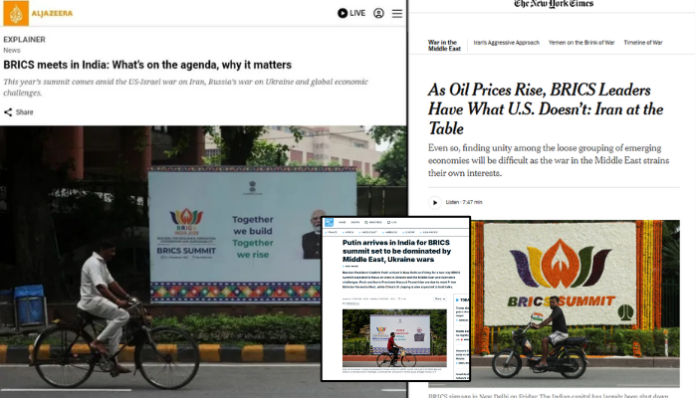
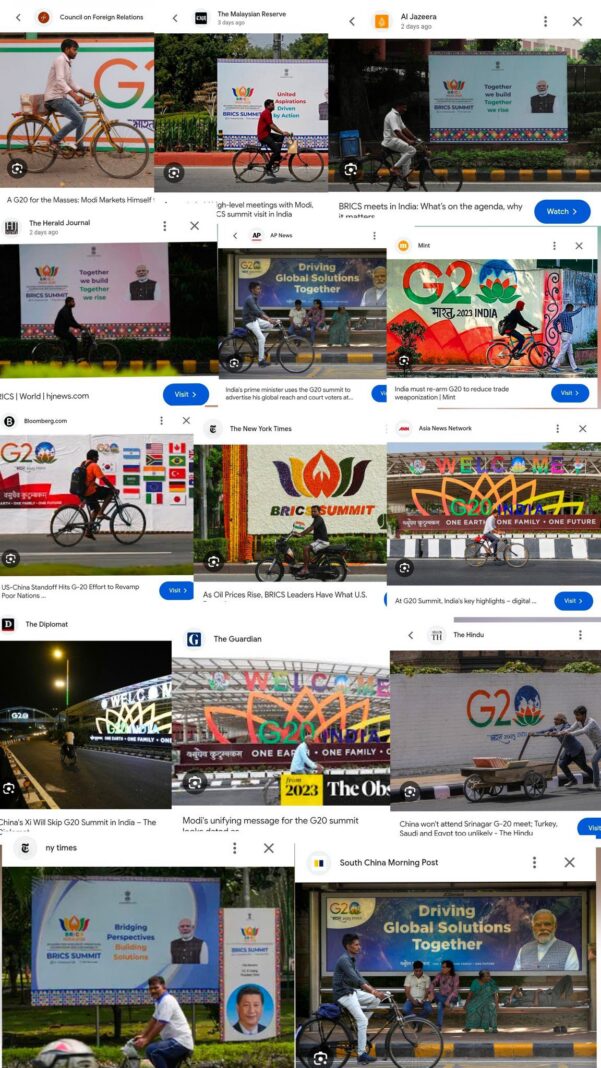
Beyond propaganda articles, a section of foreign media pushed a prejudiced narrative about India subtly through images during the BRICS Summit. The New York Times published an article headlined “As Oil Prices Rise, BRICS Leaders Have What U.S. Doesn’t: Iran at the Table”. The NYT piece’s image showed BRICS signage and a moped rider passing by. The picture was taken by Reuters photojournalist Francis Mascarenhas.
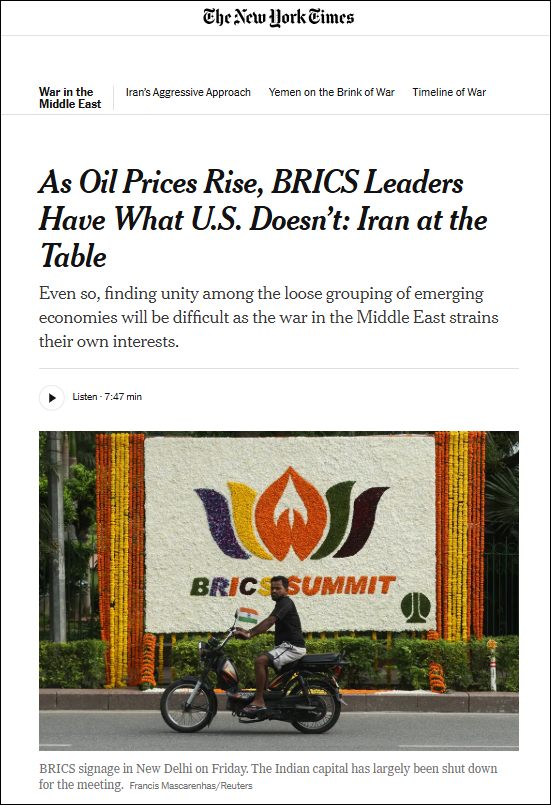
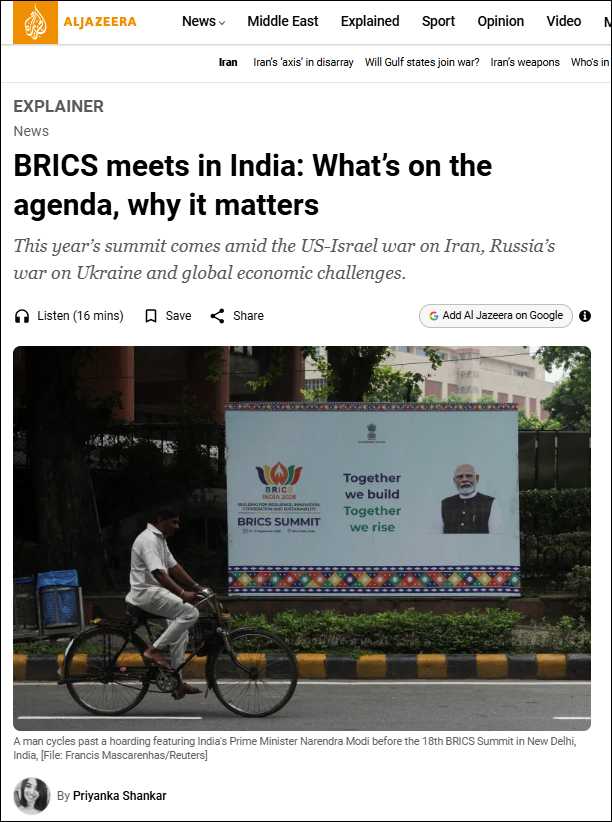
France24 published a report, “Putin arrives in India for BRICS summit set to be dominated by Middle East, Ukraine wars”, on 11th September. The French state-owned media outlet used an image by AfP’s Sajjad Hussain, showing a BRICS Summit signage carrying PM Modi’s picture and a bicycle rider passing by.
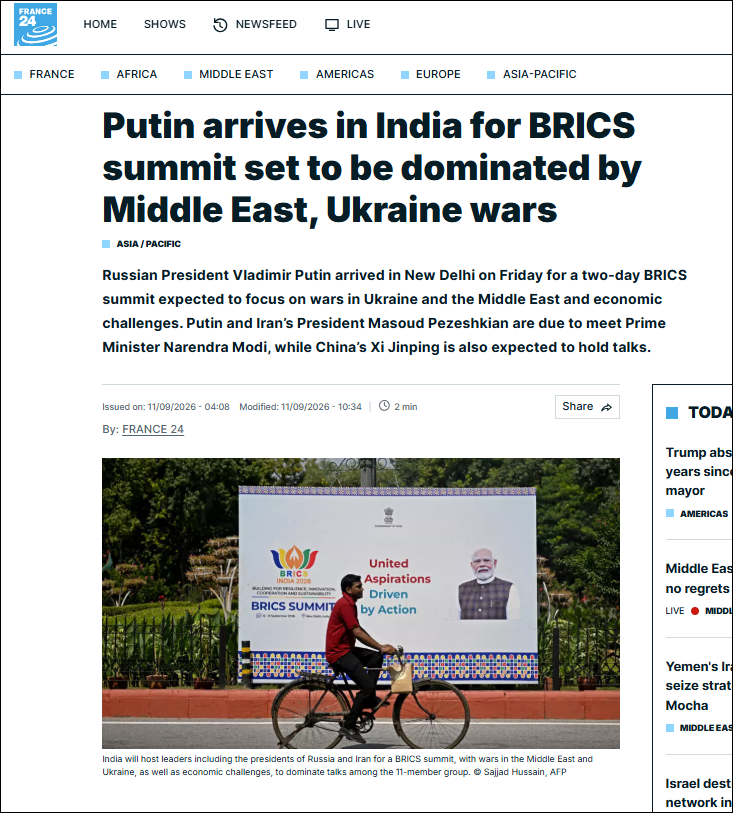
Al Jazeera, the Qatari state-owned Islamist propaganda outlet, also used a similar picture in one of its BRICS Summit-related reports. This picture also showed a cycle rider passing by a BRICS poster. This photo was also taken by Reuters ’ Francis Mascarenhas.
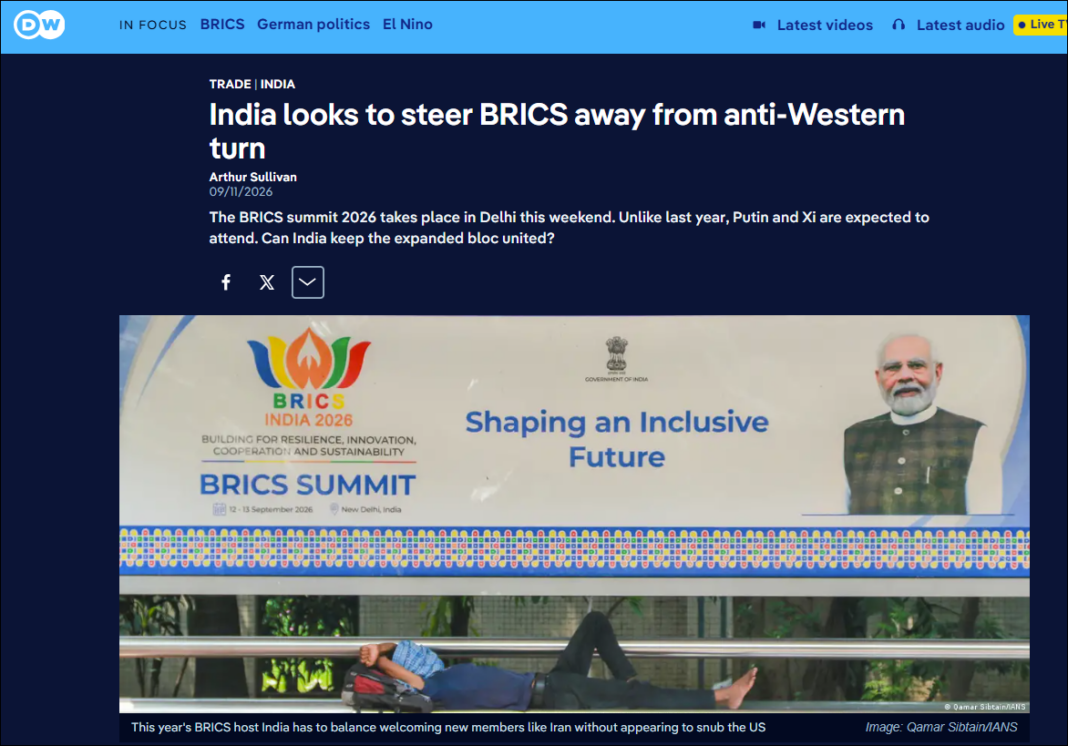
German state broadcaster DW used a picture of a person resting near a BRICS Summit sign during scorching heat. The picture was taken by Qamar Sibtain of IANS.
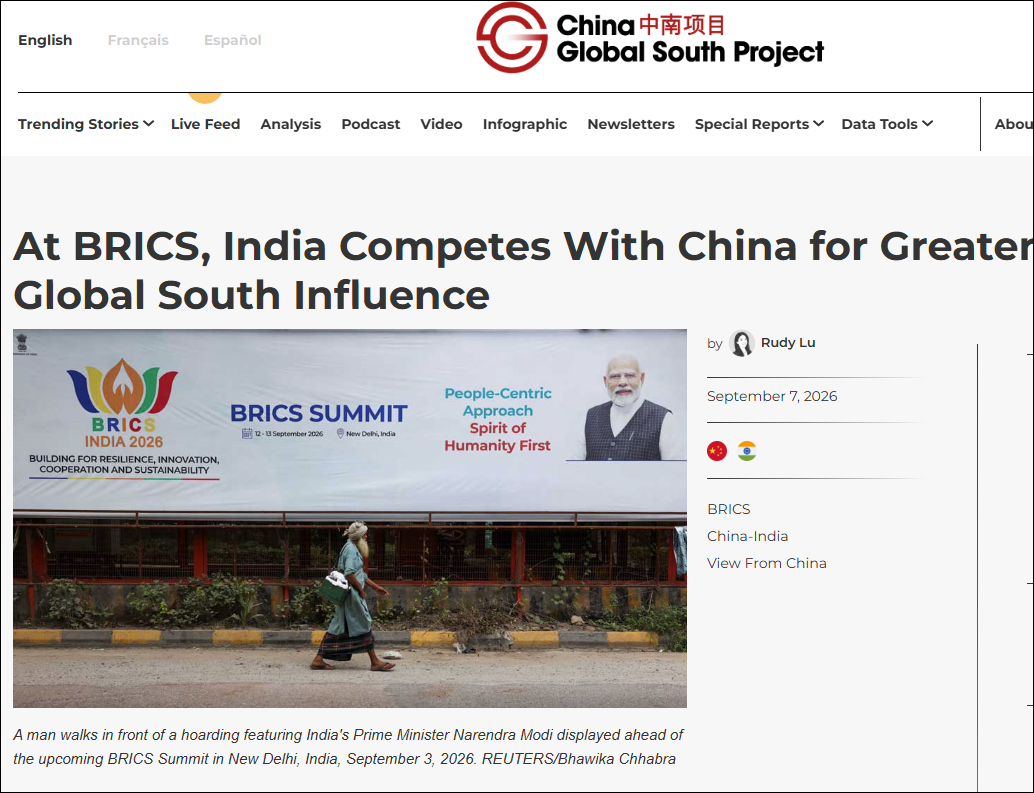
China Global South Project used an image of a man walking n front of a hoarding featuring India’s Prime Minister Narendra Modi displayed ahead of the upcoming BRICS Summit in New Delhi. The photo was sourced from Reuters.
A similar pattern can be observed across the reporting of The Guardian and other foreign media outlets. This has been a pattern noticed not only during the BRICS Summit 2026, but also during other such significant events hosted by India, including the G20 Summit.
India’s growth story travels across the world but mainly through foreign media’s prejudiced lens
Be it the 2026 BRICS Summit, the G20 Summit hosted by India, a report on record GDP growth, a world-class new airport, a semiconductor plant or an ISRO mission success, the majority of the foreign media reports on these developments carry images that are not fully related to the story but present subtle but unwarranted juxtapositions.
A close study of this pattern reveals a few repeated elements, a dusty roadside, a hand-pulled cart, an auto-rickshaw, cyclists, a crowded street, invoking a ambitions versus reality or two India’s contrast in the mind of their readers.
Regardless of how important and powerful an achievement a developing country like India secures, its framing in the international media is almost always reduced to a stereotypical and recognisable arrangement of visual shorthand.
Many people have put forth an argument that Indians are needlessly cribbing about this ‘supposed’ pattern, saying that when Europeans ride bicycles, we say how cool is that, but when Indians ride bicycles and grab foreign media’s attention, it becomes a problem.
Well, there is nothing wrong with riding bicycles. However, the comparison between Europeans riding bicycles to work or for health reasons cannot be compared to Indians riding bicycles in general. A section of Indian people doesn’t ride bicycles in scorching heat out of choice or because they are too health-conscious, but because they cannot afford motorbikes.
Povertyporn dressed up as photojournalism. pic.twitter.com/nQWM79yFu6
— Anurag (@Jhunjhunuwala_) September 14, 2026
Predictably, the foreign media’s bias has triggered a backlash in India. While some called this agenda-driven photojournalism as “poverty porn”, others criticised “Brown Sepoys” for supplying foreign media with such imagery.
This visual pattern is real, and it is not new. Wire services circulated, and several prominent foreign media outlets then chose as featured images frames of cyclists, auto-rickshaws, and mopeds passing BRICS signages and hoardings in Delhi.
In 2014, the Indian Space Research Organisation (ISRO) successfully sent its Mars Orbiter Mission, aka Mangalyaan, to Mars orbit. Instead of covering India’s achievement without bias or prejudice, the New York Times chose to demonstrate its elitism and published a cartoon in which a barefoot man wearing a dhoti and turban, holding a buffalo next to him, is seen knocking on the doors of ‘Elite Space Club’.
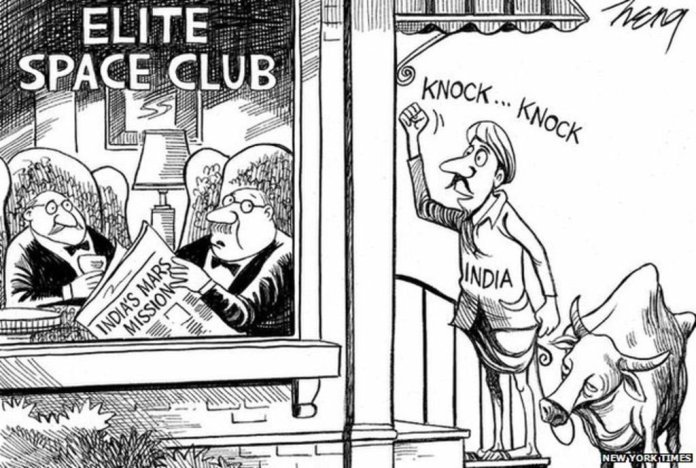
The cartoon was aimed at mocking India’s attempts to be a space power, in a disgustingly racist way.
In 2025, Tesla opened its first showroom in India. Western media covered the Mumbai showroom’s opening; however, the photos used depicted not simply the Tesla showroom or the ribbon-cutting ceremony but an auto-rickshaw passing by.
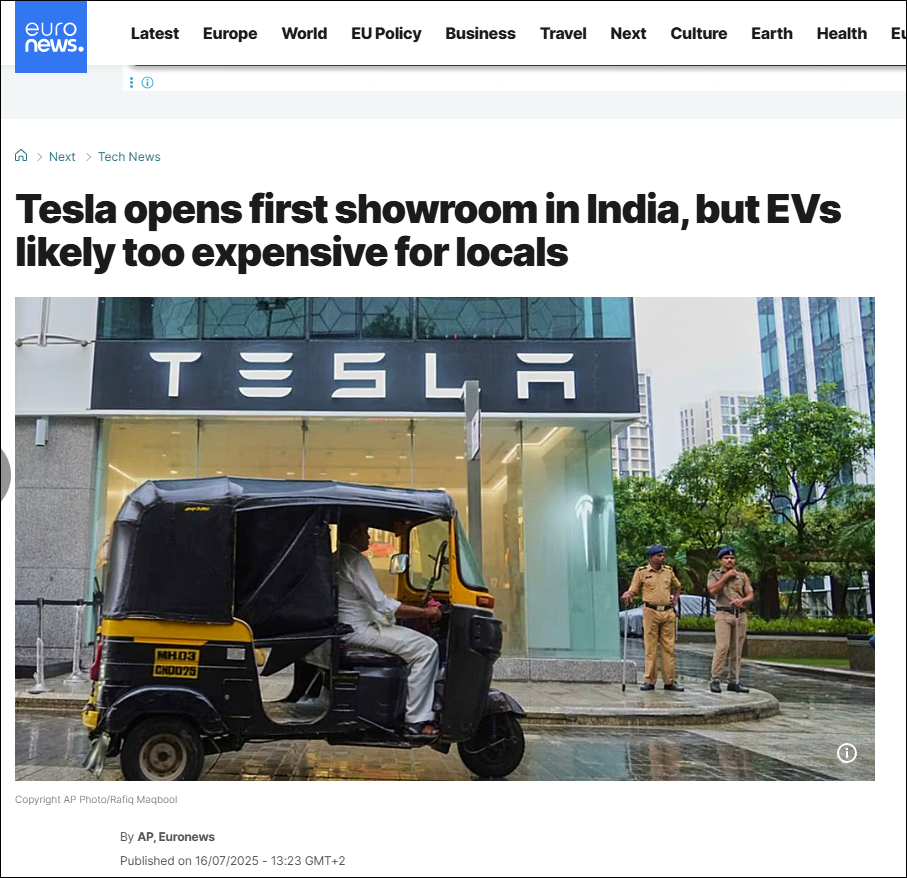
These are not random realistic snapshots of ‘how the city looks’. Photojournalists routinely hunt for juxtaposition. Then editors decide which of the dozens of available frames, in the present case Bharat Mandapam, illuminated venues, motorcades, modern infrastructure, become the image that travels globally. Using the bicycle or the moped image next to the glossy poster or hoarding is an editorial act that produces the ‘ambition versus reality’, ‘grandeur versus grit’, and a ‘country punching above its weight ’ reading.
This reading, however, is not new; rather, it has a long pedigree. The British Colonial-era “land of snake charmers” reduced one of the world’s oldest civilisations to exotic poverty. The colonial visual culture habituated the world to view India as a picturesque poverty plus superstitious country, replete with snake charmers, fakirs, dust and squalor. The true picture of India, for long, did not reach the world.
What emerged was a usable shorthand, which has now pivoted from turban and flute to ‘billboard of global ambition, emerging superpower versus ordinary Indian underneath’. This subtlety allows the foreign media outlets harbouring deep anti-India bias to let the imagery, the composition, convey the ‘this country is poor’ without having to say it explicitly.
This narrative’s post-independence version was the “Hindu rate of growth”. And now, the contemporary version is rather sophisticated, wherein India is acknowledged as vast and rising, because not doing so would be akin to denying the Sun rises from the East, but the visual grammar still defaults to juxtapositions and contrasts: satellites next to cows, slums next to malls, Teslas next to auto-rickshaws, BRICS Summit signages next to people riding cycles and mopeds.
It is not that auto-rickshaws, cycles, or mopeds are not India’s reality, or that India has no unemployment, poverty, or chaotic streets; however, these alone are not defining features of India.
India is the fourth-largest and among the fastest-growing economies in the world, and extreme poverty has slumped sharply. India’s digital public infrastructure is robust and a remarkable export, and ISRO’s cost-effective and successful missions are not a fluke.
Of course, India is a country of 1.4 billion people, and contains and will contain for a long time, both gleaming convention centres and people on cycles.
However, Western newsrooms are simply perpetuating the mental image their readers formed of India decades ago. India can reach the Moon, and still have people riding cycles; it can be nuclear power and still have auto-rickshaws as everyday transport; this is not a ‘two Indias’ framing of the Indian ‘liberals’, and their Western allies have mainstreamed over the years. There is only one India, which is home to diversities of all imaginable kinds. This is how developing countries are- in the process of development. The problem here lies in the foreign media’s presentation of India as a poverty prop.
In times when visual elements, be they photos or videos, are more and more important not only in propagating information but also in shaping opinion, such biased photojournalism perpetuates prejudices and stereotypes that India has long been trying to get the world to do away with.