

The Vishva Hindu Parishad’s (VHP) call to bar Muslims from Hindu religious celebrations, including Navaratri, has struck a nerve with the Islamo-leftist ecosystem, which has continued to rake up the issue in protest. This cabal appears determined to police how Hindus observe their festivals, pushing a skewed version of secularism whose burden, once again, is expected to fall solely on the Hindu community, even on their special occasions.
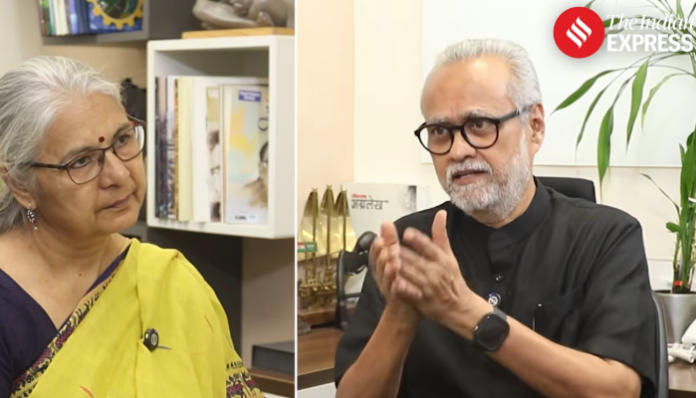
On 22nd September (Tuesday), “The Indian Express” hosted an interview with “author” and “journalist” Girish Kuber, conducted by another “journalist” Shubhangi Khapre, where the two repeatedly railed against the issue, even referring to the VHP as “Hindu Taliban” and describing its appeal as a “fatwa.”
It remains notably convenient for these individuals to deploy such objectionable terminology to diminish Hindus and their organisations while refraining from applying the same language where it would be genuinely appropriate, as they are acutely cognisant of the potential retaliation from Islamists should they attempt to criticise them.
Navaratri a commercial event, allow Muslims or celebrate in your homes
Khapre claimed, “These festivities have become closely associated with the cultural nationalism of the right wing and have kept Maharashtra and the country on the boil,” pointing to the “fatwa” given by VHP over the entry of Muslims during Navaratri and Garba programs in Maharashtra, including Mumbai, Gujarat and other states.
She protested that since Navaratri is no longer just confined to worship of the goddess within homes but has become a “commercialised” mega event featuring professional dancers and singers and drawing crowds who want to rejoice and be entertained, Muslims should not be excluded from attending the celebrations.
She asked an equally agitated Kuber if such a directive was justified, to which he replied, “No. It is horrible even to think of such a thing. First, how are they going to do it? Second, the word you used was fatwa. Everyone knows who issues fatwas and what their standard is in terms of being accommodating culturally, religiously and socially. So, are we looking at the VHP becoming the Hindu Taliban?”
He maintained that a fundamental inconsistency exists between the repeated declarations of Rashtriya Swayamsevak Sangh (RSS) chief Mohan Bhagwat concerning unity and diversity, alleging that the outfit speaks in different tongues. He endorsed Khapre’s assertion that the sacred occasion is actually a commercial program in which participants purchase tickets for attendance.
Kuber drew a forceful comparison with Christmas, which he characterised as a secular festival, and argued that while Navaratri has Hindu foundations, it is extensively celebrated for social and recreational purposes. He suggested that Hindus should restrict their Navaratri observance to their homes if they wish to prevent Muslim participation in their festivities.
This is a classic trick in the liberal playbook to separate Hindu festivals from their religious roots and reframe them as social and cultural gatherings. This approach has been evident in the representation of Onam, which has a profound connection to Hindu scriptures and the story of King Mahabali and Lord Vishnu’s Vamana incarnation, yet is showcased merely as a harvest celebration in Kerala.
A similar reframing is currently underway with Pongal or Makar Sankranti, as efforts are underway to portray it as a Tamil festival with no association to Hinduism.
Furthermore, Khapre and Kuber appear to slyly overlook that entertainment constitutes only a secondary element of Navaratri, with the musical and dance performances, including Raas Garba and Dandiya, being executed as devotional acts of worship directed toward Goddess Durga or Ambika.
The real inquiry should be why Muslims who consider the singing of “Vande Mataram” as an infringement upon their faith would wish to take part in such a program, which is essentially contrary to core Islamic principles and is termed “shirk” (the association of partners with Allah), which is the gravest sin in their religion.
However, these two “journalists” lack the courage to pose such pertinent questions and instead dictate to Hindus how to mark their religious festivals, even demanding that they either welcome Muslims or discontinue public celebrations altogether.
This is the form of secularism and syncretic cultural philosophy that this faction promotes in India, wherein Hindu citizens would be demoted to a subordinate status, with their basic rights circumscribed to please Muslim. While they accuse the VHP of purportedly acting like “Hindu Taliban,” the fact remains that these people want to transform India into another Pakistan or Afghanistan for Hindus.
An unreasonable comparison and demand for government intervention
The argument descended into further absurdity when Kuber referenced Ustad Bismillah Khan to contend that Hindus should refrain from playing the shehnai at their weddings and other occasions. First, Navaratri is exclusively devoted to a Hindu goddess, whereas a Hindu marriage constitutes a sacred sacrament (sanskara) between two individuals, with religious rituals serving as an integral component.
However, the spiritual objectives of these two are absolutely distinct. One is centred upon the marital union, while the other revolves around utter dedication and surrender to a deity. Interestingly, wedding invitations are also offered selectively, and no person has the right to demand inclusion. Similarly, Navaratri events are also not government schemes where everyone, irrespective of their beliefs, needs to be included or face allegations of discrimination.
Kuber did not stop there and dragged Bollywood in a desperate bid to prove his point. “For example, if I remember correctly, ‘Man Tadpat Hari Darshan Ko’ is a Hindu bhajan sung by Mohammed Rafi. Its music was composed by Naushad, and the lyricist was also Muslim,” asking if it is also going to be banned.
If this is the reasoning, then many Hindus within the industry were the primary agents responsible for engaging these artists to produce the compositions they created, driven by professional obligation rather than devotion or spiritual conviction, and compensated accordingly for their services.
Nevertheless, drawing a parallel between Navaratri and a Bollywood production exposes the vacuity of the submission and their perception of Hindu festivals as inconsequential.
Khapre and Kuber also appealed to Chief Minister Devendra Fadnavis and the state government for intervention in this matter.
Hindus have complex, BJP is like the British
Kuber then claimed that the development reveals the majority community’s complex, when the situation should be reversed with the minority community experiencing insecurity, remarking that the VHP has demonstrated its insecurity.
Of course, the devastation caused by extremists within the “minority” community and their actions, including stone-pelting during Hindu processions, damaging Hindu pandals, vandalism and desecration of idols, love jihad and grooming jihad, to name a few, will never receive consideration from this group, who view Muslims as perpetual victims regardless of the truth.
Moreover, Navaratri programs serve as hunting grounds for predators from the Muslim community who want to target Hindu women and young girls, another ugly reality which is ignored by the liberals.
Afterwards, Khapre and Kuber proceeded to mock the sensitive issue of “love jihad,” which had been cited as the trigger for the decision by Bharatiya Janata Party (BJP) leader and minister Nitesh Rane. They too chose to dismiss the agony and pain of the Hindu victims who fell into this trap and suffered brutal consequences, much like the rest of their coterie.
Kuber commented, “Across the country, there is a race over who can appear more Hindu or more saffron than his competitor in the same camp. Look at Assam. Look at West Bengal. Many former Congress politicians are now trying to showcase their loyalty to Hinduism,” adding that Rane was not worth their attention. He complained that the BJP is full of such leaders and threatened that the party would pay an (electoral) price for entertaining them.
Secularism was apparently never under threat when politicians routinely attended Iftar gatherings and their parties went out of their way to appease the Muslims. However, the moment a Hindu leader or entity exhibits any degree of assertiveness, it is met with a barrage of obnoxious accusations.
Hindus apparently can celebrate their festivals only so long as everyone else gets a say in it, except them. The sentiments of every community must be respected but not theirs. The ecosystem wants Hindu festivals to be treated as public affairs, open to all, mirroring a community kitchen, charitable service or government initiative.
Kuber also accused the BJP of trying to replicate the British colonial strategy of “Divide and Rule” before reiterating that Diwali is becoming universal just like Christmas. “How are you going to say that only Hindus can celebrate Diwali or only Hindus can burst crackers,” he asked.
No one has stopped anyone from bursting crackers or sharing sweets, but involving others cannot come at the cost of stripping Diwali of its religious character. Christmas might well be celebrated beyond the Christian community, yet no one argues that it should be divorced from its religious identity or that its origins should be rejected. That same courtesy, however, is not extended to Hindus, whose festivals are painted as anything but religious events.
The argument then veered into the familiar territory of boycotting Muslim artists, accusations of a “majority syndrome” and even the ludicrous question of whether concerts and movies would be next.
Notably, such remarks reveal how little distinction liberals are willing to make between a deeply religious Hindu occasion like Navratri and ordinary entertainment. It is not that they fail to understand the significance of the events, rather, they intentionally downplay it to serve a narrative built around their deranged concept of “Ganga-Jamuni tehzeeb,” which is grounded in undermining Hindus and their religious rights for Muslims.
This has long been the pattern with this global ideological clique, which repeatedly finds one pretext or another to take aim at Hindus, their festivals and their organisations for daring to take a firm stand for the community and its traditions.


