

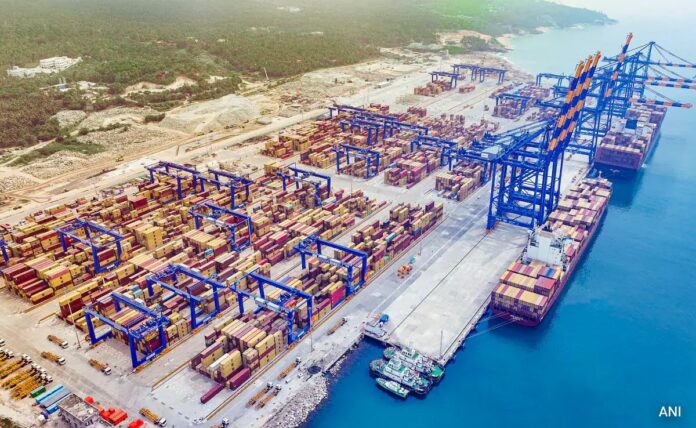
Vizhinjam International Seaport is set to enter a decisive new phase of expansion following the announcement of a ₹16,000 crore investment commitment by Adani Ports and Special Economic Zone Limited (APSEZ), India’s largest integrated ports and logistics company. The expansion marks a major scale-up of infrastructure at one of India’s most strategically located deep-water ports and builds on Vizhinjam’s strong early operational performance since commercial operations began in December 2024.
The ₹16,000 crore commitment forms part of the Adani Group’s cumulative ₹30,000 crore investment pledge in Kerala, announced at the Invest Kerala Global Summit 2025, and represents the largest private-sector investment in the state’s history. Phase 2 of the project, with an estimated investment of around ₹10,000 crore, is central to this expansion and is expected to significantly enhance Vizhinjam’s capacity and global standing.
Kerala Chief Minister Pinarayi Vijayan, inaugurating the second phase of development, said Vizhinjam was poised to become a major international transshipment hub once fully developed. “Vizhinjam Port, which started operations as a national transshipment terminal serving Indian ports, will become an international transshipment hub serving ports in Africa and the Middle East. With this, Vizhinjam will emerge as a very important centre on the global maritime trade map,” he said.
Adani Ports Managing Director Karan Adani said the project exemplified cooperative federalism and the impact of strong public-private partnerships. “In just 15 months of commercial operations, Vizhinjam became the fastest Indian port to handle one million TEUs, firmly placing Kerala on the global shipping map. This early validation has been reinforced by sustained operational performance,” he said.
Since commencing operations, Vizhinjam has set multiple national and regional benchmarks. The port crossed one million TEUs of annual capacity within 10 months, handled 615 vessels and 1.32 million TEUs in its first year, and recorded its highest-ever monthly throughput of 1.21 lakh TEUs in December 2025, making it the top-performing port on India’s south and east coasts.
A key highlight of Vizhinjam’s early success has been its ability to handle the world’s largest container vessels. Between December 2024 and January 2026, the port handled more than 50 Ultra Large Container Vessels (ULCVs) exceeding 399 metres in length, over 160 vessels longer than 300 metres, and 50 vessels with drafts exceeding 16 metres. The MSC Verona set a South Asian record as the deepest-draft vessel handled at 17.1 metres, while MSC IRINA, the world’s largest container ship, also called at the port.
Vizhinjam is India’s first semi-automated container port and the first to deploy women automated crane operators. It has also integrated indigenous technology through an advanced Vessel Traffic Management System, enabling digitally monitored and predictable port operations. The port’s infrastructure includes a three-kilometre-long breakwater, natural depths of 18–20 metres, minimal littoral drift and proximity to major east–west shipping lanes, allowing year-round operations with limited dredging.
Under the approved masterplan, Phase 2 will expand container berth length from 800 metres to 2,000 metres and extend the breakwater to about 3,900 metres, with completion targeted by 2028. Once completed, Vizhinjam’s capacity is expected to rise from 1 million TEUs to 5.7 million TEUs by 2029, adding 4.1 million TEUs to its existing capacity.
Phase 2 will include the deployment of 21 automated ship-to-shore cranes, 45 automated cantilever rail-mounted gantry cranes, a rail-handling yard, and state-of-the-art electrical and automation systems. Additional works include berth expansion, dredging and reclamation, and construction of the deepest breakwater in India—920 metres long at a depth of 21 metres. The development will also feature green infrastructure such as electric vehicle charging stations, along with critical facilities including an electrical substation, sewage treatment plant and ISPS-compliant security fencing.
Union Minister for Ports, Shipping and Waterways Sarbananda Sonowal, Adani Ports MD Karan Adani and senior state officials were present at the event. Widely referred to as the “Wonder Port of India,” Vizhinjam is increasingly being positioned as India’s principal deep-water transshipment hub, offering a competitive alternative to established regional ports such as Colombo, Dubai, Singapore and Port Klang.
The expansion is expected to drive port-led industrialisation, generate employment and significantly strengthen Kerala’s logistics competitiveness and ease of doing business, reinforcing the state’s role in global maritime trade.
