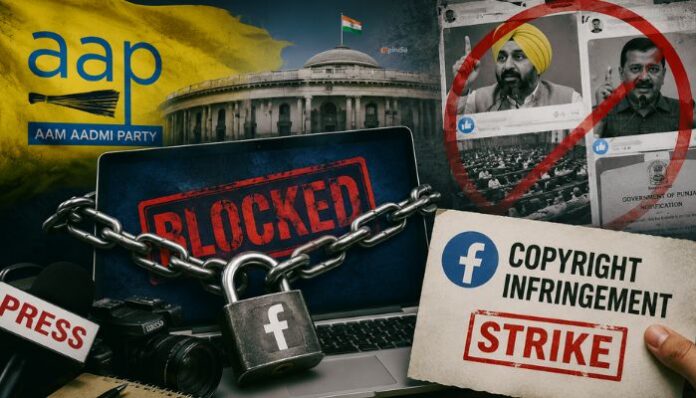
The Indian anti-BJP political parties and left-liberal ideological cabal believe in farcical sanctimony. This coterie practices nearly every wrong they accuse their ideological adversary, the BJP, of. The contrast in the blatant media censorship conduct of the Aam Aadmi Party (AAP) government in Punjab and the party is ‘BJP crushing press freedom’ rhetoric in Delhi perfectly exemplifies this hypocrisy.
AAP rose to prominence through its public commitment of ‘changing’ politics, making the system transparent, and its supremo, Arvind Kejriwal, often stresses how the media plays a crucial role in democracy.
The Aam Aadmi Party often attacks the Bharatiya Janata Party (BJP)-led Central government for ‘crushing’ press freedom. However, its own government in Punjab is inventing unique ways of censorship to essentially silence media criticism and stifle critical voices on social media.
AAP Punjab weaponising copyright strikes as a press censorship tool
Since September 2025, the official Facebook page of AAP Punjab and affiliated handles have issued numerous copyright notices, commonly called “copyright strikes”, against posts and videos critical of the CM Bhagwant Mann-led Punjab government.
A detailed investigative report published by The Reporters’ Collective on 18th August cites various incidents in the recent past to establish its claim that AAP claimed copyright ownership over around 48 videos and posts.
The report states that between January and April 2026 alone, four Facebook pages were taken down due to a copyright claim by AAP. Later, a fifth page was removed after the Punjab Police under the state government issued a notice. The affected pages had 30 lakh followers collectively.
While a ruling party staking copyright claims to have certain content or Facebook pages removed itself was outrageous, what is even more alarming is that the flagged material in most cases included content that AAP did not even own as proprietary IP.
The Reporters’ Collective analysis found that the targeted material often included press releases from Sri Akal Takht Sahib, photos of opposition MLAs, Chief Minister Bhagwant Mann’s own social media posts, representational AI-generated images of Mann and Arvind Kejriwal, state government notifications, AAP’s digital posters, and visuals from inside the Punjab Legislative Assembly, including videos of Vidhan Sabha proceedings despite the fact that content related to government works are not private party property under copyright law principles.
There have been five major cases of AAP weaponising copyright infringement claims against journalists critical of the Punjab government.
Lok Awaz TV, a Facebook page with 9.7 lakh followers, was hit with 15 copyright strikes by AAP and taken down in January 2026, restored after much criticism.
A separate personal page of journalist and Lok Awaz TV administrator Maninderjeet Sidhu also received copyright claims and faced IT Act-related issues. This page remains blocked due to a Punjab Police notice.
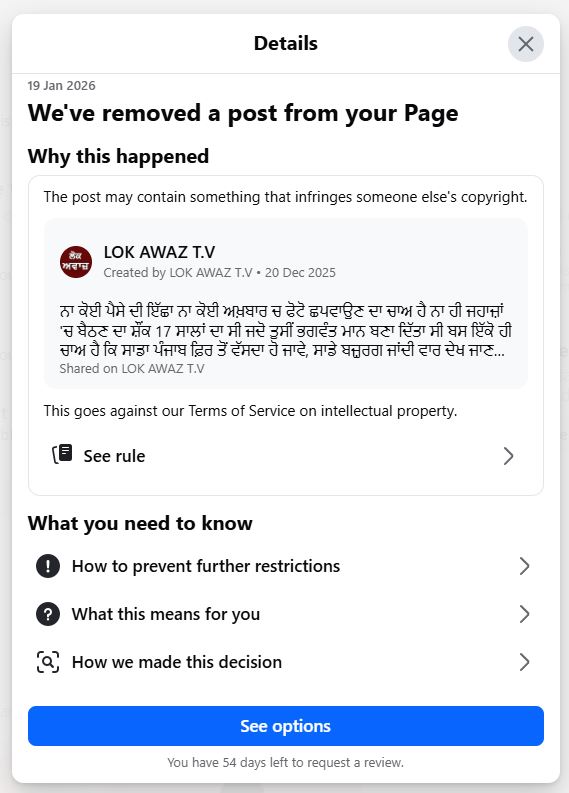
To prevent further copyright strikes from AAP, Sidhu removed all the critical posts against the Punjab government. In total, the Facebook pages of Lok Awaz TV and Sidhu received around 20 copyright strikes.
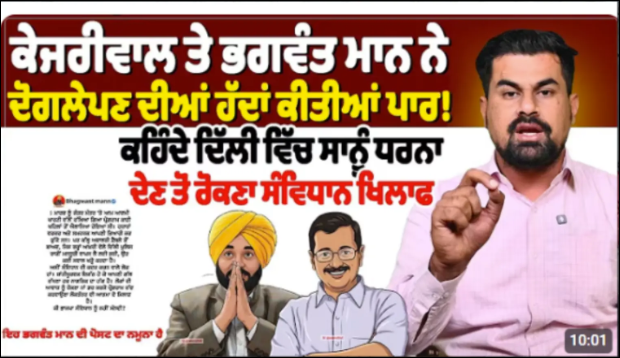
A Lok Awaz TV video was taken down simply because it had AI-generated images of CM Bhagwant Mann and AAP supremo Kejriwal. These were simple AI-improvised images of the two leaders and were not abusive or morphed derogatorily in any way.
The Collective report also highlights how a September 2025 video of Lok Awaz TV was accused by AAP of ‘copyright infringement’. In the video, AAP MLAs were seen raising placards inside the state assembly during a protest against the BJP-led Central government over flood relief funds. One of these pictures was shared by the official X handle of AAP Punjab.
Despite there being a prohibition on lawmakers taking photos inside the assembly, AAP claimed ownership of the picture and even audaciously targeted Lok Awaz TV with a copyright infringement claim.
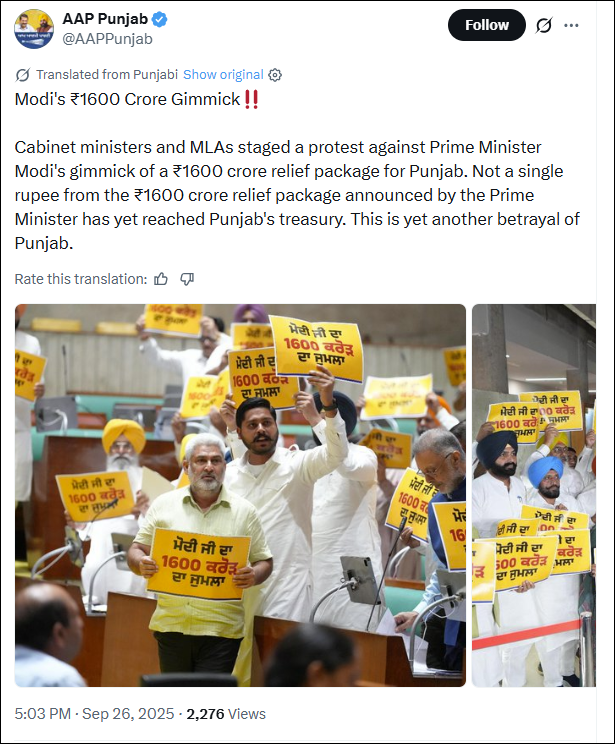
Either AAP leaders violated the rules to click pictures inside the assembly or alleged copyright infringement based on visuals taken from the state broadcaster telecast of the assembly proceedings, which are not subject to copyright.
In his January 2026 letter to Facebook’s Grievance Officer, Sidhu contended that the material he published contained visuals from publicly available government content, which does not infringe upon ‘proprietary rights’ for AAP.
Another independent journalist targeted by AAP Punjab is Rattandeep Singh Dhaliwal, whose Facebook page received as many as 19 copyright strikes from AAP in recent months. In late February 2026, Dhaliwal’s page, which had 3.24 lakh followers at that time, was taken down. AAP had alleged ‘infringement of intellectual property rights’.
AAP’s practice of hounding journalists and small media outlets is not confined only to copyright strikes. In May this year, Dhaliwal claimed that Punjab Police visited his residence over a video in which it was claimed that 32 sitting AAP MLAs might not get tickets in the next elections. Several AAP MLAs filed police complaints against him, and even termed Dhaliwal and his reporting ‘anti-national’.
One Bhatinda-based digital journalist, Jass Grewal, lost his Facebook page boasting 1.4 million followers due to three AAP copyright strikes in April 2026.
AAP’s first reported weaponisation of copyright rules as a censorship tool to silence media critics goes back to 2022, when RMB Television’s post containing the eighth list of AAP candidates for state assembly elections was removed after AAP flagged it to Meta for copyright violation over a ‘photo’.
Similarly, one Parmeet Singh Bidowali’s page with 66,000 followers received 3 Intellectual proprietary rights claims in February from AAP.
To protect his second page Punjab Inside TV, with 45,000 followers, from AAP’s copyright strikes, Bidowali was forced to delete all the content related to AAP.
Some of these independent creators approached courts for relief, and cases remain pending.
Affected media outlets and journalists have not only reported financial losses and implemented self-censorship methods like blacking out CM Mann’s face, using AI sketches and avoiding certain visuals, but also flagged AAP’s pattern of intimidation combining copyright strikes, IT Rules takedown notices, FIRs, and various other pressure tactics to silence the Punjab government’s critics.
In April this year, Press Di Azaadi Bahal Karo Sangharsh Committee had also flagged concerns that the AAP government in Punjab was weaponising copyright strikes and IT Rules takedown notices to stifle media voices.
“This is very dangerous for journalists, for free speech and for independent press,” Sahildeep Singh, who runs the Duniya Facebook page with more than 1.2 lakh followers, said.
The Committee noted that Section 79(3) of the IT Act was being used to get entire pages of critical outlets shut down, and that intermediary liability provisions were being invoked to disable accounts and remove posts in significant numbers.
In its defence, AAP claims that the target individuals were “not journalists” since they, he claimed, lacked proper degrees in journalism, despite the fact that holding a journalism degree is not mandatory by law for practising journalism.
Independent journalists, YouTubers to mainstream media outlets like Punjab Kesari: The witch hunt by AAP Punjab
The intimidation tactics of AAP Punjab against media critics, however, are not restricted only to small independent digital journalists, but also extend to big mainstream media houses.
In January this year, Punjab Kesari accused the AAP government of engaging in a “targeted witch hunt” over an article on Arvind Kejriwal published in October 2025. Soon after the publication of the said article, Punjab Kesari alleged that all state government advertisements to the newspaper and its digital arms were stopped from 2nd November, according to the publication.
The group disclosed that the Chopra family, the group’s promoters and others have been frequently targeted in recent days. It highlighted events that occurred between 11th and 15th January, including raids by the Food Safety and Standards Authority of India, the GST department and Excise agencies at Jalandhar’s Park Plaza run by Chopra Hotels Private Limited.
The Punjab Pollution Control Board’s activities at the hotel and presses, the Factories Department’s inspections of its printing presses in Ludhiana and Jalandhar, the cancellation of excise licenses and the Jalandhar hotel’s power outage were also mentioned.
Punjab Kesari alleged the AAP government was pressuring it through a string of raids and regulatory measures against its publications and affiliated businesses.
“We are writing to express our deep concern and anguish regarding certain recent developments which give rise to a serious apprehension that the Punjab government is specifically targeting the Punjab Kesari Group and its associate concerns with an extraneous motive to intimidate the press,” read a formal letter signed by the outlet’s editor-in-chief, Vijay Kumar Chopra, alongside Joint Managing Directors, Avinash Chopra and Amit Chopra.
The timing of Punjab Pollution Control Board’s activities at the hotel and presses, the Factories Department’s inspections of Punjab Kesari’s printing presses in Ludhiana and Jalandhar, the cancellation of excise licenses and the Jalandhar hotel’s power outage indicated a deliberate targeting simply over an article critical of AAP supremo.
A similar issue unfolded on 12th December of 2025 when an FIR was submitted in Ludhiana against social activist Manik Goyal, journalists Mintu Gurusaria and Maninderjit Sidhu from Lok Awaz TV, Gagan Ramgarhia, Harman Farmer, Mandeep Makkar, Gurlal S Maan, Arjan, Snammu Dhaliwal and Deep Mangli for purportedly sharing “objectionable posts.”
While the state authorities claimed the uploaded material contained misrepresented, unsubstantiated and obvious fabrications regarding the matter, Manik Goyal said their questions about the use of government helicopters when Mann was away were the root of the complaint.
Goyal added that for four years, the AAP government in Punjab did not share RTI data on helicopter & aeroplane usage and expenditure, and when journalists are seeking accountability from the government on where the taxpayers’ money is being used, they are being slapped with FIRs.
The Punjab government also targeted a Delhi-based YouTuber Ajeet Bharti in October 2025. Bharti had to approach the Punjab and Haryana Court to not only seek protection from any coercive action but also get clarity on why he has been even booked; whether it was for his alleged online remarks after a shoe was hurled at then Chief Justice BR Gavai in the Supreme Court by a lawyer on 6th October 2025.
In May 2023, Times Now reporter Bhavana Kishore, who exposed “Operation Sheesh Mahal” related to AAP National Convenor and former Delhi CM Arvind Kejriwal’s lavish official residence, was arrested by the Ludhiana Police along with video journalist Mritunjay Kumar and driver Parminder.
She was accused of striking a Dalit woman with a vehicle and using casteist insults against her. Recounting the humiliation she faced in police custody, Bhavana Kishore broke down on national television and said, “When I went to the washroom, 2-3 female constables accompanied me. There was no electricity or water at the police station (I was kept in)…”
#SheeshMahalKaBadla: 'मेरी सेहत बिगड़ रही थी, वो मुझे वॉशरूम लेकर गए और कहा गया कि आप वॉशरूम का दरवाजा बंद नहीं कर सकती'- रिपोर्टर भावना किशोर@navikakumar @SushantBSinha @BhawanaKishore#NewsKiPathshala #OperationSheeshMahal #SachJeetaSirJiHare pic.twitter.com/vUJQFHcXx6
— Times Now Navbharat (@TNNavbharat) May 9, 2023
In January 2024, the Punjab and Haryana High Court quashed the FIR against Kishore and other accused persons, along with all subsequent proceedings.
“They had no personal knowledge of the caste of the victim or her family… neither the state nor the complainant” indicated that Kishore knew about the complainant’s caste, “and their conspicuous silence speaks more than the words,” the court said.
A year before the Bhavana Kishore controversy, in April 2022, Punjab Police officials misbehaved with journalist Naresh Vats during a joint news conference between Kejriwal and Mann at The Imperial Hotel.
Recounting the mental and physical harassment he was subjected to, Vats said, “I showed them my Press Information Bureau (PIB) card. But on the pretext of checking, they took it, and after a few minutes they told me that I was not a reporter and would not be allowed to enter the press conference room. One of them asked other cops to have me arrested. When I again opposed, they dragged me out of the room. In CCTV, it could be seen…”
In May 2021, around seven Hindustan Times reporters were removed by AAP Delhi government’s social media cell coordinator Vikas Yogi from a WhatsApp group used for exchanging press notes, including a daily health update. The HT reporters had alleged that they were kicked out of the said group over a piece criticising the AAP government’s response to the oxygen crisis during the COVID pandemic.
On 28th May 2024, the AAP government in Punjab banned all Zee Media Corporation’s channels in the state. The Mann government’s blatant targeting of mainstream media channels over supposedly critical reporting drew flak from political opponents and the public.
In early November 2025, it was alleged that newspaper deliveries, including “The Indian Express”, were delayed in some areas of the state as the authorities allegedly stopped vehicles carrying newspapers and conducted checks throughout the intervening night of 1st and 2nd November.
While the police claimed that they delay in the delivery of newspapers were due to checks being done over information about the transport of drugs, weapons and explosives in a newspaper truck, the Congress and other opposition parties alleged that the AAP government in Punjab was doing unofficial inspection of newspapers to ensure no critical reporting against them reaches the public.
AAP preaches to BJP the ‘press freedom’ sermon its own government in Punjab does not follow
Evidently, the Aam Aadmi Party has little regard for press freedom and tolerance for critical reporting, beyond the performative and selective support for rights and protection of media from political persecution.
In its national messaging, particularly in criticism directed at the BJP-led ruling dispensation in the Centre, AAP often claims that the BJP is ‘crushing press freedom ‘, ‘ controlling Godi media’, and claims the BJP is stifling critical voices by unleashing central probe agencies on them. However, the AAP government in Punjab itself is doing everything it accuses the BJP of and claims to vehemently oppose.
Ridiculous copyright strikes, intellectual propriety claims, platform removal, and other intimidation tactics are being allegedly weaponised by AAP in Punjab to muzzle the voice of independent journalists and even mainstream media giants over critical coverage.
Perhaps, AAP Punjab is competing with Pakistan in terms of who can better impose press censorship, ‘control’ narrative, and keep critics in ‘check’.