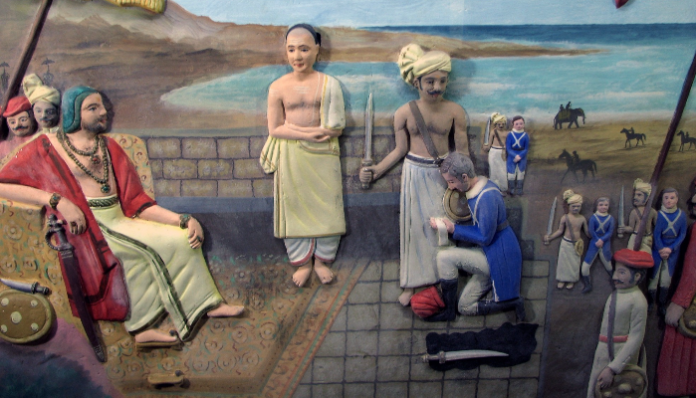
More than 160 years before Japan’s victory over Russia was celebrated as an Asian power defeating a European empire, the Kingdom of Travancore had already defeated the Dutch East India Company at Colachel in 1741. The battle emerged from Marthanda Varma’s expansion of Travancore and his challenge to the Dutch monopoly over the lucrative Malabar pepper trade.
After earlier clashes, the Dutch launched another offensive in November 1740. They blockaded Travancore’s coast, occupied settlements including Thengapattanam, Midalam and Kadiapattinam, and advanced towards Padmanabhapuram. But their position depended heavily on supplies and reinforcements from Ceylon and Batavia, while the Java War prevented the VOC from sending the manpower it needed.
Marthanda Varma responded by strengthening his army and using diplomacy to avoid fighting on multiple fronts. Local Mukkuvar fishermen also played an important role, serving as scouts, misleading Dutch forces and, according to local accounts, disrupting their ships. Under Varma and his dewan Ramayyan Dalawa, Travancore gradually cut Dutch access to Colachel by land and sea, leaving the garrison increasingly isolated.
The decisive moment came in August 1741. A Travancore cannon shot struck a Dutch gunpowder store, triggering an explosion that destroyed food and ammunition. Travancore then launched its assault. Around 400 Dutch troops, including about 150 Europeans, faced a vastly larger Travancore force. Their defences eventually collapsed, forcing them to surrender. Senior Dutch officers, including Eustachius De Lannoy, were captured.
Rather than simply imprison De Lannoy, Varma employed him to modernise Travancore’s army. He introduced European-style military discipline, firearms training, artillery and improved fortifications, eventually rising to become commander-in-chief. These reforms strengthened Travancore as it expanded northwards and absorbed several neighbouring kingdoms.
Colachel did not immediately remove the Dutch from Kerala, but it permanently weakened their political and military position. The 1753 Treaty of Mavelikkara forced the Dutch to stop interfering with Varma’s expansion and sell Travancore arms and ammunition. By the later eighteenth century, the VOC had been reduced largely to the role of a trader, while Travancore controlled important pepper-producing territories, ports and trade routes.
Read the full article on Chapter One Magazine.