

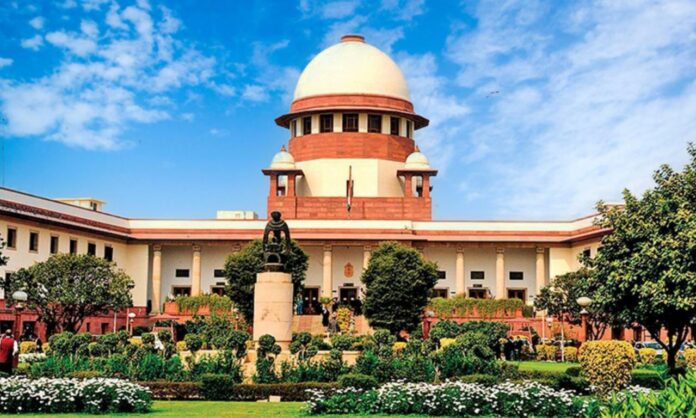
The Supreme Court on Monday declined to entertain a petition raising concerns about potential mercury leakage from residual ash generated after the incineration of toxic waste linked to the 1984 Bhopal gas tragedy. The court said the matter should be pursued before the Madhya Pradesh High Court, which has been monitoring issues related to the disposal of the hazardous waste for over two decades.
A bench comprising Chief Justice of India Surya Kant and Justice Joymalya Bagchi granted liberty to the petitioner, Bhopal Gas Peedith Sangharsh Sahyog Samiti, an organisation representing survivors of the Bhopal disaster, to move the High Court with supporting material outlining its apprehensions regarding possible mercury contamination.
While disposing of the petition, the bench observed that the appropriate course of action would be to present the concerns before the High Court along with scientific evidence. The court noted that the High Court, which has been supervising the waste disposal process for years, is best placed to examine the issue in detail.
“The appropriate recourse would be to move an application before the High Court, along with supporting material showing apprehension of leakage in the future. Since the High Court has been monitoring the matter for two decades, we request the High Court to consider such an application on merits and pass such orders as may be required in the larger public interest,” the bench said, while expressing hope that the High Court would deal with the issue expeditiously.
Petition challenges disposal of residue at Pithampur
The plea before the apex court challenged a December 10, 2025 order of the Madhya Pradesh High Court, which allowed the disposal of incinerated waste at the Common Hazardous Waste Treatment, Storage and Disposal Facility (TSDF) in Pithampur, located in Dhar district.
Earlier, in October 2025, the High Court had rejected the state government’s proposal to contain toxic residual ash at the same facility, noting that the disposal site was situated only about 500 metres from human habitation. However, in a subsequent order in December, the court kept the earlier direction in abeyance and permitted the residue to be disposed of at the Pithampur facility.
Senior Advocate Anand Grover, appearing for the petitioner along with Advocate-on-Record Anuj Kapoor, told the Supreme Court that the waste had already been incinerated following the High Court’s order. He raised concerns that mercury present in the original waste may have remained trapped in the residual ash and could eventually leach into the soil and groundwater.
Grover pointed to earlier findings from 2015, which had detected around 15 kilograms of mercury in the contaminated soil. He also questioned a subsequent report claiming that mercury was not detected in the incinerated residue.
Expert report flags possible testing gaps
To support the petitioners’ concerns, Grover relied on a recent research report by Dr Asif Qureshi of IIT Hyderabad. According to the report, the methodology used during the trial incineration may not have been adequate to detect mercury levels accurately.
The research suggested that mercury may have been retained in the residual ash because additives such as activated carbon and sulphur—used during the incineration process—can capture and trap mercury. The petition argued that the trial run report failed to conduct a proper mass balance analysis to account for the mercury content originally present in the waste.
The petitioners also questioned the suitability of the testing methods used to analyse the residue, contending that they may not have been capable of detecting mercury reliably. As a result, the report’s conclusion that mercury was “not detected” could potentially be misleading.
However, the Supreme Court noted that the oversight committee supervising the disposal process had not yet responded to the concerns raised in Dr Qureshi’s report.
Justice Bagchi observed that while the expert report alleged flaws in the methodology used by the oversight committee, the committee itself had stated that mercury levels were within permissible limits. He emphasised that such technical disagreements should first be examined through the established monitoring process.
“The report of your expert says the methodology adopted by the oversight committee is faulty, and that is why higher concentrations of mercury were not detected. That may be correct or may not be correct. We are not experts to comment on it,” Justice Bagchi remarked.
He added that due process required the oversight committee to examine the allegations and respond before the court could intervene.
Court refuses request to open storage containers
During the hearing, Grover urged the Supreme Court to direct authorities to open the concrete containers storing the incinerated ash in order to conduct fresh testing for mercury. The bench, however, declined the request, reiterating that the High Court was already overseeing the matter.
“If, for argument’s sake, it is found that there is mercury, then what do you propose? You are trying to get indirectly what you cannot get directly,” Justice Bagchi remarked.
The judge added that the expert committee should first evaluate the issue and recommend appropriate steps if any risk of leakage was detected.
“Let the expert committee look into this and give a report on what is to be done if there is a leakage,” he said.
Concerns over environmental safety
The petition also raised broader concerns regarding the safety of the Pithampur disposal site. It cited a show cause notice issued by the Madhya Pradesh Pollution Control Board in December 2024, which had alleged toxic seepage from the facility contaminating groundwater sources located as close as 50 metres from the site.
In addition, the petition referred to earlier findings by the Central Pollution Control Board (CPCB) in 2015 that had recorded significant mercury levels in the Union Carbide waste stored in Bhopal. The petitioners argued that the 2025 trial report’s conclusion that mercury was “not detected” failed to adequately explain how the previously identified mercury had been accounted for during incineration.
Petitioners to return to the High Court
Following the Supreme Court’s observations, Senior Advocate Grover agreed that the petitioner organisation would approach the Madhya Pradesh High Court with an application raising the scientific concerns.
However, he requested that the matter be listed before a different bench of the High Court, expressing apprehension about the earlier proceedings. The Supreme Court did not issue any direction on this request.
With the disposal of the petition, the matter is now expected to return to the Madhya Pradesh High Court, where the petitioners plan to place additional material questioning the safety of the incinerated residue and its potential environmental impact.
