

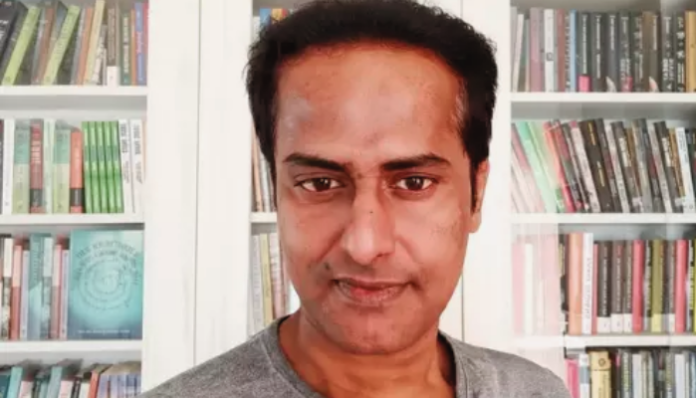
On Wednesday, 23rd September, the Gujarat High Court rejected journalist Ravi Nair’s plea seeking interim release in a criminal defamation case filed by the Adani Group. Nair, who had earlier been granted bail while his appeal against the conviction was pending, was taken into custody again on 17th September after a sessions court issued a non-bailable warrant against him for failing to appear before the appellate court.
🚨 BREAKING
— OpIndia.com (@OpIndia_com) September 23, 2026
Ravi Nair to continue to remain in jail in Adani defamation case
Gujarat HC has refused to grant interim relief to Ravi Nair, who has been in custody since September 17 in a defamation case filed by Adani Enterprises.
Nair had approached the court challenging his… pic.twitter.com/SUhkZG7dGS
Justice MK Thakker reserved the order on Nair’s petition challenging the issuance of the non-bailable warrant and said the order would be dictated next Wednesday. When Nair’s lawyer pressed for interim release, the Court said, “As this matter has been heard and the matter is kept for dictation of the order, no interim relief is required to be granted.”
The Court also observed that Nair could not challenge the non-bailable warrant after it had already been executed. It further questioned Nair for not informing the Court that he had also approached the Sessions Court seeking regular bail.
Nair’s lawyer challenges the non-bailable warrant
Advocate Abhik Chimni, appearing for Nair, told the Court that Nair had appeared on three of the eight dates fixed in the appeal. He said Nair had also been granted exemption from appearing on one occasion.
Chimni argued that the sessions court’s observation that Nair had not appeared for six months was factually incorrect. He also objected to describing Nair as “absconding” because of his absence from some hearings. “The reason given is erroneous in law,” Chimni said.
The lawyer also argued that, according to several Supreme Court judgments, a non-bailable warrant could not have been issued directly without first issuing summons or a bailable warrant.
Adani Group questions Nair’s conduct
Senior Advocate Mitesh Amin, appearing for the Adani Group, argued that Nair’s conduct before the appellate court should also be considered.
“Immediately after his appeal was admitted and suspension of sentence was ordered in April, he gave an application for leading additional evidence to derail appeal proceedings,” Amin submitted. He also said Nair had appeared before the Gandhinagar court in March only for the execution of his bail bonds. Amin further alleged that Nair had not disclosed that he had simultaneously approached the Gandhinagar court seeking bail in the same matter.
Amin also referred to a separate criminal case filed by Gujarat Police over an article Nair co-authored for The Washington Post concerning the Adani Group. He said Nair had approached the Kerala High Court for transit bail in that case while also seeking protection from arrest from the Supreme Court.
Amin further alleged that Nair had repeatedly defamed Adani Group companies. He told the Court that the sessions court had not cancelled Nair’s bail and had asked that he be produced before it on 1st October. He therefore argued that Nair should remain in custody at least until that date.
Background of the defamation case
In February, a magistrate convicted Nair in a criminal defamation case filed by the Adani Group over tweets and online articles concerning the company. The complaint was filed in September 2021 over posts published between October 2020 and July 2021.
Following his conviction, Nair appealed before the Sessions Court and was granted bail while the appeal was pending. However, after he failed to appear at a hearing, the Sessions Court issued a non-bailable warrant. Nair later appeared before the court and challenged the warrant, but his plea was rejected, and he was sent to judicial custody. He then approached the Gujarat High Court seeking release from custody.
Earlier in February 2025, Ravi Nair peddled lies about the Adani Group in the British newspaper ‘The Guardian.’
In October 2025, Nair wrote an article for the Washington Post, in which he alleged that the Government of India and Life Insurance Corporation of India (LIC) had indicated plans for around $3.9 billion in investment in Adani Group companies.
Later, a complaint was filed by Adani Ports and Special Economic Zone Ltd (APSEZ), which alleged that false and fabricated information and documents were used in the report and related social media posts. Following this, an FIR was registered against Ravi Nair. In mid-August 2026, the Gujarat High Court refused to quash the FIR against Nair.
