

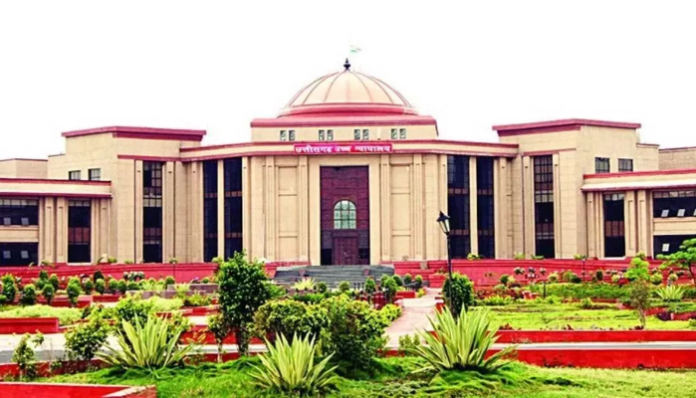
On 16th February (Monday), the Chhattisgarh High Court declared that a man touching a victim’s genitalia with his penis without penetrating them is “an attempt to rape” rather than the actual crime of rape. Accordingly, the court reduced the convict’s sentence from seven years to three and a half years, citing medical evidence of an intact hymen.
Justice Narendra Kumar Vyas stated, “Ejaculation without penetration constitutes an attempt to commit rape and not actual rape. When the evidence of the prosecutrix is considered in the proper perspective, it is clear that the commission of actual rape has not been established as the victim’s own statement creates doubt as in one stage of her evidence.”
The culprit’s appeal was partially granted by the court, which noted that although the intent was obvious, the conduct did not constitute actual rape owing to the absence of complete penetration. According to Justice Vyas, he went beyond simple preparation when he took the victim by force, undressed her and “rubbed his genitals against those of the victims.”
“These acts of the appellant were deliberately done with manifest intention to commit the offence aimed and were reasonably proximate to the consummation of the offence. Since the acts of the appellant exceeded the stage beyond preparation and preceded the actual partial penetration but without ejaculation, the appellant is guilty of attempting to commit rape,” the judge expressed.
The high court agreed that there was no question about the proof of sexual assault. It did, however, underline that the clear proof of penetration necessary for a rape conviction under the statute as it existed in 2004 could not be replaced by suspicion or the potential of partial penetration.
The court was moved against the decision rendered by Additional Sessions Judge Dhamtari (Camp Raipur) on 6th April 2005. According to the prosecution, the girl was alone when the perpetrator violently dragged her into his home on 21st May 2004 and tried to force himself on her against her will after taking off both her and his clothes.
Afterwards, he bound her hands and legs, put a cloth in her mouth and locked her in a room. Later, her mother came to her aid and the offender was sentenced to seven years of hard imprisonment by the trial court. He was found guilty under section 376(1) of the Indian Penal Code (IPC) and Section 342 of the IPC (wrongful confinement) based on the FIR (First Information Report) and the investigation that followed.
The justice considered the medical evidence and the victim’s account which reported penetration at first. However, she later mentioned that the appellant “kept his private part above her private part for about 10 minutes” and did not penetrate. The court declared that this was contradictory.
The medical report and a doctor’s testimony which conveyed that “only the tip of 1 finger could be introduced in vagina” suggesting a “possibility of partial penetration” were pointed out by the court. The medical examination revealed redness in the vulva along with the presence of white liquid which the Forensic Science Laboratory (FSL) confirmed contained human sperm.
The appellant was found guilty under section 376 read with Section 511 of the IPC after the high court overturned the conviction under Section 376(1). The two sentences will run simultaneously. The applicant had previously served for almost a year and a half and he must appear before the trial court within two months to fulfil the remaining portion of his sentence. A penalty of Rs 200 was also imposed on him.
The appellant’s argument concerning the victim’s age was dismissed by the court which observed that he had not contested the same in front of the trial court.
Notably, OpIndia has already highlighted the peculiar attitude exhibited by the judiciary in several rape cases. The perpetrators have been instructed to marry their victims, have rakhi tied by them and minor girls are even termed as “mature” by the judges. Hence, the victims and their families had to endure dire consequences following the court’s decision to grant bail to the offenders, even resulting in their killings.
