

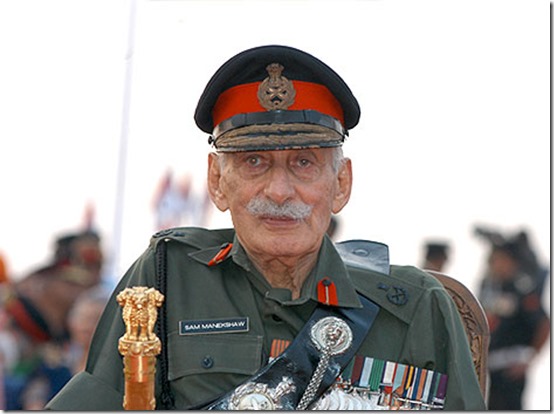
I was in class 9th when I first heard my school Principal Colonel V.K Jha talking about Field Marshal Sam Manekshaw. He was motivating a crowd of 800 students in an Open Air Theatre without using any mic – which he often used to do – and this time he was sharing stories of the war of 1971. Colonel Jha shared an anecdote which he had heard from Field Marshal Manekshaw during his Academy days:
Just after a few days of the start of the war of 1971, the then Prime-Minister of India, Indira Gandhi, called an urgent meeting to discuss about the war. Manekshaw, with a distressed face, updated her that India is losing on all fronts. Indira Gandhi calmly listened to him, sipped the glass of whiskey which she had in her hand, and informed him about the press conference waiting for them outside the room. Indira started the press conference with something like, “We are doing superb on all fronts. Field Marshal Manekshaw will update you all about the war.” Manekshaw talked to the journalists, and when he returned to the war-frontiers, he never looked back.
Manekshaw was born on 3 April 1914 in Amritsar. After completing his schooling in Punjab and Sherwood College, Nainital, he joined Indian Military Academy, Dehradun in 1932. He graduated from the IMA on 4 February 1934 and was commissioned as a Second lieutenant. Apart from his involvement in World War II during the British era, he witnessed three wars against Pakistan and China in the Independent India. On 7th 1969, Manekshaw became the Eighth Chief of Army Staff when he succeeded General P P Kumaramangalam. On 1 January 1973, he was raised to the rank of Field marshal – one among the only two Indian Army generals to be awarded this prestigious rank; the other being Kodandera Madappa Cariappa.
He was audacious, but at the same time, he was very practical and pragmatic in his approach. Months before the 1971 war, when Indira called a cabinet meeting to discuss the infiltration of thousands of people from East Pakistan (the now Bangladesh) in West Bengal, Assam and Tripura, Manekshaw refused to fight the war with available resources provided by the government. He even offered his resignation, but Indira agreed to all accept all his conditions.
Manekshaw was an inspiring leader, a great role model, a brave soldier, and above all, a great human. In 1942, during the World War II, he was hit by seven bullets in his lungs, liver and kidneys. His orderly evacuated him from the battlefield. The surgeon who was going to operate him was going to give up on his bullet-riddled body, until he asked him what had happened and got the reply, “I was kicked by a donkey.” Hearing this response, the surgeon laughed and said “Given your sense of humour, it will be worth saving you.” When the Indian Army won under Manekshaw’s leadership, the Prime minister asked him to visit Dhaka and accept the surrender of Pakistani forces. He declined it and suggested that the honour should go to his Army commander in the East, Lt. Gen. Jagjit Singh Aurora. Apart from his heroic role in the war of 1971, He also treated the prisoners of war from Pakistan with grace.
Manekshaw passed away on 27 June 2008 at the age of 94. Reportedly, his last words were “I’m okay!”


