

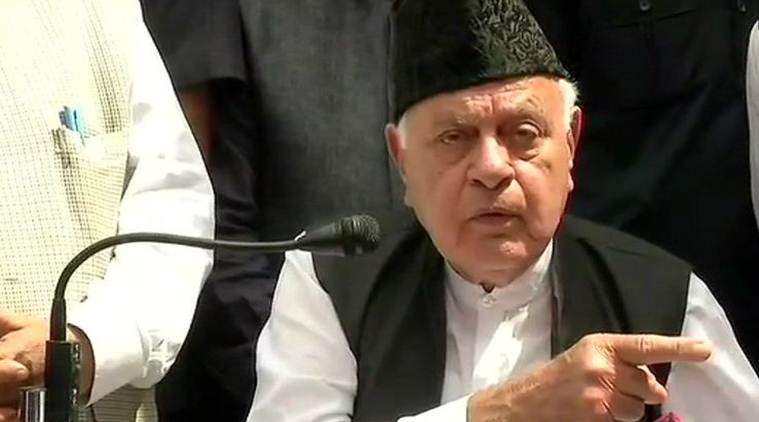
After deciding to boycott the Jammu and Kashmir Panchayat and Urban Local Bodies (ULB) polls, the National Conference(NC) today has threatened to boycott the assembly and the upcoming Lok Sabha elections if the Centre fails to clear its stand on Article 35A and 370.
Farooq Abdullah was reportedly addressing the NC party workers at a function in Srinagar to mark the 36th death anniversary of his father and NC founder Sheikh Mohammad Abdullah.
We will not only boycott Panchayat elections but also Lok Sabha & Assembly elections if the Centre doesn’t clear its stand on Article 35A and Article 370: Farooq Abdullah speaking at an event in Srinagar pic.twitter.com/PowoLkHuQK
— ANI (@ANI) September 8, 2018
Abdullah lashed out the centre saying that how can they go to their workers and ask them to come out to vote. He demanded that first the centre should do justice to them and clear its stand on Article 35-A. He further threatened that if the centre’s plan is to weaken Jammu and Kashmir’s special position, then they have will go separate way to boycott elections.
“If your plan is to weaken Jammu and Kashmir’s special position, then our ways are separate. Then we cannot have elections. Not only these (urban local bodies and panchayat) polls, but we will also boycott the assembly and parliamentary elections then,” Abdullah stated.
This statements from Abdullah comes after the Supreme Court agreed to hear the petition challenging the constitutionality of Article 35A. The petition seeks the scrapping of Article 35A in the state of Jammu and Kashmir (J&K).
The Jammu and Kashmir state administration has announced plans to conduct municipal elections from October 1 and Panchayat elections from November.
Earlier, an MLA from Abdullah’s National Conference, Javed Rana had threatened to stop unfurling of National flag in Kashmir, if any alterations are made to Article 35A or any attempts are made to abolish Article 370 from the Constitution of India.
Article 35A and Article 370 are two controversial constitutional provisions providing certain benefits to the people residing in the state. Article 35A is a provision inserted into the Indian Constitution in 1954 by the then Prime Minister Nehru, which provides the Jammu and Kashmir legislature to decide who all are ‘permanent residents’ of the State and allow on them special rights and privileges in jobs, acquisition of property in the State, scholarships and benefits of other government schemes and policies.
However, Article 370, a ‘temporary’ provision distinguishes the state of Jammu and Kashmir from the other states of India by providing a special autonomy to it. Most of the constitutional provisions which are applicable for other states are not applicable to Jammu and Kashmir. The state of Jammu and Kashmir even follows a separate penal code than the IPC named the Ranbir Penal Code.


