

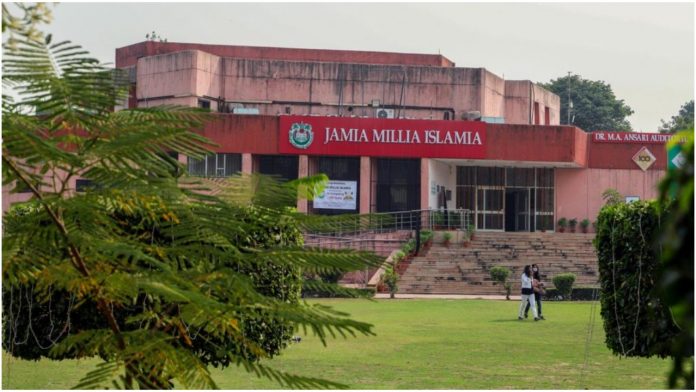
Six research scholars from the controversial university Jamia Millia Islamia (JMI) have been selected by the Modi government for the coveted Prime Minister Research Fellowship (PMRF) under the lateral entry scheme of the December 2020 drive.
In a statement, the Jamia Millia Islamia (JMI) University said that the Modi government has selected six students – Fozia Tabasum, Momina, Azra Malik, Firoz Khan, Aaliya Taiyab and Ashi Saif under the PMRF scheme. These students come from different departments, including Civil Engineering, Electrical Engineering, Centre for Nanoscience and Nanotechnology and Centre for Interdisciplinary Research in Basic Sciences, the varsity said.
Expressing happiness over the selection of six students, JMI Vice Chancellor Najma Akhtar said that five out of the six research scholars are girl students. He said the selection shows how well they are doing in research.
“I hope this would inspire other students, particularly girl students of the university, to do well in science and research. JMI stands for excellence and strives hard to provide its students with every possible support to achieve great heights,” the Vice-Chancellor said. He also appreciated the efforts of the coordinator PMRF, JMI professor Abdul Quaiyum Ansari for the “great achievement”.
Under the PMRF scheme, the six researchers from JMI will be individually getting a per month fellowship of Rs.70,000 for the first two years, Rs.75,000 for the third year, Rs.80,000 for the fourth and fifth year, respectively.
In addition to the monthly fellowship, each fellow will also get a research grant of Rs.2 lakh per year, i.e., a total of Rs.10 lakh for five years under the PMRF.
Earlier in May 2020, two students from JMI – Marya Khan and Abgeena Shabir, both from the Centre for Nanoscience and Nanotechnology (CNN), were selected for the fellowship.
Prime Minister’s Research Fellows (PMRF) Scheme
In order to attract meritorious students into research, the Government of India, in 2018, launched Prime Minister’s Research Fellows (PMRF) Scheme, which offers direct admission to such students in the PhD programmes in IITs, IISERs and IISc.
The scheme aims to attract the talent pool of the country to doctoral (PhD) programmes for carrying out research in cutting-edge science and technology domains, focusing on national priorities.
The institutes which can offer PMRF include all the IITs, all the IISERs, the Indian Institute of Science, Bengaluru and some of the top Central Universities/NITs that offer science and/or technology degrees.


