

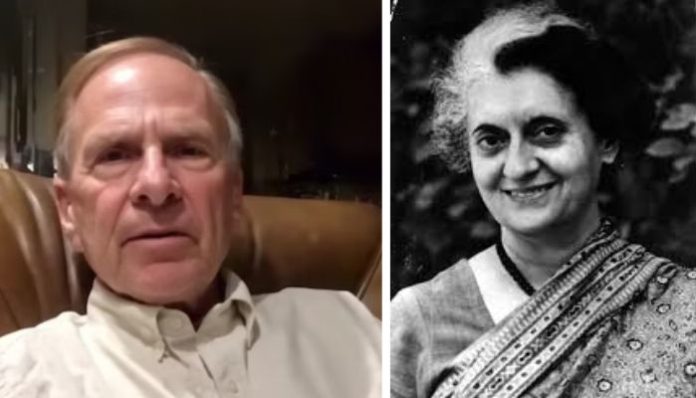
A former CIA officer, Richard Barlow, has revealed that India and Israel once discussed a secret joint plan to destroy Pakistan’s Kahuta nuclear facility in the early 1980s. Barlow said that the plan could have “solved a lot of problems,” but it never went ahead because then Prime Minister Indira Gandhi chose not to approve it. He called her decision a “shame.”
EP-11 with Ex-CIA Officer Richard Barlow (1985–1988) on Pakistan’s Nuclear Program premieres today at 5 PM IST | ANI Broadcast
— ANI (@ANI) November 7, 2025
“It’s a shame Indira didn’t approve it. Would have solved a lot of problems,” On reported Israel-India proposal for a preemptive strike on Pakistan’s… pic.twitter.com/IrCnOo9vwX
Speaking to news agency ANI, Barlow explained that the proposed “covert operation” aimed to stop Pakistan’s nuclear weapons program before it became a major threat. He said he had heard about the plan through intelligence circles during his time in the CIA, although he was not directly involved in it. “I heard about it at some point. But I didn’t get my teeth into it because it never happened,” he said.
Barlow’s comments came days after U.S. President Donald Trump told CBS News’s “60 Minutes” that while the United States has stayed away from nuclear testing for over thirty years, some countries, including Pakistan, continue conducting underground nuclear tests. Following Trump’s remarks, India’s Ministry of External Affairs spokesperson Randhir Jaiswal criticised Pakistan’s “clandestine and illegal nuclear activities,” saying they reflect its long-standing pattern of behaviour.
According to reports and declassified information shared by ANI, the planned strike on Pakistan’s Kahuta uranium enrichment plant was a joint idea between India and Israel. The Kahuta facility was the heart of Pakistan’s nuclear program, and the goal of the planned attack was to stop Islamabad from making nuclear weapons or passing nuclear technology to other countries like Iran, which Israel considered a serious threat.
Barlow pointed out that the U.S. government under President Ronald Reagan would not have supported such an operation, especially one involving Israel, because it might have disrupted America’s war efforts in Afghanistan during the Soviet invasion. He said Pakistan used this situation as leverage, knowing the U.S. needed its support to fight the Soviets.
“I think Reagan would have cut Menachem Begin’s ba**s off if he did anything like that. Because it would have interfered with the Afghan problem,” Barlow said, referring to Israel’s former Prime Minister.
Barlow also mentioned that Munir Ahmad Khan, who headed the Pakistan Atomic Energy Commission (PAEC), warned American lawmakers that stopping aid to Pakistan could harm cooperation over Afghanistan. “As you alluded to, what Munir Khan said was that they were basically using the flow of covert aid to the Mujahideen as blackmail,” Barlow explained.
The Kahuta plant, led by Pakistan’s nuclear scientist AQ Khan, later became central to Pakistan’s successful nuclear weapons program. It played a key role in helping Pakistan carry out its first nuclear tests in 1998, marking a major milestone in the region’s nuclear history.
Notably, earlier this year, the Congress party accused the Morarji Desai government of stopping the ‘Operation Kahuta’. The party called the government the ‘First Sangh Parivar Government,’ as A.B. Vajpayee was the External Affairs Minister, and L.K. Advani was the I&B Minister in the government.
Congress had posted on X, “After RAW confirmed the nuclear activity at Kahuta, they sought Desai’s approval for a strike on the facility. But Morarji refused angrily and denied permission. Then, in an act still debated in Indian intelligence circles, Desai personally called General Zia and casually revealed, “We know about your enrichment facility in Kahuta.” Just like that, Operation Kahuta was dead.”
