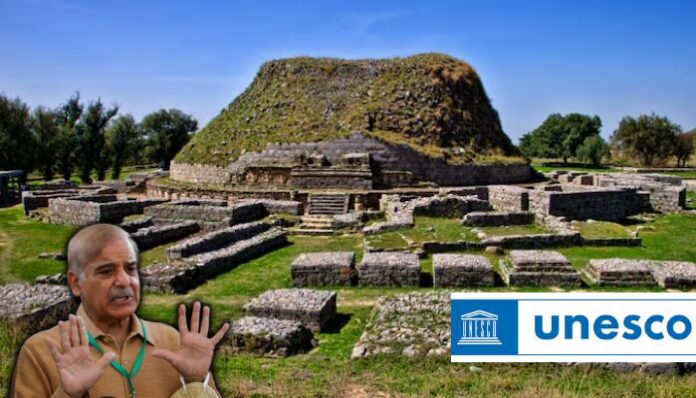
In a recently held unilateral international conference on the defunct Indus Waters Treaty held in Islamabad, Pakistan’s Information and Broadcasting Minister Attaullah Tarar said that he ‘proudly’ tells people abroad that Pakistanis are “children of Indus Valley Civilisation”. This supposed pride, however, is as real as its claim that there are no terrorists in Pakistan. The country has recently been called out by UNESCO for undermining the integrity of two Vedic-era sites in Taxila or Takshashila.
UNESCO warns removal from World Heritage Sites list for using cement to ‘conserve’ Vedic-era Taxila sites
The United Nations Educational, Scientific and Cultural Organisation (UNESCO) has formally asked Pakistan to reverse recent ‘reconstructions’ and “unnecessary interventions” at Mohra Moradu, a Buddhist monastery and stupa complex from the Kushan era, and Sirkap, the Indo-Greek city layer. Both these sites are located in the Taxila (Takshashila) archaeological complex in present-day Pakistan’s Rawalpindi district. These sites are UNESCO-recognised World Heritage Sites from the post-Indus Valley Civilisation period (around 2nd century BCE to 5th century CE).
Pakistan, a cultureless Islamic Republic suffering from an identity crisis, long dismissed its pre-Islamic, essentially Hindu past as an age of Jahiliyyah or the era of spiritual darkness that achieved redemption only after the arrival of Islam through Mohammad Bin Qasim.
However, Pakistan resorted to promoting Taxila via its museum projects, heritage initiatives and tourism campaigns, to attract foreign visitors, as a part of the broader agenda to appropriate the Indus Valley Civilisation and its Hindu history, although by either downplaying or extricating its Hinduness.
Pakistan’s desperation for material gains from remnants of the pre-Islamic past of ancient Indian regions that now fall within its periphery lacks required sensitivity in the preservation of the IVC-related and other historical sites.
This is evident from the fact that Pakistan’s Department of Archaeology and Museums used cement and modern masonry at Mohra Moradu and Sirkap, under its ‘conservation’ work. UNESCO has deemed this a violation of internationally accepted methods and principles for preservation of historical monuments and has harmed the authenticity and integrity of the Vedic-era sites.
Consequently, UNESCO recently held a meeting with senior Pakistani government officials and warned Pakistan that if the recent interventions are not reversed at parts of the World Heritage Site and corrective measures are not taken, Taxila would be put on the UN body’s List of World Heritage in Danger.
Highlighting the seriousness of its warning, the UNESCO officials told Pakistan that the organisation earlier removed a World Heritage Site in Germany from the list over improper conservation methods.
The matter first came to the UN body’s notice in March this year after a visitor shared photos and videos with Pakistan’s Permanent Delegate to UNESCO in Paris, showing how the original walls had been replaced with new modern masonry and even had their height increased during ‘conservation’ work. UNESCO took note of the matter; its officials conducted a joint technical visit to the Taxila Museum and other related sites on 12th June, along with Pakistan’s Department of Archaeology and Museums and Ministry of National Heritage and Culture.
Notably, the ancient city of Takshashila is a layered site with deep roots in the Indian subcontinent’s history. The city features in Vedic-era literature, Mahabharat and Buddhist Jatakas as a renowned centre of learning. Taxila later became a hub of Gandharan Buddhist culture, Greco-Buddhist art, and one of the world’s oldest and greatest universities.
Pivoting away from dismissing its pre-Islamic history as an era of ‘Jahilliyah’, Pakistan is feigning love for Indus Valley Civilisation, and appropriating ancient Hindu scholars and warriors as its esteemed ancestors.
While in rhetoric, Pakistan is promoting IVC and Gandharan heritage as ‘ancient Pakistan’, the 78-year-old Islamic Republic has demonstrated historical neglect of the region’s ancient history and its archaeological remnants.
From IVC sites like Mohenjo-daro and Harappa to Taxila and Buddhist sites in the Swat Valley area, the Pakistani governments over the decades have failed to prioritise principled conservation of these historical sites. Neither the absolute Hindu-hating Jihadist military dictators nor the military-backed ‘democratic’ governments cared much about the Indus Valley Civilisation, the pre-Islamic historical sites and their conservation.
The pre-Islamic sites faced neglect and excuses of resource and budget constraints; no such hindrance occurred when it came to protecting and renovating Islamic heritage sites.
In October 2009, the 7th-century CE rock-carved Buddha statue was dynamited and defaced by Pakistan Army-harboured Taliban Jihadis, who also attacked many Kushan-era stupas. The Taliban terrorists drilled holes into the face, shoulders, and feet of the statue, filled them with explosives, and detonated them, destroying the statue’s face and upper body, in an apparent emulation of the 2001 Bamiyan Buddhas destruction in Afghanistan.
Besides Islamic intolerance for even archaeological remnants of Kafirs, locals even looted Buddhist relics and illegally excavated some historical sites in the Swat Valley region and sold the priceless artefacts on the black market.
In many cases, the third or fourth generation converted Muslim descendants of Hindus, Sikhs, and Buddhists attach no significance to the historicity of archaeological sites and encroach on them.
Not to mention, the Pakistani populace, with tacit backing of their administrations, destroyed countless pre-partition Hindu temples and recently razed a 125-year-old Gurudwara in Panjab’s Farooqabad.
It must be recalled how in 2023, Pakistan, in its bid to erase the region’s Hindu past, demolished the Hinglaj Mata Mandir (temple) in Sindh province.
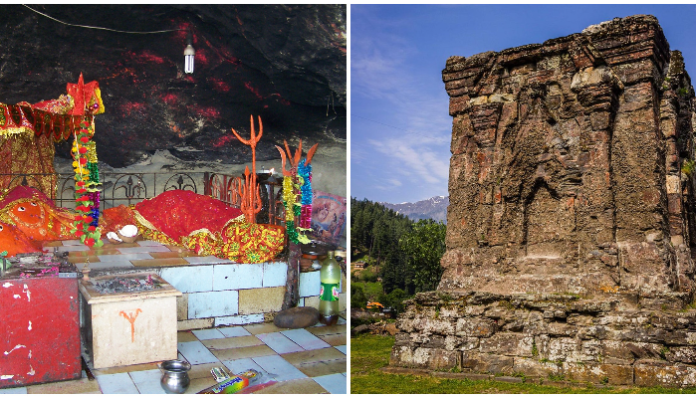
Pakistan also destroyed the Sharda Peeth Mandir, which is another Hindu shrine along the Line of Control (LoC). Ironically, the ancient Hindu temple was recognised as a UNESCO heritage site, although that status could not save it from Pakistani hatred for Hinduism.
On one hand, Pakistan is rebranding itself as a ‘civilisational state’ and promoting IVC sites as its national pride; on the other, it is destroying or damaging its pre-Islamic archaeological sites. This is when the Pakistani government and a significant section of common people claim to be ‘custodians’ of the Indus Valley Civilisation, although Field Marshal Asim Munir intermittently reminds his countrymen how Pakistani Muslims are different from Hindus in all aspects of life and how they must not forget the divisive and hateful two-nation theory.
Regardless of whether a military dictator is holding the reins of power directly, or through a puppet representative, Pakistan has undergone deeper and deeper Islamisation.
For decades, the Pakistani discourse emphasised descent from Arabs, Turks, Persians, or Central Asians, the ‘Ashraf’ narrative of foreign and ‘pure’ Muslim ancestry.
During the reign of General Zia-ul-Haq, Pakistan underwent significant cultural and historical rewriting.
The Zia regime, which lasted for a decade, beginning in 1977, modified school curricula for Islamiat and Pakistan Studies to instil and assert an Islamic identity by enforcing a psychological and cultural alignment with Arab history, delineating pre-Islamic roots of the fourth- or fifth-generation converted Muslims whose ancestors were predominantly Hindus.
For over 70 years, Pakistani school curricula, political discourse, media, and even the entertainment industry, to some extent, celebrated Islamic conquests, falsely convincing the Pakistani Muslim populace that they are descendants of ‘warrior races’ like Turks, Arabs, everyone but Hindus, although they were just one DNA test away from discovering the ‘unsettling’ truth. They continue to present Muhammad bin Qasim’s 8th-century invasion of Sindh as a watershed and celebratory moment for Pakistani Muslims.
On one hand, Pakistan is labelling Pāṇini, Chanakya, Raja Purushottama and other historical Hindu Sanatani figures as ‘ancient Pakistanis’, on the other hand, they name their missiles after Ghaznavi, Ghori, Abdali, all Islamic barbarians and invaders. For decades, Pakistani Islamists and politicians discouraged Sarees, Bindi and other such Hindu attire and ornaments merely because of inextricable Hindu influence, dismissing them derogatorily as ‘Hinduana’.
But now, Pakistan has adopted a Janusian approach, wherein it is keeping the country Islamised to avoid broader backlash in a country where even QR-codes can trigger a ‘blasphemy’ row, while also pretentiously embracing the pre-Islamic past and retrofitting facts to appropriate the history of ancient India. It is the same Pakistan that discriminates against the Ahmadiyya sect of Muslims for not being Muslim enough, and kills, rapes, forcibly converts to Islam, and treats its Hindu minorities as subhumans.
None other than Indians know it better that Pakistan’s newfound love for its pre-Islamic past is fake and self-interest driven. Adopting a contradictory approach has been Pakistan’s 78-year-old DNA.
Pakistan’s Quaid-e-Azam, Muhammad Ali Jinnah, a pork eater, founded Pakistan. An Islamic fanatic, Zulfiqar Ali Bhutto portrayed himself as a socialist ‘reformist’, and yet he ostracised Ahmadiyyas from Islam and made Islam Pakistan’s state religion.
Similar was the story of Benazir Bhutto, who the West hailed as ‘liberal’ Iron Lady while Taliban emerged and thrived under her watch. Nawaz Sharif, Pervez Musharraf, and even Imran Khan, all had their own contradictory philosophies when in power, reflecting how opportunism come naturally to Pakistani leaders.
Now Pakistan is promoting Harappa and Mohenjo-daro as national pride, because these IVC sites are more than just archaeological remnants. They are diplomatic assets and economic resources; Pakistan wants to cash in. Pakistan gets UNESCO funding and uses cultural diplomacy to whitewash its global terror hub image. Pakistan is attracting foreign archaeological protection initiatives, including the UK-based Cultural Protection Fund, to preserve ‘ancient Pakistani’ heritage. The move is sinister.
Pakistan is seeking the West’s support for its agenda of securing global recognition as the primary inheritor and custodian of the Indus Valley Civilisation, even as around 60% of IVC sites lie in India. Pakistan aims to dilute India’s ancient civilisational claim and attach the ‘civilisational state’ label to its own name.
OpIndia highlighted earlier how ISPR bots are concocting an IVC versus Indo-Gangetic Civilisation narrative to establish a present-day borders-based rivalry narrative.
Pakistan’s recent ancient India history appropriation manoeuvres are directly linked to the Indus Waters Treaty, the wretched water-sharing agreement signed in 1960, that the Modi government has scrapped indefinitely in response to the April 2025 Pahalgam Islamic terror attack by Pakistan-sponsored jihadis.
Indus is the lifeline of Pakistan, and its agriculture heavily depends on its waters. With the Modi government not budging to Pakistan’s nuclear threats, farcical international court verdicts, and not heeding the desperate pleas of Pakistani officials, the hostile neighbour is playing a narrative game.
Pakistan is selectively embracing, claiming, rather, appropriating only the Indus Valley Civilisation, as evident from its neglect and insensitive ‘conservation’ of Taxila sites since they do not belong to the IVC-era.
This selective embrace seeks global support by building a sympathy-evoking argument that the Indus River is directly linked to the Indus Valley Civilisation, and since the IVC is ‘Pakistani’ heritage, it is legally and morally wrong for India to deprive Pakistan of access to present-day resources linked to its heritage. Pakistan’s whole pivot from ‘we are full Turkish, Arab blood’ to ‘we are children of Indus’ is a pressure tactic in the making.