

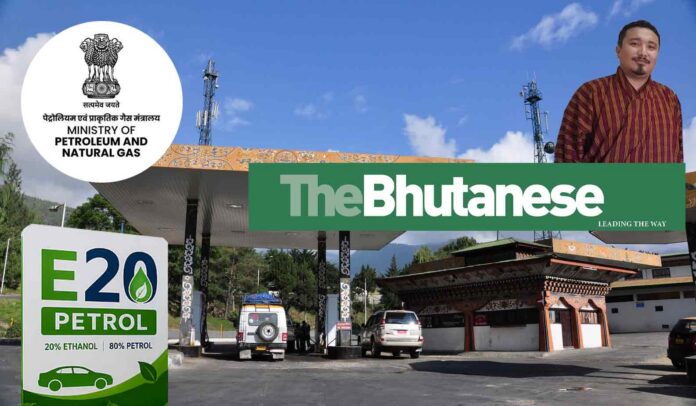
The Ministry of Petroleum and Natural Gas of the Government of India has denied reports by a section of Bhutanese media claiming that Bhutan has said no to E20 petrol exported from India. In a post on its official X account, the Ministry clarified that no such offer has been made by Indian Oil Marketing Companies, and there is no proposal whatsoever for the export of E20 petrol to Bhutan. The Ministry has advised the public to rely solely on official communications from itself and the OMCs rather than unverified reports.
Fact Check
— Ministry of Petroleum and Natural Gas #MoPNG (@PetroleumMin) July 5, 2026
❌ Claims that Bhutan declined an offer to import E20 petrol from India are incorrect.
No such offer has been made by the Oil Marketing Companies (OMCs), and there is no proposal for export of E20 petrol to Bhutan.
✅ Please rely only on official information from… pic.twitter.com/sqyAcEIvbw
The claim by The Bhutanese
This clarification directly addresses a report published by The Bhutanese, which claimed that Bhutan had turned down offers of E20 petrol from Indian OMCs including IOCL, BPCL and HPCL. The article said that the Department of Trade of the Royal Government of Bhutan had confirmed that Bhutan is not importing E20 and had resisted such supplies due to concerns over fuel quality, compatibility with older underground storage tanks, and risks of water seepage in Bhutan’s hilly terrain.
The report published last week claimed that Indian OMCs are offering E20, but Bhutan is resisting the offer. It stated, “It has been learnt that Indian Oil Marketing Companies (OMCs) have been offering to supply E20 petrol to Bhutan, but Bhutan has resisted so far.” As per the report, the govt is concerned that the tanks used by petrol pumps in the country are not compatible with ethanol-blended petrol, and thinks that it may pose challenges in ensuring fuel quality and preventing contamination
It quoted the Department as having requested Indian PSUs and OMCs to continue supplying normal motor spirit as long as it remains available in the Indian market, while seeking advance notice in the event of any future transition to ethanol blends, in case pure petrol becomes unavailable in India, so that dealers could upgrade their infrastructure in time. The report presented this as Bhutan effectively saying no to an ethanol fuel offer from India.
The Bhutanese report, which was published last week, was picked up by several Indian news outlets yesterday and today, leading to widespread circulation of the claim that Bhutan has rejected to buy E20 petrol from India.
Editor defends claim, exposes himself
After India’s fact check clarifying that Indian OMCs have not offered E20 to Bhutan yet, Tenzing Lamsang, editor of The Bhutanese, posted a thread on X in which he stood by his newspaper’s story. He shared a copy of a written response from Bhutan’s Department of Trade, claiming it confirmed that an offer for E20 had been made by Indian OMCs during technical meetings, which was rejected by Bhutan. Lamsang added that his verbal interviews with officials had also verified this account, and he reiterated that The Bhutanese stood by the report based on both written and verbal inputs from official sources, while expressing appreciation for India’s consistent fuel supplies to Bhutan.
1/2
— Tenzing Lamsang (@TenzingLamsang) July 5, 2026
Since people have tagged me to this tweet, please find the written response by the Department of Trade of the Bhutanese Govt confirming to me an offer was made by Indian OMCs & the Department requested the OMCs to supply normal petrol.
My verbal interviews confirmed it too. https://t.co/X2AMVOIieC pic.twitter.com/DVBy8WvPcm
A careful examination of the very statement posted by Tenzing Lamsang himself, however, shows that it does not support the claim of an offer having been made or declined. The official response from the Department of Trade, issued in reply to specific questions from The Bhutanese, begins by stating plainly that Bhutan is not importing E20 petrol fuel. It then explains the technical concerns about ethanol-blended petrol absorbing water due to its hygroscopic properties, the condition of existing old underground tanks, and risks of contamination or performance issues in Bhutan’s terrain.
Crucially, it records that in view of these concerns, the Indian PSUs and OMCs were requested during technical meetings to continue supplying normal petrol for Bhutan as long as such fuel remains available in the Indian market. It further notes that Bhutan has asked for advance notice should India move to higher ethanol blending levels, to allow time for infrastructure upgrades.
The document makes it clear that it was a proactive request from the Bhutanese side for continued supply of conventional petrol and advance notice for preparatory planning for any future change in Indian supply. It contains no reference to any formal offer, proposal or push from the Indian OMCs to supply E20 that was then turned down by Bhutan.
This distinction is significant. The written statement confirms Bhutan’s preference for normal petrol and its infrastructure-related apprehensions, but it does not say that Indian OMCs extended an offer for E20 which Bhutan rejected.
"Bhutan Won't Buy Ethanol-Blended Petrol"
— OpIndia.com (@OpIndia_com) July 5, 2026
This half truth was spread by anti-Hindu, anti-India Tenzing Lamsang, who has repeatedly incited hatred against the Hindutva IT cell.
He has also been siding with Islamist and claimed that Buddhist monasteries lie buried beneath temples… pic.twitter.com/Sfv9qCFOeW
India’s Petroleum Ministry’s position that no such offer was made and no export proposal exists is therefore consistent with the text of the official Bhutanese response. While Tenzing Lamsang has maintained that verbal communications indicated Indian OMCs were raising ethanol-related points in meetings, the documented evidence he himself shared does not corroborate the existence of such an offer.
Therefore, the original article’s claim that Bhutan said no to ethanol fuel offer from Indian OMCs is based on an interpretation that goes beyond what the official written record actually states. Bhutan’s request for assurances on continued normal petrol supply, and for advance notice of any change, reflects prudent planning on its part given its complete dependence on Indian fuel imports and the practical challenges of its storage infrastructure, but this does not mean rejecting an offer that was never extended.
It is interesting to note that while Bhutan is not ready for ethanol-blended petrol yet, Nepal has already prepared for it to cut the cost of imported oil. The Nepal government has allowed Nepal Oil Corporation to blend up to 10 percent ethanol in every litre of petrol, depending on availability. This is a global trend, with oil supply becoming uncertain over global conflicts, governments dependent on imported oil are looking towards using ethanol to partially replace petrol. Therefore, it is possible that Bhutan govt may also mandate the industry to upgrade its infrastructure to use ethanol.
Notably, Bhutan does not have an automobile industry, and most of the vehicles used in the country are imported from India. Which means most of the cars being used in the country are already compatible with E10 and E20 petrol. However, the government is concerned about the petrol pumps, as their tanks and equipment may require upgrades.
It is evident that a normal proactive request by Bhutan to India was wrongly turned into ‘Bhutan said no India’ by The Bhutanese, whose editor, Tenzing Lamsang, is known for his views against the Narendra Modi-led BJP government in India. He has been supporting anti-India forces in India, and speaking against most of the decisions taken by the Modi government. Therefore, the latest report, and then his ‘clarification’, can be seen as his and his newspaper’s attempt to create the impression of a rift between India and Bhutan.
While Indian companies have not offered E20 petrol to Bhutan yet, Tenzing Lamsang created a hypothetical situation of India offering such fuel to Bhutan based on the statement from the Bhutan government to make the claim that the Bhutan govt has rejected the blended fuel. In an attempt to create such a narrative, he asked questions to the Bhutan govt, and used the reply for his propaganda, even though the govt’s response didn’t support his claims.


