

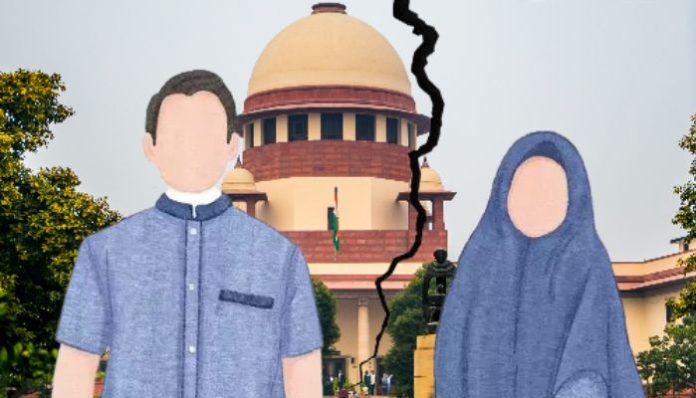
The Indian Supreme Court has questioned the legal validity of the practice of talaq-e-hasan, a form of divorce under Muslim law where a husband says “talaq” once every month for three months to end a marriage. This kind of divorce has a difference from the so-called instant triple talaq, talaq-e-biddat, where the divorce is enforced immediately after the husband says the word talaq three times at the same time.
This instant triple talaq system was outlawed by the Supreme Court of India in 2017, and then was formally banned by a law passed by parliament in 2019.
A bench comprising Justices Surya Kant, Ujjal Bhuyan, and NK Singh expressed surprise during a hearing today that even in modern times, talaq-e-hasan was permitted to persist, given its far-reaching repercussions on women’s rights. “How is this allowed in modern society?” the court asked while hearing multiple petitions challenging the validity of talaq-e-hasan.
The court has merged several petitions, such as that of Benazir Heena, a Muslim woman who was divorced under talaq-e-hasan, where her former husband did not get involved directly in the process, and his lawyer had pronounced talaq on his beghalf.
She faced problems such as her inability to get her child admitted to school on account of not being able to satisfactorily prove her marital status. The court slammed the practice of lawyers issuing talaq on behalf of husbands and held that the entire divorce process must be undertaken in accordance with the stipulated religious procedures to save the dignity of women.
“Can this be a practice? How are these new innovative ideas being invented?” the court asked questioning the practice of lawyer pronouncing talaq instead of husbands, when told that it is a common practice in Islam.
“What prevents the husband from directly communicating with her? He has such an ego that even for divorce, he cannot speak to her. How can you promote this in a modern society? It is the dignity of a woman,” the court told the lawyer who was defending the practice.
While praising Benazir Heena for pursuing justice, the court noted that less privileged women may be at risk due to such cases. It pointed out that early or unfair stigmatisation of women with the accusation of remarriage as polygamy was a major issue.
The Supreme Court is considering the question of referring the talaq-e-hasan issue to a larger Constitution Bench with the realisation that judicial intervention might be required to eliminate the discriminatory effects and ensure that constitutional rights are enforced.
What is Talaq-e-Hasan
Talaq-e-hasan is a form of divorce in Islam whereby a Muslim husband, while his wife is in a state of purity and not menstruating, pronounces “talaq” once each month over three months. Immediately after each pronouncement, an iddat, the advised duration being about 90 days or three menstrual cycles, interposes, in which there can be reconciliation of the spouses.
If that happens, the divorce is revoked. The divorce becomes irrevocable if no reconciliation happens after the third pronouncement. The present method accommodates a cooling-off period and is viewed as a more thoughtful and respectable mode of divorce compared to instant triple talaq, whereby a husband can have an immediate and irretrievable divorce.
While talaq-e-hasan is recognised under Islamic law and approved by various schools of Muslim jurisprudence, its compatibility with modern legal and constitutional principles, especially regarding women’s rights and equality, is under judicial scrutiny.
The Supreme Court of India is still reviewing whether the practice of talaq-e-hasan should be permitted to stand in today’s jurisprudence, balancing religious traditions with basic human rights and dignity. This current judicial review is a significant moment in India’s quest to make all personal laws respect the constitutional guarantees of equality and justice for women.
