

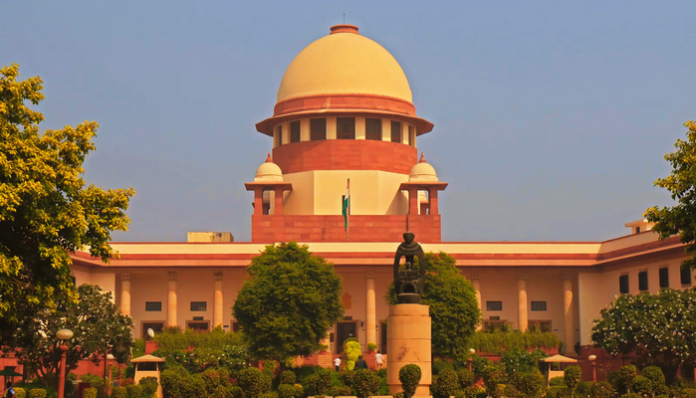
During the hearing of the final arguments on Thursday (27th November) in the petitions challenging the Special Intensive Revision (SIR) being carried out by the Election Commission of India (ECI), the Supreme Court said that the commission cannot be prevented from undertaking the exercise unless it is proved that the poll body is not empowered to do it. “This is not a routine updation of the electoral roll but a special revision. Any process which is fair and transparent can go on, unless it can be shown the ECI has no power to do it,” a bench of Chief Justice of India Surya Kant and Justice Joymalya Bagchi remarked.
The Election Commission cannot conduct en masse SIR: petitioners
The Court’s remarks came in response to the contentions of Senior Advocates Kapil Sibal and Abhishek Manu Singhvi, appearing for the petitioners, who claimed that the SIR was unconstitutional and that the Election Commission cannot determine the citizenship of voters. Claiming that the SIR exercise has no legal backing, Singhvi argued that SIR was conceived as an ‘individuated exercise’ and not an ‘en masse/ blanket exercise’ under the Representation of Peoples Act 1950 (ROPA) and related rules. “Never before in India, not under the ROPA and not under the Rules, are you allowed an en masse right?” Sanghvi said.
The Senior Advocate further claimed that en masse verification of voters was contrary to Article 327 of the Constitution, which deals with the power of Parliament to make provision with respect to elections to the Legislatures. Singhvi interpreted Section 21(3) of the Election Commission Act as empowering the Commission to conduct the SIR only for a particular constituency or a part thereof and not for all constituencies of a State simultaneously.
“An SIR is a revision of rolls on an individualised/bilateral method on a limited constituency; there is no power en masse,” he asserted. Notably, Section 21(3) of ROPA states, “Notwithstanding anything contained in sub-section (2), the Election Commission may at any time, for reasons to be recorded, direct a special revision of the electoral roll for any constituency or part of a constituency in such manner as it may think fit”.
Going by your argument, the ECI will never have the power for SIR: CJI
Responding to his contention, the CJI said, “Going by your argument, the ECI will never have the power for SIR.” The Court explained that if the Election Commission finds that a large number of voters in a state are dead, it cannot pick and choose constituencies in the state to conduct the SIR. “If reasons to be recorded are common to all constituencies of the state, will it not be discriminatory on the part of EC to pick and choose constituencies,” the Court said. “In such a scenario, EC will compulsorily be required to undertake this exercise for every constituency in the state if reasons exist. It is open for you to argue that no reasons are recorded or reasons are not sufficient or the power itself is not available,” the Court added.
Senior Advocate Sibal, appearing for another set of petitioners, termed the entire SIR process as unreasonable, citing that under the process, voters are required to furnish the birth certificate or other documents to prove that either of their parents was an Indian Citizen. He said that the Booth Level Officers (BLO) engaged in the SIR, who could merely be school teachers, lack the jurisdiction to decide the citizenship of the voters. Countering Sibal’s argument, Justice Bagchi pointed out the Court’s earlier ruling according to which voters were allowed to produce documents like Aadhaar Cards for identity verification during the Special Intensive Revision (SIR).
The Supreme Court is hearing a batch of petitions challenging the legality of the SIR. The court has prima facie maintained that the Election Commission is empowered to conduct the SIR under Section 21(3) of the ROPA.
