

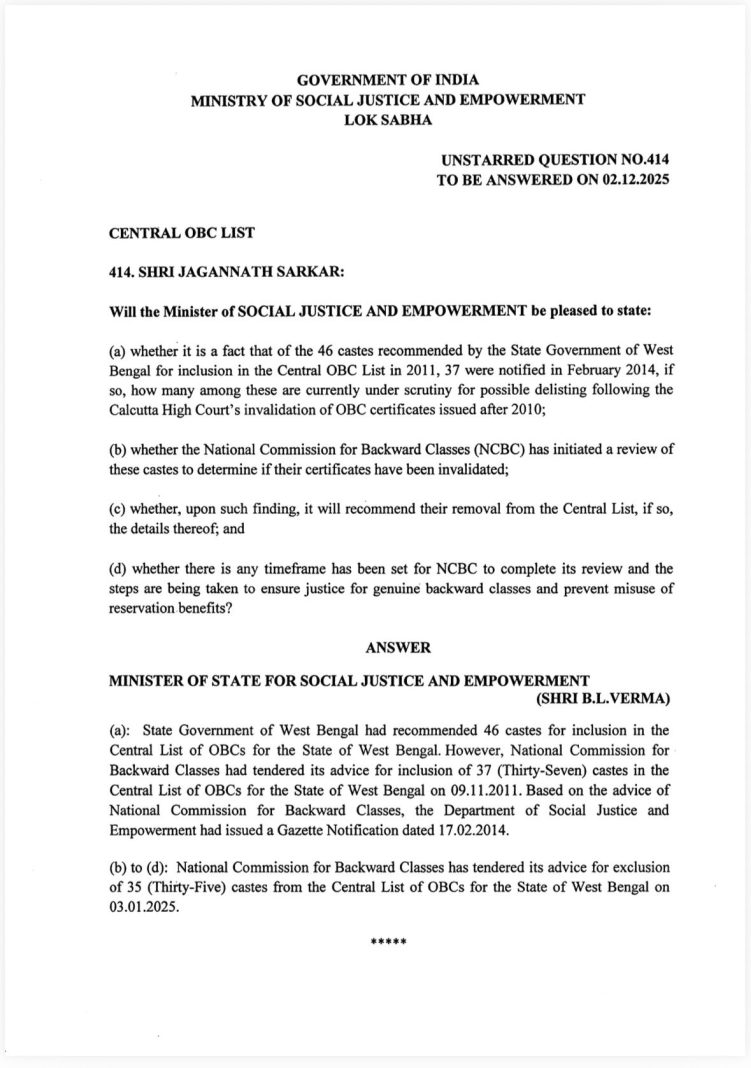
The Ministry of Social Justice & Empowerment confirmed on Tuesday (December 2, 2025) that the National Commission of Backward Classes (NCBC) recommended the exclusion of 35 communities from West Bengal’s Central list of Other Backward Classes (OBCs). Most of the 35 communities recommended for exclusion are Muslim.
As per reports, the recommendation of the NCBC to exclude certain communities was made in January 2025, months after the commission initiated a probe into 37 communities, which were included in the Central OBC list of West Bengal in 2014, ahead of the Lok Sabha elections. Out of these 37 communities, 35 were Muslim communities.
The state government had originally proposed 46 communities for inclusion in the Central OBC list in 2011. However, following a review by the NCBC, 37 communities were approved and notified in 2014. In 2023, the NCBC began the re-examination of these 37 communities included in the Central OBC list.
“This recommendation was made in continuation of the NCBC’s scrutiny of West Bengal’s OBC list in light of a high number of Muslim communities being listed as OBCs. Most of the communities in the list of 35 recommended for exclusion are such Muslim communities. One or two of them may be non-Muslim communities,” said Hansraj Gangaram Ahir, under whose chairmanship the NCBC made the recommendation.
The tenure of Ahir, who took charge as the NCBC chairman in December 2022, ended on 1st December. During Ahir’s chairmanship, the NCBC scrutinised the OBC lists in several states, including West Bengal, Karnataka, and Kerala. The commission conducted a ground visit in West Bengal in February 2023, after which Ahir flagged the issue of a large number of Muslim communities being included in the State OBC list.
The recommendation made by the NCBC needs to go through certain procedural requirements to be implemented by the Central government. Any advice rendered by the NCBC must be signed by the Chairperson, Vice-Chairperson, and all Members. At the time of making the recommendation for exclusion, the Commission only had a Chairperson and one Member, and no Vice-Chairperson.
In addition to that, as per the 102nd Constitutional Amendment, after receiving the NCBC’s advice, the Central government is required to get any recommended changes to the Central OBC list passed in the Parliament, after which the President notifies the amended list.
Pertinently, a case relating to the West Bengal government’s inclusion of certain communities on its OBC list is pending before the Supreme Court. In July this year, the Apex Court stayed the proceedings before the Calcutta High Court to prevent it from hearing the case. The top court is examining the process the state government followed to classify these communities as OBC.
