

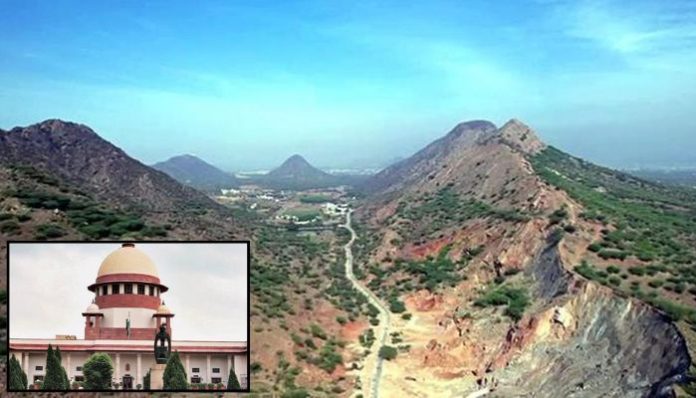
The Supreme Court on Monday, 29th December, put its recent ruling on the definition of the Aravalli Hills on hold, saying that more clarity and expert input were needed before moving forward. The court said the environmental impact of the earlier recommendations must be studied in detail, especially since those recommendations were largely prepared by a committee dominated by bureaucrats.
A bench headed by Chief Justice of India Surya Kant, along with Justices JK Maheshwari and AG Masih, stayed the judgment delivered last month on the Aravalli Hills. The ruling had accepted a new definition of the Aravalli range, mainly for regulating mining activities. The bench made it clear that both the recommendations of the committee and the findings based on them will remain suspended for now.
“We direct that the recommendations of the committee and the findings of the Supreme Court shall remain in abeyance till then,” the bench said, adding that the matter will be taken up again on 21st January, 2026.
Need for fresh expert review
The court observed that a fresh committee of experts should examine the environmental consequences of the recommendations already accepted. According to the bench, such a sensitive issue requires scientific and environmental expertise, not just administrative inputs. The case is being heard suo motu by the Supreme Court after widespread protests and concerns that the new definition could seriously harm the Aravalli ecosystem.
Solicitor General Tushar Mehta appeared for the Union government and told the court that there were many misconceptions about the government’s role and the court’s earlier order. He said an expert committee had been set up earlier, its report was submitted, and the Supreme Court had accepted it. However, the bench felt that further examination was still required.
What was the earlier definition?
The Aravalli mountain range stretches across Delhi, Haryana, Rajasthan and Gujarat. In November, the Supreme Court had approved an elevation-based definition to identify what qualifies as the Aravalli Hills for mining regulation. According to reports, this definition would have excluded more than 90 per cent of the Aravalli region from strict mining controls, triggering public outrage and protests.
The committee had suggested that any landform in the Aravalli districts with an elevation of 100 metres or more above the local relief should be classified as Aravalli Hills. It also defined an “Aravalli Range” as two or more such hills located within 500 metres of each other.
Background of the case
The matter has its roots in May 2024, when the Supreme Court, hearing a case about illegal mining within the Aravallis, pointed out that the definitions for the Aravallis were not the same across states. To rectify this situation, a committee was formed and submitted a report in October 2025 on how the Aravallis should be protected and conserved.
In its 20th November judgment, a bench led by then CJI BR Gavai had accepted the committee’s definitions and upheld restrictions on mining in core or inviolate areas. However, the court had also refused to impose a complete ban on mining, saying that total bans often encourage illegal mining and the rise of mafias.
