

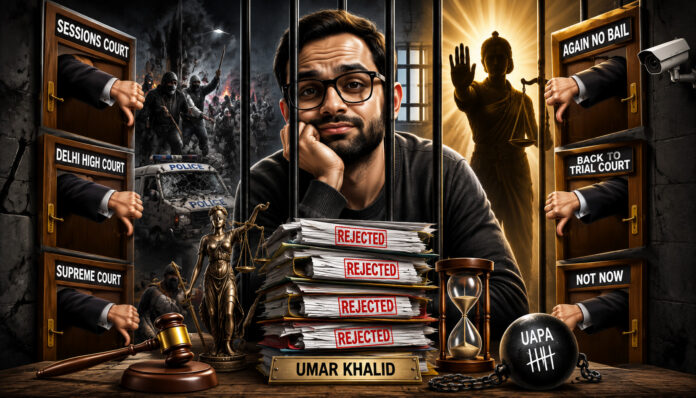
Umar Khalid has asked for bail eight times. Eight times, in the Sessions Court, the Delhi High Court and the Supreme Court, a judge has gone through the Delhi Police file and decided it is strong enough for him to stay in Tihar. Today, as the Delhi High Court hears his ninth plea, that record is the story.
Khalid, a former JNU student leader and co-founder of ‘United Against Hate’, was arrested in September 2020 over the anti-Hindu riots that broke out in north-east Delhi that February, during protests against the Citizenship Amendment Act, riots that killed 53 people and injured more than 700. The Delhi Police case, under FIR 59/2020, does not say he threw a stone and set a car on fire. It says he did something courts have repeatedly found much more serious. He helped plan the violence, as part of what police call a ‘larger conspiracy,’ carried out through speeches, WhatsApp groups and planned road blockades timed for maximum disruption.
That case runs under the Unlawful Activities (Prevention) Act, the UAPA, India’s toughest anti-terror law. Parliament wrote into it a bail rule, Section 43D(5), that turns the usual rule on its head. A judge cannot grant bail unless satisfied there are no reasonable grounds to believe the accusation is true. It is one of the hardest bars to clear in Indian law. Khalid has not cleared it so far.
First stop: The sessions court says NO (2022)
Khalid was picked up on the night of September 13, 2020, and charged under FIR 59/2020. He moved the Sessions Court for bail in July 2021. The prosecution, led by Special Public Prosecutor Amit Prasad, put forward chats from a WhatsApp group called the ‘Delhi Protest Support Group’, saying they showed Khalid wanted to push the government to the edge, and that the anti-CAA protests were being used to create spots of violence, not just voice disagreement. The defence challenged how the chats were being read and pointed to gaps in the charge sheet.
Eight months later, on March 24, 2022, the Sessions Court refused bail. Additional Sessions Judge Amitabh Rawat said the material, taken at face value, prima facie showed a planned conspiracy that Khalid was part of. That finding, the first of eight, became the pattern every later court would follow.
High Court upholds the ‘no bail’ view (October 2022)
Khalid appealed on April 21, 2022, before Justices Siddharth Mridul and Justice Rajnish Bhatnagar. The prosecution’s case rested heavily on a speech Khalid gave in Amravati, Maharashtra, a few days before the riots, the court itself focused on whether his words about the Prime Minister went from strong rhetoric to actual incitement, read together with speeches by co-accused Sharjeel Imam calling for disruption. The defence said the chargesheet was full of contradictions, the bench was not convinced.
On October 18, 2022, the High Court turned down bail, saying the chargesheet made out a prima facie case of terrorist activity and criminal conspiracy under the UAPA. Under Section 43D(5), that finding by itself is enough to keep bail out of reach, no matter how long someone has already been in jail.
A narrow exception, and a separate, smaller case closes
On December 3, 2022, the Karkardooma Court acquitted Khalid and co-accused Khalid Saifi in a separate, much smaller case relating to vandalism and arson at a Khajuri Khas parking lot. It’s important to be clear about the scale: that case never carried UAPA charges and was never the reason he was kept in custody. It changed nothing in FIR 59, the larger conspiracy case, where both the Sessions Court and the High Court had already found a prima facie case against him. Nine days later, he was given one week’s interim bail, under a gag order that barred him from speaking to the media, to attend a family wedding, a temporary, conditional release on humanitarian grounds, not a fresh look at the merits of the case.
To the Supreme Court, and then a tactical retreat
Khalid filed a Special Leave Petition on April 6, 2023, challenging the High Court’s bail rejection. The hearing barely moved for over a year, judges recusing themselves, lawyers unavailable, and the case being tagged with a separate constitutional challenge to the UAPA meant he got no real hearing at all through 2023. Rather than let the delay drag on, on February 14, 2024, Umar Khalid withdrew the petition himself, betting that a fresh application built around the time already spent in jail might work better in the trial court than a stalled Supreme Court appeal. It didn’t.
Back in the trial court (2024-25)
Khalid applied for fresh bail on May 28, 2024. Sessions Judge Sameer Bajpai rejected it, relying on the Supreme Court’s rulings in NIA v Zahoor Ahmad Shah Watali and Union of India v Barkathullah to hold that even a surface reading of the evidence still pointed to Khalid’s involvement, and finding no real change in circumstances since the last order. The appeal that followed dragged into 2025 before Justices Navin Chawla and Shalinder Kaur finally heard it. Solicitor General Tushar Mehta’s position for the state was blunt: if you’re accused of acting against the nation, you stay in jail until a trial says otherwise.
High court again says no, upholds prosecution’s version
On September 2, 2025, the Delhi High Court rejected bail for Khalid and eight co-accused. Justice Kaur’s judgment accepted the prosecution’s version that the riots were the result of a premeditated, well-orchestrated conspiracy, not spontaneous unrest. The court pointed to the sheer scale of the case, around 3,000 pages of chargesheet, backed by 30,000 pages of electronic evidence, as reason enough that the trial needed to run its full course rather than be rushed. It said clearly that delay alone cannot override the UAPA’s bail bar when the underlying allegations remain serious. Five years inside did not move the needle.
Supreme court: Bail for some, not for the architects (January 2026)
Khalid appealed on September 10, 2025. Over weeks of hearings, the Delhi Police told the Court the riots were an ‘orchestrated, pre-planned and well-designed’ attack on India’s sovereignty, not a protest that spiralled out of control. ASG S.V. Raju laid out the state’s case in fine detail. CCTV cameras allegedly covered and acid bottles thrown from rooftops at Chand Bagh, accounts from protected witnesses about a planning meeting on February 23, 2020, an alleged funding network running through shell companies and the Jamia alumni association and, using location data, chat records and witness statements, the claim that Khalid himself had directed the start of the chakka jam road blockades. The defence argued for parity with co-accused already granted bail, the bench drew a line instead.
On January 5, 2026, five co-accused, Gulfisha Fatima, Meeran Haider, Shifa Ur Rehman, Mohd Saleem Khan and Shadab Ahmed, were released on bail with twelve conditions. Khalid and Sharjeel Imam were not among them, the Court described the two as ‘architects’ of the conspiracy, on a different footing from the others. Not participants who joined a protest, but the men the bench found had directed it. They were told they could reapply only after a year, or once protected witnesses were examined, whichever came first.
A new twist, another no at trial court, and today’s hearing
On May 22, 2026, a different Supreme Court bench, hearing a co-accused’s case, granted six months’ interim bail and pointed to a ‘perceived divergence’ in how benches were applying an earlier ruling on prolonged custody, sending the underlying question to a larger bench. Khalid and Imam cited this as their own change in circumstances and filed fresh pleas on June 13, 2026. On July 4, 2026, Justice Bajpai dismissed them as not maintainable, holding the trial court remained bound by the Supreme Court’s January order until its own conditions for reapplication were met. Khalid has now appealed that order to the Delhi High Court, which was listed today before Justices Prathiba M. Singh and Vikas Mahajan, in which reply from Delhi Police has been sought within two weeks.
Conclusion
Eight rulings, three courts, one answer every time, the case clears the UAPA’s bar. That’s the thread running through six years of litigation, and it’s why Khalid remains in custody today while the Delhi High Court hears his ninth attempt. The only real question left in the system isn’t whether the prosecution’s case has held up, by every court’s own account, so far, it has. It’s a narrower legal point the Supreme Court has now sent to a larger bench, which is whether years in custody can ever outweigh that finding under the UAPA’s statutory bar. That ruling, whenever it comes, will matter well beyond this one case.


