

The Indian Army’s precision strikes during the night of May 6–7, in which nine terrorist hideouts inside Pakistan were destroyed in just 24 minutes, appear to have triggered panic well beyond the battlefield. Newly released documents under the United States’ Foreign Agents Registration Act (FARA) indicate that India’s Operation Sindoor, launched in April last year, deeply rattled Pakistan’s diplomatic establishment and forced Islamabad into an intense lobbying campaign in Washington to prevent a wider conflict.
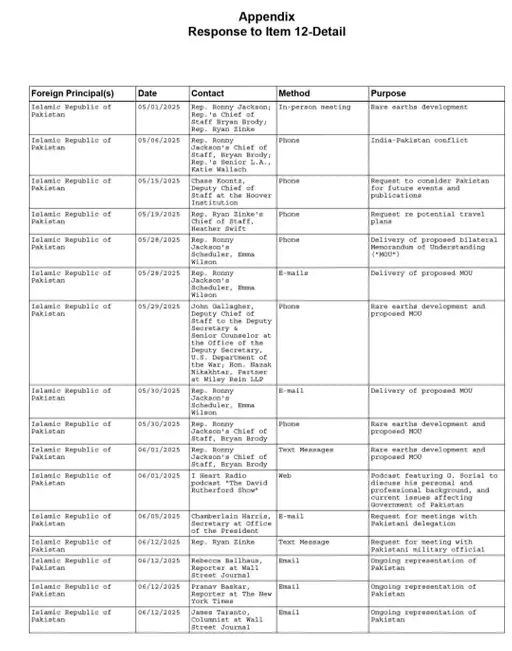
According to the filings, Pakistan activated its diplomatic network in the US almost immediately after Operation Sindoor began. Pakistani diplomats contacted senior officials across the Trump administration, members of Congress, the Pentagon, and the State Department nearly 60 times in a matter of weeks. These efforts, carried out through emails, phone calls, and in-person meetings, were aimed at pushing for a ceasefire and pausing India’s military action. The lobbying continued from late April through and beyond the four-day operation.
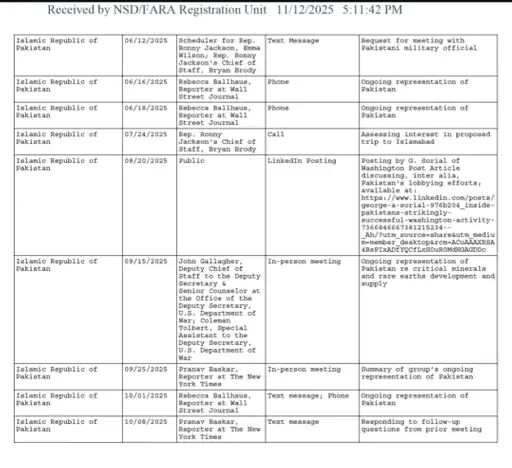
To gain rapid access to key decision-makers, Pakistan reportedly spent around ₹45 crore to hire six American lobbying firms. The disclosures show a concerted attempt to influence Washington’s response as Indian forces dismantled terror infrastructure with unprecedented speed and precision. In a separate filing, US-based Sidley Law LLP stated that it assisted Pakistan in strengthening economic engagement with the United States and provided support during the period of heightened India–Pakistan tensions.
Interestingly, there is no mention of US President Donald Trump’s mediation during Operation Sindoor in the filings of the US lobbying firms.
At the same time, FARA records also show that the Indian Embassy in Washington engaged an American lobbying firm, SHW Partners LLC, to facilitate official communication with the US government. According to the filings, SHW Partners worked for the Indian Embassy between April and December 2025, primarily arranging meetings and coordinating outreach on diplomatic and trade-related issues.
Notably, on May 10— the day the four-day military confrontation ended—SHW Partners, acting on behalf of the Indian Embassy, helped establish contact with White House Chief of Staff Susie Wiles, US Trade Representative Jamison Greer, and National Security Council official Ricky Gill. Discussions during these interactions included the status of the India–US trade agreement and media coverage surrounding Operation Sindoor. The firm’s role, as described in the filings, was limited to facilitating communication through calls, emails, and meeting arrangements.
The documents also reveal that the Indian Embassy sought assistance in arranging a meeting for a multi-party Indian delegation with Vice President JD Vance and Secretary of State Marco Rubio. Several entries refer to ongoing discussions related to India–US trade negotiations, indicating that diplomatic engagement continued alongside military developments.
Responding to questions over the disclosures, the Ministry of External Affairs clarified that such lobbying activities are legal, transparent, and a long-standing practice in the United States. MEA sources stated that all records are publicly available on the US Department of Justice website and that embassies, private companies, and business organisations routinely engage consultants under FARA to improve communication and outreach. They emphasised that the Indian Embassy has hired such firms intermittently since 1950 and rejected any suggestion of third-party mediation in Operation Sindoor, calling such claims completely incorrect.
However, the developments have triggered political reactions at home. The Congress party raised concerns over the sequence of events on May 10, pointing to the timing of US announcements related to the halt of Operation Sindoor. Congress General Secretary Jairam Ramesh noted that US Secretary of State Marco Rubio made the first public statement on stopping the operation at 5:37 pm that day, arguing that the timeline merits closer scrutiny.
Congress leader Amitabh Dubey further claimed that the involvement of US Trade Representative Jamison Greer in discussions on the same day raises questions about whether trade considerations played any role in the decision to pause military action. The government, however, has firmly denied any such linkage, maintaining that India’s military and diplomatic decisions during Operation Sindoor were sovereign, strategic, and entirely independent.
Taken together, the FARA disclosures underscore the extent to which Operation Sindoor unsettled Pakistan diplomatically, even as India pursued parallel diplomatic engagement in Washington. While Pakistan scrambled to halt the momentum through aggressive lobbying, the Indian government has maintained that its actions, both military and diplomatic, were conducted transparently and in line with established international norms.
