

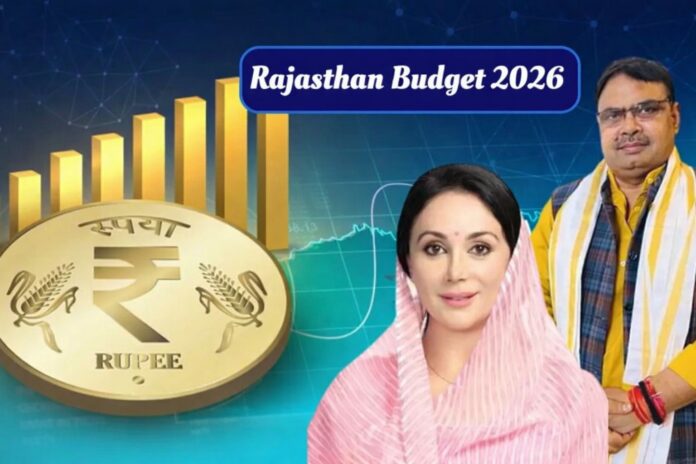
The Rajasthan government on Tuesday presented the Budget for 2026–27 under the vision of “Viksit Rajasthan 2047,” laying out an expansive roadmap focused on infrastructure expansion, water security, industrial growth, employment generation, and green development. The budget is anchored around ten core pillars, including infrastructure, citizen safety, industry, health, tourism, governance, agriculture reforms, green budgeting and tax reforms.
A major thrust has been placed on drinking water and water security. Under the ‘Har Ghar Nal’ scheme, 6,500 new villages will be connected at a cost of ₹4,500 crore, while three lakh new drinking water connections will be issued next year. The government will also float work orders worth ₹24,000 crore for drinking water projects and spend ₹750 crore to ensure 24-hour water supply in desert regions. Additionally, ₹650 crore has been allocated to extend the Bisalpur project to 1,092 villages, along with the installation of 600 new tubewells and the launch of mobile water testing labs.
The power and energy sector will see significant upgrades, with six new 220 kV grid substations, 13 new 132 kV and 110 new 33 kV substations planned. Solar parks worth ₹2,950 crore will be set up in Bikaner and Jaisalmer, while Ajmer DISCOM’s system will be integrated with AI for real-time monitoring. The budget also proposes ₹1,800 crore for new roads and bridges and the construction of 15 new railway overbridges and underpasses next year.
On infrastructure, the government announced its highest-ever capital expenditure, with ₹3,427 crore earmarked this year. A total of 16,430 km of new roads will be added, taking the overall road network development to 42,000 km. The state economy is projected to cross ₹21 lakh crore in 2026–27, with per capita income expected to rise beyond ₹2.02 lakh, reflecting a 41.39% expansion compared to the previous government’s period.
Industrial development also features prominently, with ₹350 crore allocated for new industrial parks and a plan to develop 3,600 hectares in the Jodhpur-Pali-Marwar industrial belt. New logistics hubs and inland container depots will be set up, while Rajasthan Foundation will open 14 new chapters abroad to attract investment and diaspora engagement.
For youth, education and employment, the budget introduces interest-free loans up to ₹10 lakh under the CM Swarojgar Yojana, benefiting around 30,000 youth. A Rajasthan Testing Agency will be set up on the lines of the NTA to conduct online exams. Meritorious students of Classes 10 and 12 will receive e-vouchers for laptops, while 40 lakh students from Classes 1 to 8 will get free uniforms. New skill centres and techno hubs will also be established across districts.
In healthcare, the government announced the ‘Raj Suraksha Yojana’ for immediate treatment in serious illness and accident cases, deployment of highway trauma ambulances, and expansion of mental health services in medical colleges and district hospitals. A new IPD tower and neonatal ICU will be built at JK Lon Hospital in Jaipur, and ₹300 crore has been allocated for fire safety equipment in hospitals.
Women and child development received a boost with plans to open Rural Women BPOs, raise the loan limit under the Mukhyamantri Lakhpati Didi scheme, upgrade over 700 anganwadis into ‘Nandghars’, and provide electricity connections to more than 17,000 anganwadi centres.
In agriculture, the budget proposes starting work on the ₹32,000 crore Yamuna water project for Shekhawati, installing 50,000 solar pumps, providing subsidies for farm machinery, fencing support to farmers, and setting up compost units in 3,496 panchayats. AI and remote sensing-based real-time crop and weather monitoring centres will also be established. The agriculture budget has been increased to ₹1.19 lakh crore, which is 7.59% higher than last year and stands at 5.55% of GSDP.
On the green front, ₹130 crore has been allocated for Aravalli conservation, including plantation over 4,000 hectares and strict action against illegal mining. The state will plant 10 crore saplings next year and launch a carbon credit rating pilot project. New EV charging stations and CNG stations will also be set up to promote cleaner transport.
Overall, the Rajasthan Budget 2026–27 signals a strong push towards infrastructure-led growth, water and energy security, employment generation, digital governance, and environmentally sustainable development, aligning the state’s fiscal roadmap with the long-term vision of “Viksit Rajasthan 2047”.
