

A political storm has erupted in India after the Indian Express alleged ‘internal dissent’ between the country’s 3 Election Commissioners. The issue has become a political hot potato with the Opposition exploting the opportunity to claim ‘crisis of institutional integrity’ within the Election Commission.
And this ‘controversy has brought the spotlight on an important question – Why does India have an Election Commission with 3 Commissioners? Why not one or two?
For nearly four decades since independence, the single man in charge of conducting India’s free and fair elections was sufficient. Only an awesome contest of wills between a prime minister with an absolute majority and an unyielding civil servant birthed the present 3-member Election Commission.
The Constitutional Mandate (1950-1984)
On 25th January 1950, the Election Commission of India (ECI) was born. The Chief election commissioner (CEC) headed this constitutional body which oversaw the conduct of free and fair elections in India. The system worked smoothly with the CEC as the sole decision-maker, from the landmark elections of 1952 till the late 1980s.
Late 1984 saw Rajiv Gandhi elected to power with a stunning mandate of over 400 Lok Sabha seats, riding on the wave of sympathy following Indira Gandhi’s assassination. With such an overwhelming majority, Rajiv Gandhi’s government did not feel the need for any independent authority to keep check on its powers.
After all, it has uncharacteristically overturned the Shah Bano judgement and the passage of the Anti-Defection Law through its sheer will. However, the Prime Minister’s office soon found itself at loggerheads with the CEC on election-related issues.
A man called Peri Sastri
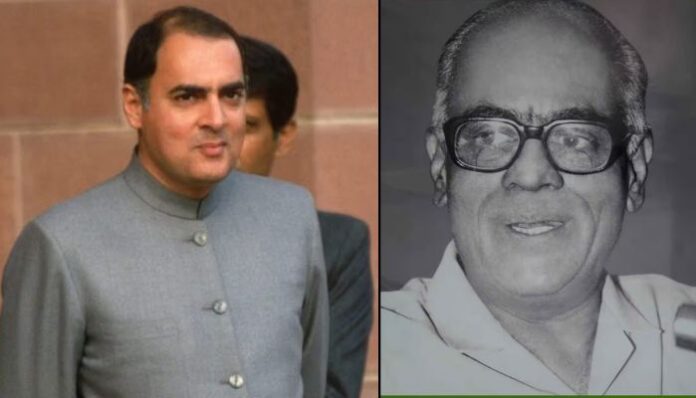
R.V.S. Peri Sastri was sworn in as India’s eighth chief election commissioner on 1st January 1986. The self-effacing Sastri believed in the sanctity of the autonomy granted to the ECI by the Constitution and did not look upon any interference from the government with fondness.
The first major stand-off occurred in the spring of 1987 when Rajiv Gandhi sought to defer the Haryana assembly elections to a date after the presidential poll. Haryana was ruled by the Congress with Chief Minister Bhajan Lal, whose defeat in the assembly polls would affect the voting pattern in the presidential race.
Peri Sastri refused to accede to the Prime Minister’s request. With a wave of anti-incumbency sweeping north India, Sastri went ahead and conducted the Haryana elections in June 1987. The Congress was decimated as a result and the Lok Dal-BJP alliance came to power with Chaudhary Devi Lal as the chief minister.
Sastri then conducted the presidential election as scheduled in July, which was won by R. Venkataraman of the Congress. However, the damage to the Prime Minister’s image had been done. Sastri had openly defied the government.
The stand-off with the government intensified the following year when Peri Sastri declined to countermand the entire Faridabad parliamentary by-election in 1988 due to widespread allegations of rigging. Congress demanded that the entire election be declared null and void while Sastri ordered repolls in only those booths affected by violence and malpractice (161 booths).
Further tussles with the government over electoral rolls in Assam, in which the ruling party accused the ECI of being biased against the Asom Gana Parishad (AGP) resulted in a series of behind-the-scenes meetings to get Sastri removed from office. Peri Sastri however proved impervious to pressure and when the government finally failed in its efforts to get him removed, it decided to dilute him.
The Midnight Ambush: October 1989
On 9th October 1989, President Venkataraman (on the advice of the Union Cabinet) superseded the Election Commission by notifying the formation of a multi-member election commission with S.S. Dhanoa and V.S. Seigell as the new election commissioners. Peri Sastri was kept in the dark about this development.
A week later, on 16th October, the President appointed two new election commissioners: S.S. Dhanoa and V.S. Seigel. In his memoirs, S.S. Dhanoa wrote how he and the newly appointed Seigel found their first morning at Nirvachan Sadan greeted with a barrage of abuse by an irate Peri Sastri who refused to accept Dhanoa’s authority! The Union Law Secretary had already met Sastri earlier in the week and tried to browbeat the CEC into accepting the new status quo.
Dhanoa himself writes that neither Sastri nor the new appointees had been consulted before this farce was enacted. With a three-member Election Commission in which decisions were taken by a majority vote, the two Union appointees could openly defy the CEC.
The first test of this came the very next day (17th October 1989) when the Prime Minister Rajiv Gandhi announced the dates for the 1989 general election. (This was a prerogative of the Election Commission.) This left the opposition with barely a month to prepare for the polls while Congress prepared its attack strategy for the campaign trail. Sastri, caught between the anathema of judicial review and the electoral arithmetic of the nation, simply signed off the dates with a shrug!
The very next day, as the news broke, the Prime Minister was quoted as saying that the CEC was overburdened with work and hence the need for a multi-member Election Commission. Exactly a year ago, in October 1988, Rajiv Gandhi had stood in Parliament and vehemently opposed the very idea of a multi-member Election Commission!
The Rollback and return of the trio
The political game plan backfired spectacularly as the anti-graft crusade of V.P. Singh saw the Congress routed out of power in the November 1989 elections. The National Front government promptly revoked the multi-member Election Commission notification in January 1990, restoring the single-member Election Commission and removing Dhanoa and Seigel from office. However, Dhanoa challenged this in the Supreme Court which upheld the government’s right to reduce the strength of the Election Commission.
However, this ploy was not repeated when the Congress returned to power with P.V. Narasimha Rao who was met with an even more truculent CECT.N. Seshan.
As a man who took his mandate in the Constitution as a sacred trust and cleaned up electoral rolls with a rod of iron, Seshan often clashed with the political establishment. In an echo of the 1989 episode, the Rao government appointed two additional election commissioners (M.S. Gill and G.V.G. Krishnamurthy) in October 1993 to keep a check on Seshan. (Gill later served as a minister in the Union Cabinet under the Congress-led UPA government.)
Seshan challenged the appointment of the new commissioners in the Supreme Court. In a landmark judgment (T.N. Seshan v. Union of India) delivered in 1995 by a five-judge bench, the validity of the multi-member Election Commission was upheld, thus making it a permanent feature of the Indian political system.
The Lesson Behind Today’s Headlines
When Indian Express reports of “ideological rifts” or the “2-1 votes” by the Election Commissioners, remember that the very existence of a three-member Election Commission was once considered anathema by both the government and the judiciary. The idea of having a multi-member Election Commission is to enable the majority to rule.
So, any friction, dissent or differing opinions within the Election Commission are normal features of the system, implanted by history.
For those who feel that the Election Commissioners do not speak with one voice, remember that democracy’s twin pillars, the ballot and the Supreme Court, have always been there to settle differences. Just as they did in 1989 and 1993.


