

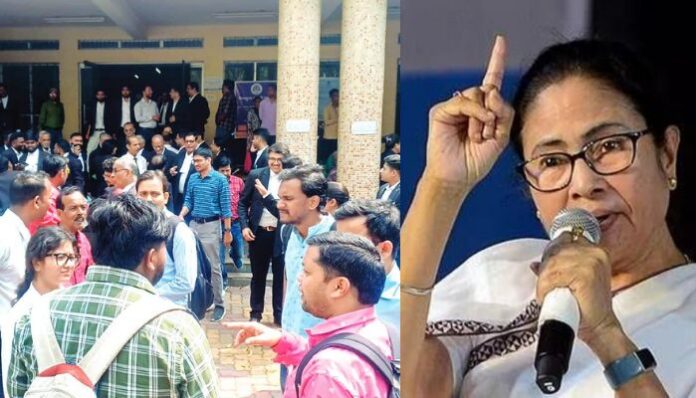
Tension spread across West Bengal on Tuesday, 24th February, after at least five courts received bomb threats through email. The messages were sent just two days after the Supreme Court ordered that judicial officers would supervise the Special Intensive Revision (SIR) of electoral rolls in the state, a move that has already sparked political debate.
The first alert came in the morning when a threatening email was sent to the chief judge of the Kolkata City Civil Court. Soon after, similar emails were reported from other courts, including those in Bidhannagar and Berhampore. The coordinated nature of the threats immediately raised concerns within the administration.
Bomb disposal squads and police units were rushed to the affected court complexes. The Kolkata City Civil Court was evacuated to allow a thorough search by sniffer dogs and forensic experts. Police also cordoned off the surrounding areas to avoid panic. By the afternoon, it was confirmed that no explosives had been detected, and the threats were likely to be hoaxes. However, the incident had put the entire state machinery on alert.
State chief secretary Nandini Chakraborty, director general of police Peeyush Pandey and Kolkata Police commissioner Supratim Sarkar held a press conference at Nabanna, the state secretariat, while the search operations were on.
“We are investigating the source of the mails. The pattern is the same. All the district judges are working in their respective areas. The state government is working actively to ensure their safety and security so that the SIR exercise is not affected,” the chief secretary said.
West Bengal: On various session courts receiving bomb threats, Nandini Chakravorty, West Bengal's Chief Secretary, says, "In their respective areas, the state government is committed to providing them all security and ensuring that they are able to discharge their functions… pic.twitter.com/vfeB3t1yvT
— IANS (@ians_india) February 24, 2026
Police begin investigation, trace digital trail
Kolkata Police Commissioner Supratim Sarkar stated that the emails had a similar format and were received by both the City Civil Court and the Bankshall Court. Sarkar further added that, “Our cyber crime wing is trying to trace the source of the e-mail. We will take strong action once the sender is identified.”
Sarkar warned that people should not panic and that anyone who attempted to spread fear would face stern action. Later in the day, Kolkata Police filed a case based on a complaint filed by the Registrar of the City Civil Court. The Hare Street Police Station filed the case, and the Special Task Force (STF), along with the Cyber Police Station, started investigating the case.
Supreme Court order and SIR process in focus
The timing of the threats has drawn attention because they came shortly after the Supreme Court directed that judicial officers oversee the Special Intensive Revision of electoral rolls in West Bengal. The SIR exercise involves reviewing and verifying over 50 lakh discrepancies in the voter list.
The Supreme Court intervened following a trust deficit between the state government and the Election Commission regarding the revision process. The Supreme Court chose to assign about 250 active and retired judicial officers to oversee the process to ensure that it is fair and transparent.
There have been reports of tension and even intimidation associated with the SIR process. In light of these reports, Director General of Police Piyush Pandey has been asked to provide complete security to the judicial officers involved in the process. The Supreme Court had earlier expressed concern over the possibility of violence or intimidation tactics being used against officials involved in the revision of the electoral roll.
For now, the bomb threats have turned out to be false alarms, but the incident has heightened security across court complexes in the state. With investigations underway and political reactions pouring in, authorities are focusing on maintaining calm and ensuring that both the judicial process and the electoral roll revision work continue without disruption.
