
In early August 2026, the National Highways Authority of India (NHAI) found itself at the heart of a controversy after visuals showing dangerous and substandard ‘rumble strips’ on National Highway-25 (NH-25) near Rajasthan’s Prathvipura village went viral online. After an initial rebuttal of social media posts flagging the safety hazard the strips posed, NHAI ended up getting fact-checked by social media users and suspending a concerned project director.
The viral video showed raised asphalt ridges at a median opening causing vehicles to bounce sharply. Highway users quickly flagged the so-called rumble strips, which actually were poorly constructed speed humps or breakers, on NH-25 as hazardous on a high-speed national highway corridor.
As the videos of the rumble strips across NH-25 near Prathvipura village surfaced online, several netizens raised questions over the design of the strips, the necessity of such rumble strips on a national highway, and whether they met road safety norms.
People raised concerns that such unusually high and inconsistent ‘rumble strips’ can cause vehicles to experience sudden jolts and lead to loss of control, abrupt braking, or collisions, especially during night or in poor visibility.
In response to the social media outrage, the NHAI published an X post on 3rd August 2026 and claimed that the viral visuals of the rumble strips on NH-25 in Rajasthan do not depict the actual condition. It shared a comparison picture, captioned: “As shown on social media vs actual image of the section”.
The NHAI also said that the rumble strips were constructed at the request of a local public representative for the safety of local villagers and highway users.
“As reported by some sections of the media regarding construction of rumble strips at the median opening near Prathvipura village on NH-25 in Rajasthan, NHAI would like to inform that the media reportage does not depict the actual condition of the section. The construction of rumbling strips is being carried out at the request of the local public representative to enhance the safety of both National Highway users and the residents of the village. NHAI appreciates the valuable feedback received from the Highway users and remains committed to ensure a safe travel experience for all commuters,” it said.
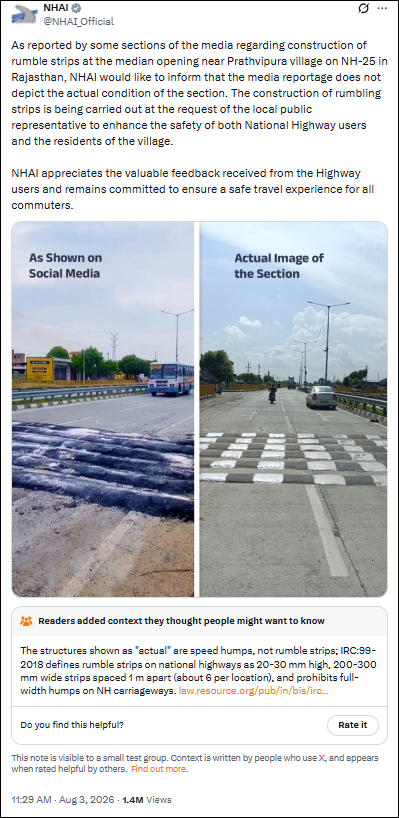
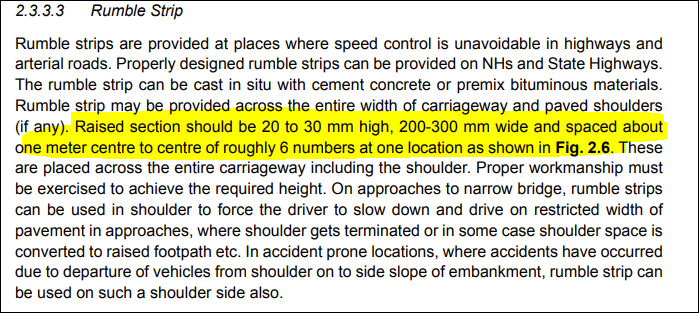
A closer look at both the images, however, makes it clear that even the supposed ‘actual image’ does not really show standard rumble strips, but speed humps. As per the rules, rumble strips on national highways should be 20-30 mm high, 200-300 mm wide strips spaced 1 m apart (about 6 per location). In addition, there is a prohibition on full-width humps on NH carriageways.
The NHAI’s ‘rebuttal’ intensified the backlash further, as people called out the authorities for passing off hazardous flat-topped speed breakers or humps as rumble strips.
One X user wrote, “That’s certainly not rumble strips. You are sadly mistaken if you think you can pass off flat-topped speed breakers as rumble strips. These are speed breakers and are undoubtedly a safety hazard for highway drivers.”
That's certainly not rumble strips. You are sadly mistaken if you think you can pass off flat-topped speed breakers as rumble strips. These are speed breakers and are undoubtedly a safety hazard for highway drivers.
— THE SKIN DOCTOR (@theskindoctor13) August 3, 2026
Pertinently, several social media users shared longer videos of the same location and drew comparisons between the “actual image” shared by the NHAI with elements from the additional on-site videos.
So you are saying this video is a lie?pic.twitter.com/ZIYE0taYo4
— Himanshu gupta (@hmanshu_gupta) August 3, 2026
It emerged that the “actual image” the NHAI shared was actually either of a different location or the opposite carriageway.
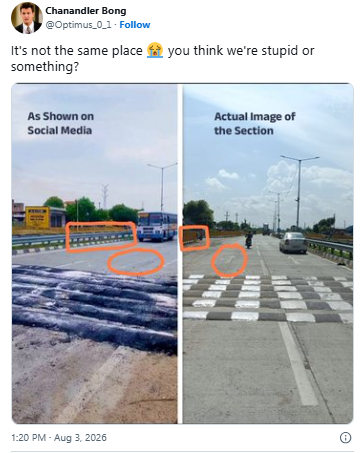
Social media calls out mismatched ‘factcheck’ imagery, NHAI backtracks
By the evening, the NHAI backtracked from its own rebuttal of the viral claims about the substandard and hazardous rumble strips, rather, speed breakers.
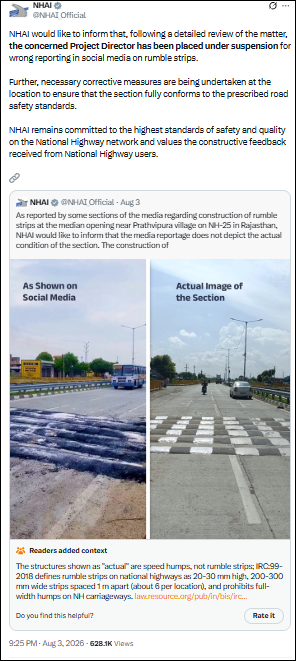
At 9:25 pm on Monday, the NHAI published an X post informing that it has conducted a detailed review of the matter. The NHAI said that following a review, it has suspended the concerned Project Director for “wrong reporting in social media on rumble strips.”
The NHAI further stated that it is undertaking corrective measures at the location to ensure conformity with prescribed road safety standards.
“NHAI would like to inform that, following a detailed review of the matter, the concerned Project Director has been placed under suspension for wrong reporting in social media on rumble strips. Further, necessary corrective measures are being undertaken at the location to ensure that the section fully conforms to the prescribed road safety standards. NHAI remains committed to the highest standards of safety and quality on the National Highway network and values the constructive feedback received from National Highway users,” the NHAI said.
The NHAI’s initial clarification remains problematic for another reason. The Ministry of Road Transport and Highways has reiterated on multiple occasions, including in a 2016 circular, that constructing speed breakers or humps on National Highways by local authorities or by NHAI at their behest/request is against the rules. Constructing speed humps on National Highways is prohibited because it essentially is a safety hazard and also defeats the basic objective of providing an obstruction-free high-speed facility.
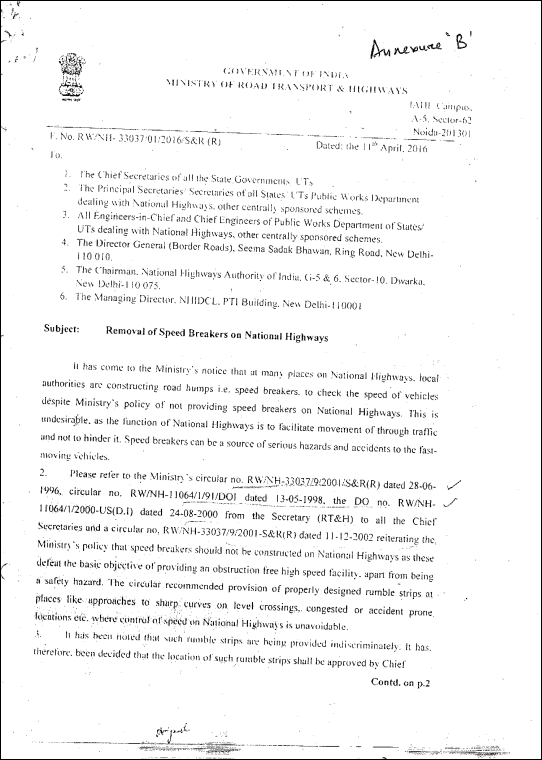
Instead of speed humps, the authorities recommend properly designed rumble strips at places like approaches to sharp curves on level crossings, congested or accident-prone locations, etc., where control of speed on National Highways is unavoidable.
However, in the present case, the NHAI first said that the ‘rumble strips’ were constructed at the request of a local political representative and later admitted “wrong reporting” and undertaking of corrective measures. It is being highlighted that not only did the actual installations exceed the IRC specifications, but also that the NHAI justified non-standard construction work solely on political request, subordinating engineering principles to local political pressure.
The NHAI’s handling of the whole matter has revealed a mixed picture. On one hand, the NHAI quickly committed to physical corrections, demonstrating seriousness about accountability. On the other hand, however, the NHAI initially denied ground reality by sharing mismatched imagery.
Not only this, the NHAI passed off a series of small speed bumps as ‘rumble strips’. It must be recalled that back in September 2023, the NHAI itself, in response to an RTI query, said that the construction of rumble strips and speed breakers has been banned on National Highways.
“There are no guidelines to erecting rumblers on NHs. In this regard, specific instructions have been issued to all Project Directors for removal of speed breakers from all NH stretches and ensuring patchless roads for road users (including ambulances),” the NHAI responded in its official reply to the query filed by one Nikhil Desai.
The NHAI could have first conducted a thorough review, ascertained complete facts, and then issued a clarification instead of rushing to discredit the viral claims.