

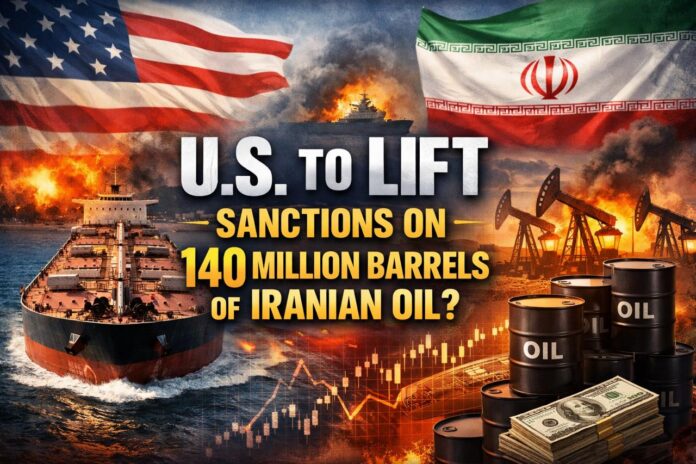
With tensions in the Gulf spiralling after Iran’s aggressive moves, Washington is weighing a short-term but impactful intervention to stabilise global oil markets.
U.S. Treasury Secretary Scott Bessent indicated that the Biden administration could soon lift sanctions on a massive volume of Iranian crude, around 140 million barrels currently stranded at sea. The move, he suggested, is aimed at quickly injecting supply into a market rattled by disruptions, particularly after Iran’s closure of the Strait of Hormuz and attacks on tankers pushed prices above $100 per barrel.
“This is roughly 10 days to two weeks of global supply,” Bessent noted, framing the potential release as a temporary pressure valve to cool soaring prices.
The strategy mirrors a recent decision to allow the sale of sanctioned Russian oil stuck on tankers, which added another 130 million barrels into circulation. Together, these moves signal a clear shift: instead of intervening in financial markets, the U.S. is focusing on boosting physical supply to offset a daily shortfall estimated between 10 and 14 million barrels due to disrupted shipping routes.
Bessent also hinted at further measures, including a possible unilateral release from the U.S. Strategic Petroleum Reserve—on top of last week’s coordinated G7 drawdown of 400 million barrels.
Meanwhile, geopolitical coordination is intensifying. President Donald Trump is expected to engage with Japanese Prime Minister Sanae Takaichi on securing maritime routes through Hormuz, a critical artery for Japan’s energy imports. Tokyo, too, could release additional reserves to cushion the shock.
Adding another layer of concern, Bessent flagged China as an increasingly unreliable supplier of refined fuels, noting a halt in exports like jet fuel across Asia.
In essence, the U.S. is attempting a delicate balancing act, countering geopolitical shocks with rapid supply-side fixes, while the world watches how long these stopgap measures can hold.
