

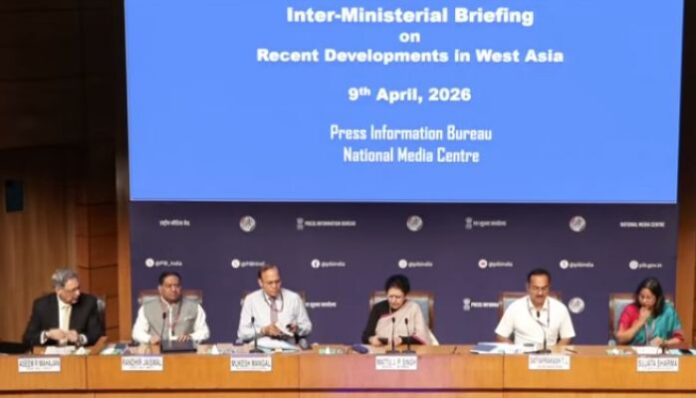
Amidst the prevailing tensions in West Asia due to the Iran war, the Central government held the daily Inter-Ministerial briefing on 9th April. Though a two-week ceasefire understanding has been reached between the US and Iran, the situation remains fragile amidst violations, contradictions in terms of peace talks, and the looming possibility of the resumption of violence.
MEA briefs about India’s engagements with Gulf countries
During the press briefing, the Ministry of External Affairs spokesperson informed that EAM S Jaishankar will be visiting the United Arab Emirates to review close cooperation and further strengthen the comprehensive strategic partnership between the two countries.
“We are closely following developments in West Asia and continue to engage with countries in the region. As noted earlier, the External Affairs Minister will pay an official visit to the United Arab Emirates from 11–12 April 2026, where he will meet the UAE leadership to review close cooperation and further strengthen the comprehensive strategic partnership between the two countries. We are also reaching out to other countries in the GCC region. The Minister of Petroleum is visiting Qatar on 9–10 April 2026,” MEA spokesperson Randhir Jaiswal said.
Aseem R. Mahajan, Additional Secretary (Gulf), informed that a 24/7 control room and missions are providing continuous assistance through advisories, helplines, and coordination with local authorities. Since the war erupted between Iran and the Israel-US joint front on 28th February, 815,000 passengers have returned with flights operating from countries where airspace is open, including the UAE, Saudi Arabia, Oman, and partially from Qatar. He added that alternate routes are being arranged for regions with restrictions in the Gulf.
“India is closely monitoring the Gulf and West Asia situation, with a 24/7 control room and missions providing continuous assistance through advisories, helplines, and coordination with local authorities. Over 815,000 passengers have returned since February 28, with flights operating from countries where airspace is open, including the UAE, Saudi Arabia, Oman, and partially from Qatar. Alternate routes are being arranged for regions with restrictions, such as Kuwait, Bahrain, Israel, and Iraq. More than 2,170 Indians have been moved out of Iran via Armenia and Azerbaijan, as evacuation and facilitation efforts continue to ensure the safety, security, and smooth travel of Indian nationals,” Mahajan said.
No incidents involving Indian vessels or seafarers have been reported in the past 24 hours
During the inter-ministerial presser, Mukesh Mangal, Joint Secretary, Ministry of Ports, Shipping and Waterways, informed that the ministry is working in coordination with the MEA and Indian missions. Mangal informed about the arrival of the vessel Green Asha. He further gave details of the functioning of the DG Shipping control room.
“The Ministry of Ports, Shipping and Waterways, in coordination with the MEA and Indian missions, is actively monitoring the situation. No incidents involving Indian vessels or seafarers have been reported in the past 24 hours, and the vessel #GreenAsha has safely reached JNPA. The DG Shipping control room has handled over 5,600 calls and 12,000 emails, including 166 calls and 317 emails in the last 24 hours. More than 1,800 Indian seafarers have been safely repatriated so far, including 49 recently. Port operations remain normal, with continued efforts to ensure seafarer welfare and uninterrupted maritime activities,” he said.
Drug prices remain stable despite the disruption of global supply chains
Addressing the media, Satyaprakash T. L., Joint Secretary, Ministry of Official account of Department of Pharmaceuticals, Ministry of Chemicals and Fertilisers, admitted that the Iran War has caused global supply chain disruption for pharma inputs; however, drug prices in India remain stable.
To back the pharma sector in the time of crisis, the Centre has reduced customs duty on 40 petrochemical products to zero.
In addition, the government is coordinating with key ministries to ensure an uninterrupted supply of critical inputs like propylene, ammonia, and methanol, which are essential for medicines such as ibuprofen. The ministry said that morpholine and packaging materials are also being managed.
“Global supply chains for pharma inputs have been disrupted due to the West Asia crisis, affecting solvents and APIs. However, drug prices remain stable. To support the sector, the government has reduced customs duty on 40 petrochemical products to zero. Given the strong link between pharma and petrochemicals, the government is coordinating with key ministries to ensure uninterrupted supply of critical inputs like propylene, ammonia, and methanol—essential for medicines such as ibuprofen,” the Joint Secretary said.
“While methanol supply remains a concern, domestic producers are stepping in, and logistics are being strengthened. Other inputs like morpholine and packaging materials are also being managed, with the situation expected to stabilise soon. Overall, the government is actively monitoring and facilitating supplies to avoid disruptions in drug production,” he added.
Domestic consumers are being prioritised for LPG requirements
Sujata Sharma, Joint Secretary at the Ministry of Petroleum, told the media on Thursday that LPG supply in India has been affected due to the West Asia crisis since the country’s 60% LPG requirement is met via imports. The government has prioritised domestic consumers. In addition, online booking has reached 98%, and OTP-based LPG delivery stands at 92%.
The ministry admitted that commercial LPG has been impacted by the supply chain disruptions; however, it has been restored to around 70%.
“In view of this, domestic consumers have been prioritised, and 100% supply for household use has been ensured. No dry-out has been reported at any LPG distributor. Yesterday alone, more than 51 lakh households received LPG cylinder deliveries. Our online booking has reached 98%, and OTP-based LPG delivery stands at 92%. There has been some impact on commercial LPG; however, it has been restored to around 70%. Bulk non-domestic LPG supply has also been restored for sectors such as pharmaceuticals, food, polymers, agriculture, packaging, and paints, among others,” Joint Secretary Sujata Sharma said.
Furthermore, the Petroleum Ministry revealed that to support students and labourers, the supply of 5 kg LPG cylinders has been increased. In addition, awareness camps were organised by oil marketing companies.
“To support students and labourers, the supply of 5 kg LPG cylinders has been increased. In the past week, over 2,000 awareness camps were organised by oil marketing companies, resulting in the sale of around 20,000 cylinders. On a single day, more than 1.06 lakh 5 kg cylinders were sold, compared to an average of about 77,000 in February. Since 23rd March, nearly 10 lakh such cylinders have been sold,” Sharma stated.
