

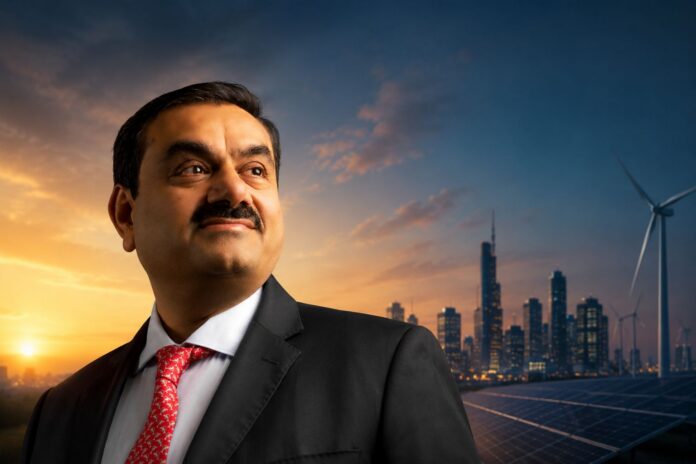
At the Confederation of Indian Industry (CII) Annual Business Summit 2026 in New Delhi, Gautam Adani laid out what he described as the “new geometry of power”, arguing that the future global order will be determined not merely by military or economic strength, but by a nation’s control over energy and artificial intelligence infrastructure.
In a keynote address that blended geopolitics, technology and economic strategy, the Adani Group chairman said the assumptions underpinning globalisation over the past three decades had collapsed, with countries increasingly treating semiconductors, cloud infrastructure and data as strategic national assets rather than neutral commercial tools.
“The world that is emerging is not flat. It is fractured and contested,” Adani said, warning that energy routes, supply chains and digital infrastructure are now deeply tied to national security calculations. He argued that “energy security and digital security” have become the “twin foundations of national power.”
Drawing comparisons between the United States and China, Adani said both powers, despite their differing political systems, have converged on the same strategic objective: reducing dependence on foreign-controlled energy and intelligence infrastructure. He pointed to America’s shale revolution and China’s aggressive renewable energy expansion and AI push as examples of long-term state-backed capability building.
According to Adani, the next defining global contest will centre around control of “compute”, data centres, chips, servers and AI models that increasingly shape economic and strategic influence. “The country that controls its energy will drive its industrial future. The country that controls its computing will drive its future of intelligence. And the country that controls both will shape the century ahead,” he said.
Turning to India’s position, Adani argued that the country possesses a unique advantage because of its scale of domestic demand across manufacturing, mobility, logistics and digital services. He highlighted that India has already crossed 500 gigawatts of installed power capacity and is targeting nearly 2,000 GW by 2047.
However, he cautioned that India’s AI ambitions cannot rely solely on software expertise or outsourced technology services. In one of the speech’s sharper observations, Adani said the traditional Indian IT model was built on “writing code for other people’s platforms”, whereas the AI age would reward those who own the data, compute infrastructure and foundational platforms themselves.
Adani also rejected fears that artificial intelligence would primarily destroy jobs, arguing instead that India should approach AI as a productivity and empowerment tool. Drawing parallels with the rise of UPI and India’s digital payments revolution, he said AI could unlock entirely new markets, companies and business models over the coming decades.
Explaining his vision of the “AI stack”, Adani described three interconnected layers: energy, compute and applications. He stressed that AI should not be viewed merely as software, but as a complete infrastructure ecosystem involving electricity generation, cooling systems, networks, chips, data centres and skilled manpower.
The billionaire industrialist used the platform to highlight the group’s own investments in this space. He reiterated the Adani Group’s $100 billion commitment towards energy transition and digital infrastructure, including the 30-GW renewable energy project at Khavda in Gujarat, projected to become the world’s largest single-site renewable energy plant.
He also announced major investments in sovereign compute infrastructure, including a partnership with Google to develop a gigawatt-scale data centre campus in Visakhapatnam, as well as collaborations with Microsoft and other firms. Adani said another $100 billion commitment had been earmarked for the group’s data centre business.
“India must not rent the infrastructure of its intelligence future. India must build it, power it and own it on its own soil,” he declared, framing AI sovereignty as the next stage of India’s economic and strategic independence.
Reflecting on his personal journey, Adani said he had spent decades building projects “where many saw only impossibility,” from ports constructed on marshlands to power infrastructure in remote regions. He concluded by arguing that the next freedom struggle would not merely be fought at physical borders, but across “grids, data centres, factories, classrooms, laboratories and minds.”
