

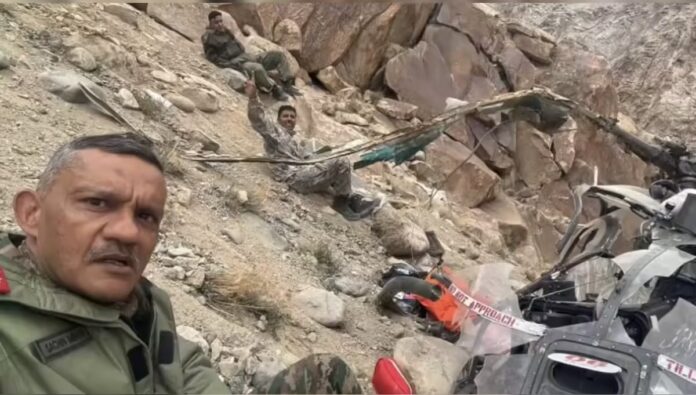
Three senior Indian Army officers narrowly escaped tragedy after a helicopter crash in Ladakh’s rugged Tangste region near Leh, in what many are calling a remarkable survival story amid one of the world’s most unforgiving terrains.
The incident occurred on May 20, though it was officially confirmed only later. The helicopter involved belonged to the Army’s ageing Cheetah fleet and was carrying a high-ranking team comprising a Lieutenant Colonel, a Major, and Major General Sachin Mehta, General Officer Commanding (GOC) of the 3rd Infantry Division.
The single-engine helicopter was being flown by the Lieutenant Colonel and the Major, while Major General Mehta was travelling as a passenger. All three officers sustained injuries in the crash but survived the impact.
Soon after news of the incident surfaced, a photograph from the crash site began circulating widely across social media. The image showed Major General Mehta and the two other officers sitting on rocks beside the wreckage of the severely damaged helicopter. The photograph quickly drew attention, with many describing it as a snapshot of resilience after what could easily have ended in disaster.
Given Ladakh’s harsh mountain terrain, extreme weather conditions and the operational challenges associated with flying at high altitudes, the officers’ survival has been viewed as extraordinary. Authorities have ordered an official inquiry to determine what led to the crash.
Renewed spotlight on the Cheetah fleet
The incident has once again put the spotlight on the Army’s Cheetah helicopters, aircraft that have served India for decades but have increasingly faced scrutiny over safety concerns.
Introduced in the 1970s, the Cheetah helicopters have played a crucial role in military operations, particularly in difficult high-altitude regions. They were instrumental during Operation Meghdoot in 1984, supporting Indian operations in the Siachen Glacier against Pakistan.
Despite their strong legacy and reputation as capable high-altitude platforms, the fleet has been linked to several accidents in recent years, some of which claimed the lives of pilots and military personnel.
The Indian military has already begun replacing the ageing helicopters with newer indigenous platforms. The transition is expected to be led by the Light Utility Helicopter (LUH) developed by Hindustan Aeronautics Limited (HAL), designed specifically for operations in challenging terrains.
Reports indicate that the Army has already placed orders for limited-series production LUHs, which are expected to bring improved safety, operational capability and modern technology to frontline missions.
Even today, the five-seater Cheetah remains respected as one of the world’s most effective helicopters for extreme high-altitude flying. However, the latest Ladakh crash has added urgency to the conversation surrounding its retirement and replacement.
