

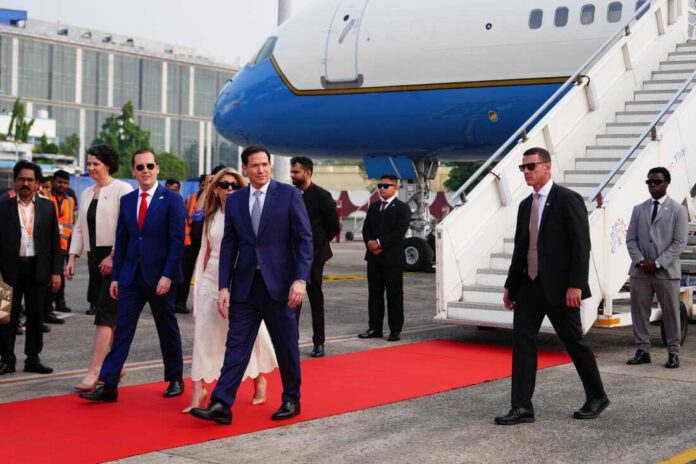
US Secretary of State Marco Rubio has announced a new “America First” visa scheduling tool as part of a wider effort to modernise the functioning of American consulates and make the visa process more targeted and efficient. The announcement came during Rubio’s high-profile four-day diplomatic visit to India, where he emphasised the growing strategic and economic depth of US-India relations.
The newly introduced system aims to prioritise visa appointments for individuals whose travel is considered directly beneficial to American economic and strategic interests. In practical terms, this places business executives, investors, and professionals involved in cross-border commercial activity closer to the front of the queue.
Speaking about the broader relationship between the two countries, Rubio said many of the strongest developments in US-India ties are taking place outside the spotlight. He pointed to expanding business engagement and investment flows as evidence of a partnership that has steadily deepened over time.
#WATCH | Delhi: At the US Embassy Support Annex Building dedication ceremony, US Secretary of State Marco Rubio says, "We're introducing a new America First visa schedule that prioritises business professionals that strengthen these ties. But the facility, as I said, is not just… pic.twitter.com/pkY5nlb6r5
— ANI (@ANI) May 23, 2026
According to Rubio, Indian companies have invested more than $20 billion in the United States, reflecting growing economic interdependence between the two countries. He also highlighted the expanding security partnership, including military cooperation and joint exercises in the Indo-Pacific region.
Rubio argued that cumbersome or unpredictable consular systems can become obstacles to precisely the kinds of exchanges that strengthen bilateral relations. Business visits, investment meetings and strategic partnerships, he suggested, should not be slowed by administrative bottlenecks.
To address that challenge, the new scheduling tool has been built around a simple principle — giving earlier access to those applicants whose work and travel contribute directly to strengthening ties with the United States. This includes professionals travelling to close business deals, expand operations, sign agreements, or represent companies with investment interests in American markets.
However, Rubio said the initiative extends beyond serving visa applicants alone. He also framed the system as an operational upgrade for US diplomatic missions and the staff responsible for handling large volumes of consular work.
Addressing employees at the mission, including consular officers and support personnel, Rubio described them as being on the “front lines” of advancing American national interests on a daily basis.
He said the new system would improve efficiency while also reducing operational costs.
“This facility saved Americans money because it’s going to make us more efficient. It’s going to allow us to do the work we have to do anyway but more accurately, faster, and in a more efficient way,” Rubio said.
The initiative appears to signal a broader shift toward using technology and targeted prioritisation to streamline consular services, while aligning visa administration more closely with Washington’s economic and strategic objectives. For India, where demand for US visas remains among the highest globally, any changes to processing systems could have a significant impact on business travel and investment-linked mobility.
