

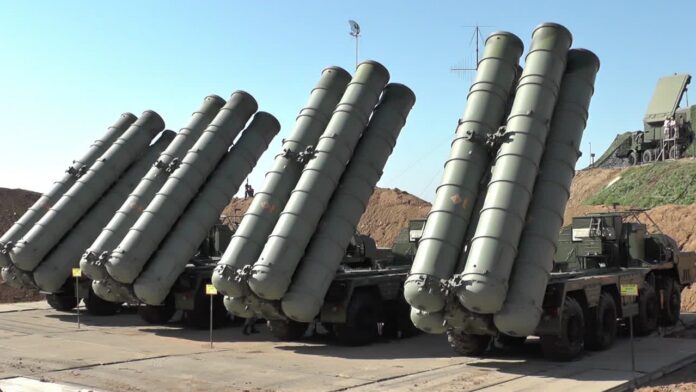
In a significant boost to India’s air defence architecture, the fourth squadron of the Russian-made S-400 ‘Sudarshan Chakra’ missile defence system has arrived in the country and is expected to be deployed at an operational location shortly. The delivery brings India one step closer to completing the landmark 2018 agreement with Russia for five S-400 squadrons, of which three are already deployed and operational.
The arrival of the new squadron comes at a crucial time as India continues to strengthen its ability to counter a wide spectrum of aerial threats across its northern and western fronts. Widely regarded as one of the world’s most capable long-range surface-to-air missile systems, the S-400 can simultaneously detect, track and engage multiple targets, including fighter aircraft, airborne early-warning platforms, cruise missiles, drones and ballistic missiles.
Each S-400 squadron comprises 16 specialised vehicles, including advanced radar systems, command-and-control units and missile launchers. A squadron is organised into two batteries with six launchers each, collectively carrying up to 128 missiles. Under the deal, India has acquired 60 launchers and nearly 6,000 missiles with interception ranges extending from 120 km to 380 km.
India signed the ₹35,000-crore (approximately $5.4 billion) S-400 contract with Russia in 2018. While the first three squadrons were inducted and made operational over the past few years, the delivery schedule was impacted by disruptions caused by the Russia-Ukraine conflict. With the fourth unit now delivered, only one squadron remains pending under the original agreement.
The induction significantly enhances India’s layered air defence network, which is designed to neutralise threats at multiple ranges and altitudes. The S-400’s ability to engage several targets simultaneously and create a large defensive umbrella makes it a critical component of India’s strategic deterrence capability.
India’s plans, however, extend beyond the current order. The Defence Acquisition Council (DAC) has reportedly cleared the procurement of five additional S-400 squadrons, signalling New Delhi’s intent to further expand its long-range air defence coverage.
At the same time, India is pursuing self-reliance in this domain through Project Kusha, an ambitious indigenous long-range air defence programme. The project aims to develop a homegrown system with capabilities comparable to the S-400, capable of intercepting aircraft, missiles and drones at extended ranges. Indian defence firms, including Solar Industries, are involved in the programme as development and production partners.
With the fourth S-400 squadron now on Indian soil and indigenous alternatives progressing simultaneously, India is steadily building a more robust and self-sufficient air defence shield to address emerging security challenges.
