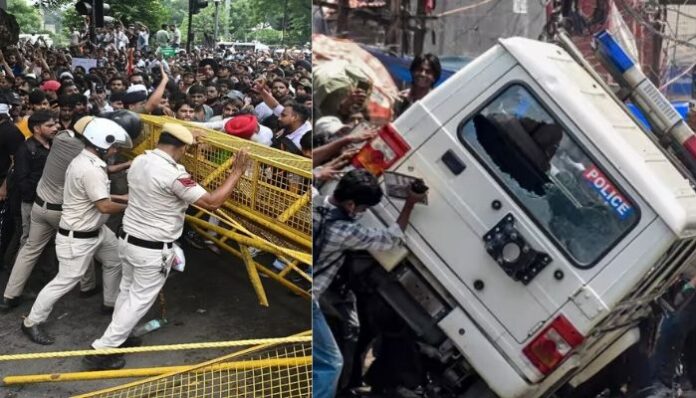
The BJP governments in Bihar and Assam issued notifications on 27th July 2026, stating that all FIRs against Cockroach Janta Party (CJP) protestors seeking the resignation of former Education Minister Dharmendra Pradhan shall be withdrawn.
BJP governments in Bihar and Assam assure withdrawal of all FIRs against CJP protestors
The notifications stated that those detained or arrested shall be released, and no further adverse action will be taken against individuals who participated in protests before 6 pm on 26th July.
“No adverse legal action punitive/retaliatory shall be taken by the Government against any individual participating in the protests before 6 P.M. on 26.07.2026, across the entire state. Also, the legal process for withdrawal of all existing First Information Report (FIRs), criminal complaints or showcause notice against individuals, before 6 P.M. on 26.07.2026 on account of their participations in the said protests, will be initiated immediately,” the notification issued by Bihar government’s Home Department stated.
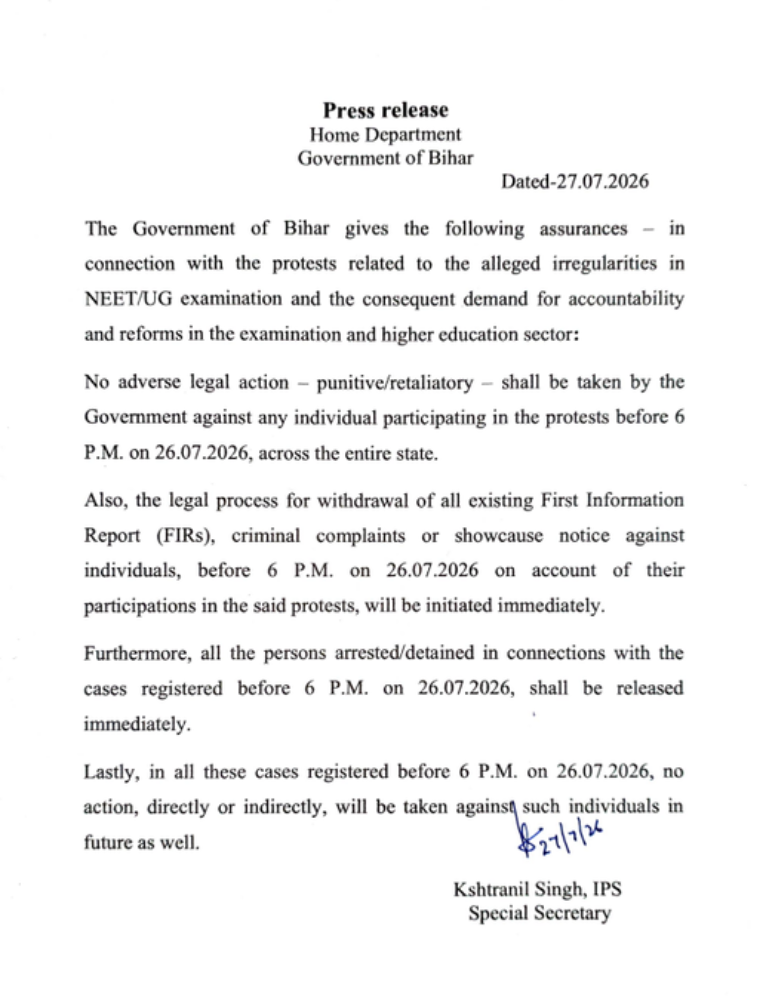
“Furthermore, all the persons arrested/detained in connection with the cases registered before 6 P.M. on 26.07.2026, shall be released immediately. Lastly, in all these cases registered before 6 P.M. on 26.07.2026, no action, directly or indirectly, will be taken against such individuals in future as well,” the notification signed by Special Secretary Kshatranil Singh added.
The Bihar government said its move to withdraw FIRs against CJP protestors was in response to recent agitations demanding accountability and reforms in the examination and higher education sectors.
Notably, the Bihar Police had detained around 694 individuals in connection with protest-related violence, including stone pelting and arson. As per the police, 91 police personnel and 13 civilians were injured, while 15 government vehicles were damaged by CJP protestors. One of the senior police officers lost an eye in the protest violence.
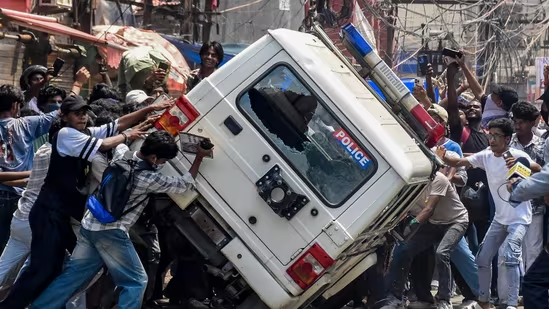
The protests in Bihar were organised by the All-India Students’ Association (AISA) and Revolutionary Youth Association (RYA) in solidarity with the CJP protest in New Delhi.
In a separate press release issued on 28th July, Assam’s Home and Political Department announced that it will withdraw all the cases and other legal proceedings against CJP protestors. The department noted that a total of five cases were registered, and 13 protestors were arrested.
“No adverse legal action will be initiated by any of the Police authorities within the State against those persons who have been involved in these protests. The process for withdrawing the registered cases, irrespective of the stage of the process within the State of Assam, will be initiated as per law promptly,” t
signed by the Additional Chief Secretary to the Govt. of Assam, Home and Political Department, stated.
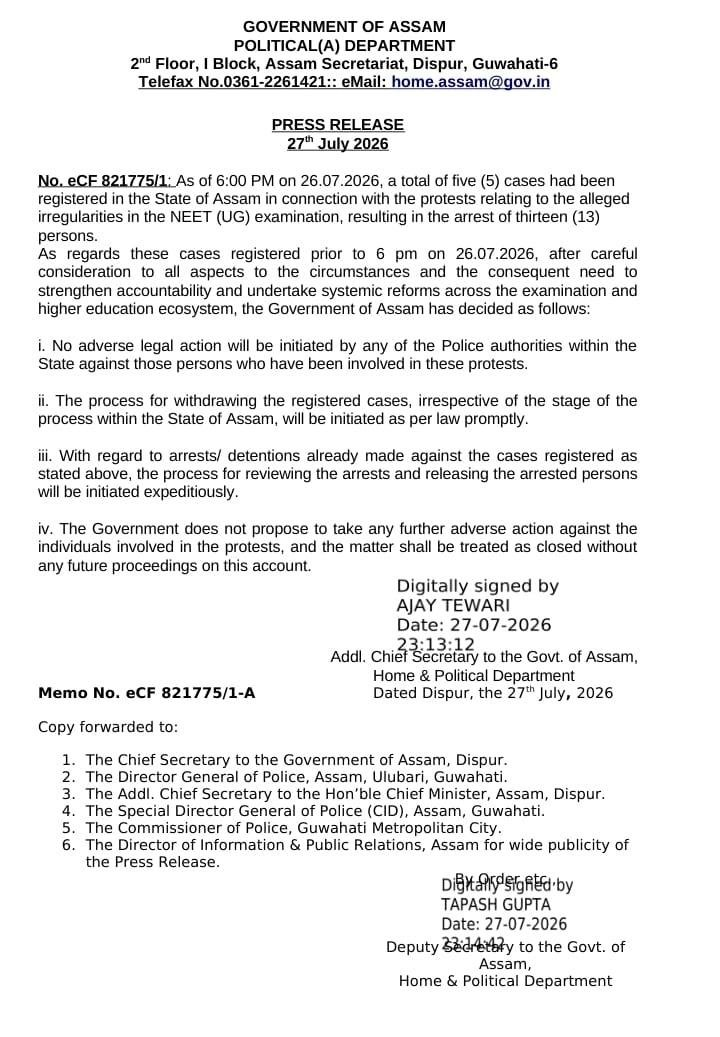
“With regard to arrests/ detentions already made against the cases registered as stated above, the process for reviewing the arrests and releasing the arrested persons will be initiated expeditiously. The Government does not propose to take any further adverse action against the individuals involved in the protests, and the matter shall be treated as closed without any future proceedings on this account,” the press release added.
Meanwhile, CJP chief spokesperson Saurav Das published a video message online, sharing the Assam order and stating that government representatives met CJP leaders and shared copies of Bihar and Assam notifications guaranteeing FIR withdrawals. Das also claimed to have assurances for other BJP-ruled states, including Rajasthan and West Bengal.
#Important: 1 AM update.
— Saurav Das (@SauravDassss) July 27, 2026
Hours after our press conference, Government’s representatives met us. The meeting lasted for 2-3 hours. They shared copies of the Bihar and Assam notifications guaranteeing FIR withdrawals, no action in future, and release of all detainees and… pic.twitter.com/G7WcHHcfAs
The FIR withdrawal assurances from the BJP governments are coming in accordance with the BJP-led Central government’s commitment to the CJP during negotiations for ending the 36-day Jantar Mantar agitation.
The issuance of notifications from the Bihar and Assam governments came right after CJP national spokesperson Ashutosh Ranka claimed that the agreement on no police action was being “breached”. He demanded immediate withdrawal of FIRs against protestors, failing which, he threatened, “We will be forced to sit on protest again”.
Government moves reflect recognition of the sensitivity of the issue, but is the Centre overcompensating for the initial indifference?
It is an undeniable truth that the NEET UG paper leak and broader examination-integrity grievances were genuine. Numerous students and their families faced real distress when the NEET UG paper leak happened in May this year. The most tragic consequence of the lapse was the alleged suicide of over 20 students.
OpIndia has repeatedly emphasised that the Cockroach Janta Party is not an organic or spontaneous movement but an unofficial B-Team of the Aam Aadmi Party, with CJP’s founder Abhijeet Dipke himself being a former AAP functionary. During the protests, it was seen how Samajwadi Party leaders and workers joined the agitation. We have also discussed how the CJP followed the “Laughtivism” playbook wherein non-serious methods and outlook are employed to achieve goals as serious as pushing the government into a lose-lose situation and even pulling off regime change.
However, when the CJP picked up the NEET paper leak issue, it essentially picked up an issue strong enough to rally the support of a significant number of students across the country. While the CJP expanded its tentacles from social media to the ground, the Central government remained indifferent towards the protest, though not towards the paper leak issue itself.
The accused persons involved in the NEET UG paper leak were arrested, fresh exams were announced and conducted without any major lapses, and results were declared within the announced timeline. However, the CJP’s protest and climate activist Sonam Wangchuk’s hunger strike overshadowed the government’s efforts.
It is a popular opinion that if former Education Minister Dharmendra Pradhan had resigned in May itself, things would not have magnified to this extent. Dharmendra Pradhan’s resignation or not, the Central government’s deliberate refusal to even acknowledge Wangchuk’s weeks-long hunger strike and the CJP protest until 19th July backfired monumentally. Now, the government appears to be overcompensating for the initial indifference by accepting any and every demand the CJP is pushing, just to secure a permanent end to the agitation.
There is no doubt the Modi government has recognised the scale of outrage and hurt through the Education Minister’s resignation, commitment to provide compensation, and most importantly, the anti-paper leak bill.
Perhaps, a genuine sympathy for the protestors may also have driven the government. However, withdrawing FIRs against and committing no punitive action in future against violent protestors sets out a very bad precedent.
Setting violent CJP protestors free for the sake of ending the protest: BJP governments are setting a bad precedent
The near-blanket withdrawal of FIRs against violent CJP protestors, and written assurances, may indicate to critics and the Opposition that the Modi government is on the backfoot. However, it is worth remembering that law and order and the burden of maintaining peace also lie on the government in office.
Whether the ‘backfoot’ will really translate to emboldening anarchist elements under a government that has a stellar internal security record, or will actually be some much-needed breathing room during the Monsoon Session so more attention is focused on governance, rather than outrage and street violence, remains to be seen.
By giving written FIR rollback assurances in the face of the CJP’s ‘ultimatum’, the government, however, is inadvertently setting a precedent that sustained disruptions and street violence under the garb of fighting for a genuine issue are enough to arm-twist a government into accepting their demands while also allowing their violence and their perpetrators to roam free.
It must not be forgotten that peaceful protest is a democratic right and an important pressure valve. However, when that very peaceful protest turns violent, it automatically enters the rioting territory.
Today, the Central government and BJP governments in Bihar and Assam are taking back FIRs against violent protestors as a quick fix to the ‘cockroach’ menace and to restore order. However, these concessions will risk emboldening the anarchic elements, especially politically and ideologically driven entities, who remain perpetually unsatiated until the ouster of the perceived adversarial government.
From the 2021 Farmers’ Protest to the 2026 CJP protests, the Centre has tackled many violent street protests that aim to normalise the idea that street veto can override law enforcement and prosecutorial discretion.
It is the responsibility of the government and the police department to segregate peaceful protestors from those who indulged in violence and vandalism. The imperative to restore peace and normalcy cannot be fulfilled at the cost of sidelining due process.
Pertinently, the Delhi Police have revealed that it verified the backgrounds of 2,873 individuals involved in the CJP’s ‘Chalo Sansad’ protests and found that all of them had criminal antecedents. Of these, 989 had previously been involved in serious criminal cases, including murder, attempted murder, robbery, rape, kidnapping, crimes against women, illegal arms offences, and narcotics-related offences.
There is a possibility that similar findings may emerge in the case of detained protestors in Bihar, Assam, and other BJP-ruled states. However, the governments in these states chose to treat the violent protestors as part of the undifferentiated bloc of ‘student protestors’ that must receive collective amnesty, regardless of their violent and anarchic shenanigans.
It is no exaggeration to say that regardless of the intentions, the BJP-led governments in the Centre and across various states appear to be handing a license to unruly elements to mobilise, weaponise prolonged occupation of public spaces, resort to violence and vandalism, and trivialise the authority of elected governments, police and courts, to hold the Republic hostage.
Now, due to the government’s suicidal extension of amnesty to violent anarchists, those who assaulted police officials, damaged government vehicles and damaged public property under the garb of ‘peaceful protests’ will most likely walk free.
Sensitivity towards Gen-Z demands is understandable; however, there is a serious need for the Central government to prevent the establishment of this problematic precedent. The Republic cannot afford to allow lawlessness to masquerade as freedom. If the rioters of the 2020 anti-Hindu Delhi Riots faced the law, the same should happen with the anarchists of CJP protests.
Ironically, the CJP wants accountability from the Central government for the NEET paper leak and broader exam irregularities and has even secured the resignation of Dharmendra Pradhan. However, the CJP does not want its ‘cockroaches’ to appear for the test of accountability for indulging in violence, vandalism and hooliganism in the name of ‘student protest’.