

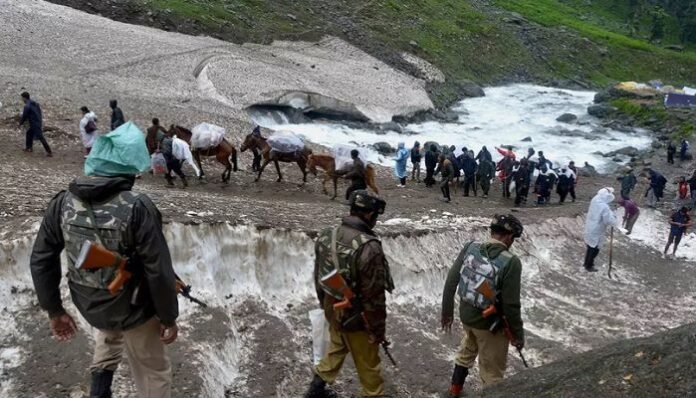
The annual Amarnath Yatra is set to begin on 3rd July, and authorities have put in place one of the most extensive security arrangements ever seen for the pilgrimage. With lakhs of devotees expected to travel to the holy cave shrine in the Himalayas over the next two months, security agencies have rolled out a multi-layered security grid covering the entire route from Jammu to the shrine through both the Pahalgam and Baltal tracks.
The yatra will continue until 28th August, and officials say every possible step is being taken to ensure the safety of pilgrims. The arrangements include real-time surveillance, watch towers, vehicle monitoring systems, restricted airspace and tighter checks on service providers associated with the pilgrimage.
#WATCH | Jammu: As part of a security mock drill, the National Security Guard (NSG), the Special Operations Group (SOG) of the Jammu and Kashmir Police, and the CRPF conducted a combing and clearing operation at the Amarnath base camp in Jammu.
— ANI (@ANI) June 23, 2026
The Holy Shri Amarnath Ji Yatra… pic.twitter.com/sM87udFWju
Massive security cover across Yatra routes
Although security agencies have said there are no specific intelligence inputs about any threat to the pilgrimage, authorities are not taking any chances. The security setup has been significantly strengthened following last year’s terror attack on tourists in the Baisaran Valley near Pahalgam.
Thousands of security personnel from multiple agencies have been deployed along the routes. Electronic surveillance systems have been installed at strategic locations, while CCTV cameras will continuously monitor the movement of pilgrims and vehicles.
Officials said the government has also declared the entire Amarnath Yatra route a no-fly zone. As a result, helicopter services to the shrine will remain suspended for the second consecutive year. The decision has been taken as part of the broader security strategy aimed at preventing any potential threat from the air.
Authorities will monitor pilgrim convoys in real time through an integrated surveillance network. RFID tags have also been issued to pilgrims, vehicles and service providers to track movement and improve security management.
New QR-Code identity cards for service providers
For the first time, Jammu and Kashmir Police have introduced QR-code-based tamper-proof identity cards for pony riders and other service providers involved in the pilgrimage.
Officials say the move is aimed at preventing terrorists from disguising themselves as workers serving pilgrims.
“The cards, when scanned, will provide complete information about the service provider,” a police officer said. “This is essential to stop terrorists from disguising themselves as pony riders or other service providers.”
Security agencies believe the digital verification system will make it easier to identify genuine workers and quickly detect any suspicious individual attempting to infiltrate the pilgrimage routes.
Watch towers, mock drill and surveillance
Police have also constructed high-rise watch towers and observation posts, known locally as “Machan Morchas,” at several sensitive locations along the route.
Over the past week, Jammu and Kashmir Police and other security agencies have been carrying out mock drills and surveillance exercises to prepare personnel for emergency situations. These drills are intended to improve coordination and ensure a quick response in case of any security incident.
Traffic restrictions announced
Authorities have also issued a detailed traffic plan for the duration of the yatra. Pilgrims have been asked to strictly follow designated travel timings and routes.
To facilitate smooth movement of pilgrim convoys, restrictions have been imposed on civilian traffic along certain stretches of the Srinagar-Jammu National Highway. According to the advisory, civilian vehicles travelling towards the Valley from Jammu will not be allowed to depart before 11:30 am. Similarly, vehicles moving towards Srinagar will not be permitted to cross the Banihal-Qazigund tunnel after 3 pm.
Similar restrictions have been enforced on important roads within the Valley as well.
Director General of Police Nalin Prabhat has stressed the need for stronger coordination among all agencies involved in the operation. Officials say continuous intelligence sharing and close cooperation between security forces will be key to ensuring that the pilgrimage is completed safely and peacefully.
