

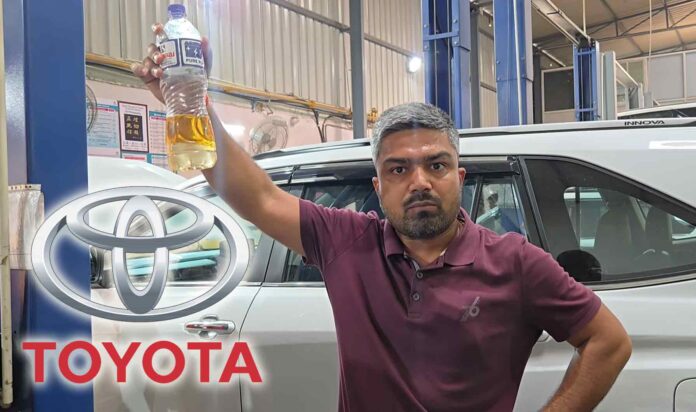
Toyota Kirloskar Motor has issued an official statement denying the claims by Bihar-based YouTuber and journalist Manish Kashyap that his new Toyota Innova Hycross was damaged due to the use of E20 Petrol. The company has said that the car is fully compatible with petrol blended with 20% ethanol, and it didn’t cause any serious engine damage as claimed by Kashyap. Toyota also revealed that the car was affected by the use of contaminated fuel, not E20.
The clarification came after a viral video uploaded by Manish Kashyap triggered fresh debate on social media about E20 ethanol-blended petrol in India. In the widely circulated clips, Kashyap alleged that his new Toyota Innova Hycross, despite being officially marked as compatible with up to E20 fuel on the filler cap, suffered serious engine troubles including vibrations, knocking and breakdown-like symptoms after barely 12,000 kilometres. He claimed the problems began after he started using E20 petrol, In the videos, he displayed fuel samples drained from the tank and fuel lines that showed visible dirt, debris and what he described as abnormal ethanol content.
The YouTuber also questioned the quality of fuel at pumps while criticising the government’s ethanol-blending programme and asking who should be held accountable, the fuel station, refinery, vehicle maker or policymakers. Kashyap also repeatedly criticised Union Minister for Road Transport and Highways Nitin Gadkari. He argued that consumers should have the option of purchasing regular petrol instead of only E20-blended fuel and questioned who would be responsible if a vehicle develops fuel-related issues.
After the videos went viral, Toyota Kirloskar Motor (TKM) has issued the detailed official clarification, firmly rejecting any link between the reported issue and E20 fuel. The company stated that the Toyota Innova Hycross in question is a fully E20-compatible vehicle that has been designed, tested and certified for the use of ethanol-blended petrol.
As per the statement, a thorough technical assessment by the company’s service team confirmed that the vehicle suffered no damage whatsoever to any component or its fuel system. The problem was traced solely to non-standard and contaminated fuel, not E20. As per standard protocol, the fuel tank and lines were drained, thoroughly cleaned and the vehicle was refilled with standard E20 petrol. After inspection, the Innova Hycross was found to be operating normally and was handed back to the customer in perfect condition, the company stated.
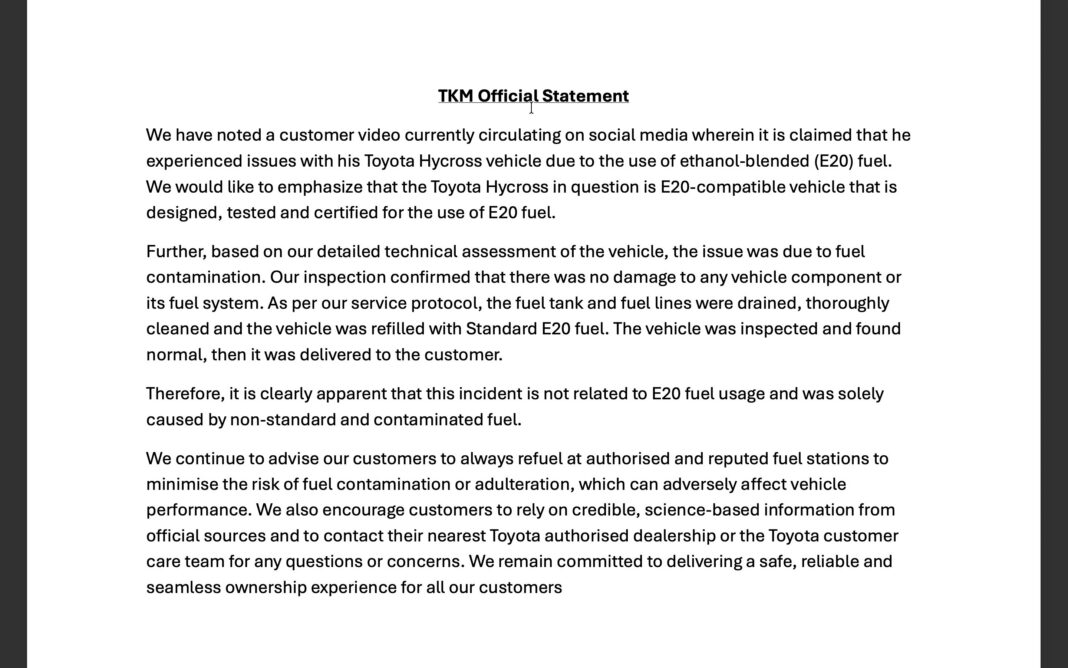
“Therefore, it is clearly apparent that this incident is not related to E20 fuel usage and was solely caused by non-standard and contaminated fuel,” said the company.
Toyota advised all customers to refuel only at authorised and reputed fuel stations to avoid risks of contamination or adulteration, which can harm vehicle performance. It has urged owners to depend on credible, science-based information from official sources and to contact their nearest Toyota dealership or customer care team for any concerns. TKM has reaffirmed its commitment to ensuring a safe, reliable and seamless ownership experience for every customer.
This clarification comes amid a noticeable surge in similar claims and propaganda circulating on social media against the E20 fuel rollout across India. Despite multiple automakers confirming that their E20-certified models are fully compatible and government tests showing only marginal effects on mileage with no widespread component damage, unverified videos and posts continue to create unnecessary alarm among vehicle owners. In the present case, Toyota’s technical findings have once again demonstrated that proper fuel quality, rather than the ethanol blend itself, remains the key factor in vehicle health.
