

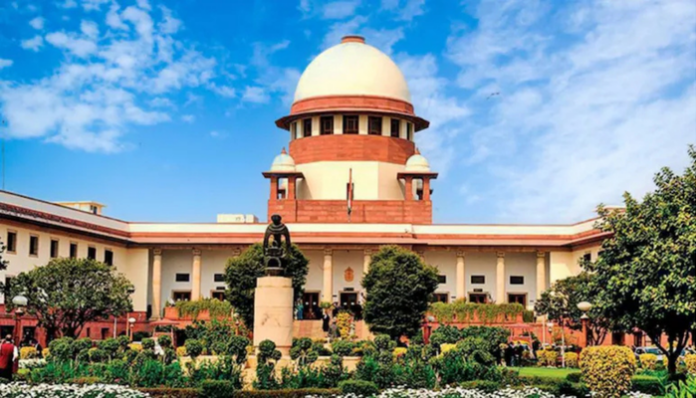
The Supreme Court on Thursday (9th July) stayed criminal proceedings against a man accused of forcing a family in Madhya Pradesh to convert to Islam. A Bench of Justice Manoj Misra and Justice Shree Chandrashekhar, sitting during the Court’s partial working days, passed the interim order in a petition filed by the man challenging the High Court’s decision refusing to interfere with an FIR registered against him.
The FIR was lodged in 2023 under Sections 3 and 5 of the Madhya Pradesh Freedom of Religion Act and Section 506 and 34 of the Indian Penal Code at Jeerapur police station in Rajgarh district.
The FIR was filed against the accused Hemraj Tailor by the wife of the complainant. She stated in the FIR that her husband converted to Islam about 8 years ago after being motivated by the petitioner. She held the petitioner responsible for the religious conversion of her minor son as well. The complainant said that for the past one-and-a-half years, she and her family have also been subjected to continuous pressure to convert. She accused the petitioner of having personally urged her to accept Islam.
Opposing the FIR against him, the petitioner argued that the FIR was filed after a delay of 8 years. He pointed out before the Apex Court that he himself, along with his family, professes the Hindu religion. He said that there was no material linking him to the conversion of the complainant’s husband and her minor son.
Background of the case
In April this year, the Madhya Pradesh High Court dismissed Tailor’s petition filed under Section 528 of the Bharatiya Nagarik Suraksha Sanhita, 2023, seeking quashing of the FIR. The High Court declined to interfere, noting that the statements of the complainant and her minor son disclosed a prima facie case against him. The court said that the allegations against Tailor were serious and should be tried, adding that continuation of proceedings in the matter could not be treated as an abuse of the process of law.
The petitioner subsequently approached the Supreme Court seeking a stay on the criminal proceedings against him.
