

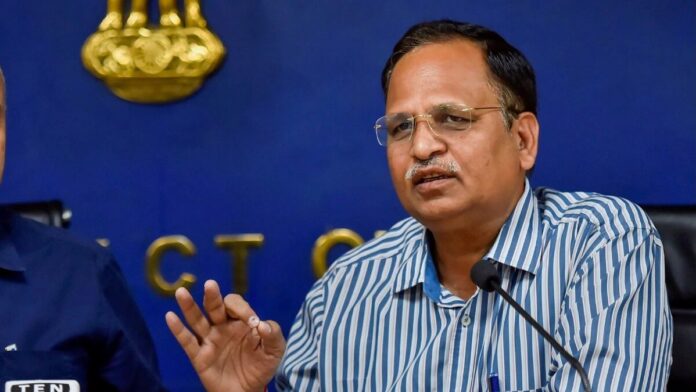
Former Delhi minister and Aam Aadmi Party (AAP) leader Satyendar Jain was granted bail by a Delhi court on Thursday in connection with the Delhi Jal Board (DJB) sewage treatment plant (STP) tender irregularities case.
Special Judge Dig Vinay Singh of the Rouse Avenue Court directed Jain to furnish a personal bond of Rs 2 lakh along with two sureties of the same amount. Jain, who was arrested by the Anti-Corruption Branch (ACB), had been in judicial custody along with five other accused in the case.
The court’s decision came after detailed arguments on Jain’s bail application. The matter was previously heard on August 25, when Jain was present before the court.
Defence challenges necessity of arrest
Appearing for Jain, senior advocate N Hariharan, assisted by advocate Vivek Jain, argued that the ACB had arrested the former minister nearly 27 months after registering the case in May 2024.
The defence contended that such a delay itself raised questions over the necessity of arrest at this stage. It submitted that Jain had cooperated with the investigation and therefore there was no justification for keeping him in custody.
Another key argument made by the defence concerned the origin of the ACB case. According to Jain’s lawyers, the FIR was registered on the basis of information received from the Enforcement Directorate (ED). The defence maintained that there was, however, no money trail linking Jain to any proceeds of crime in the related money-laundering proceedings.
Jain’s lawyers also challenged the ACB’s allegations concerning the expansion of the Rohini STP.
The defence said the proposal to increase the plant’s capacity from 15 million gallons per day (MGD) to 25 MGD had been recommended by a technical committee. It further argued that the plant’s peak capacity was around 30 MGD.
The lawyers maintained that the decisions under scrutiny were essentially matters of policy and technical assessment. They argued that courts should be cautious about substituting their own assessment for decisions taken in matters involving public policy and technical requirements.
The defence also told the court that Jain was neither a flight risk nor in a position to interfere with the investigation, and that appropriate bail conditions could ensure his presence whenever required.
It further pointed out that none of the accused had been arrested in the ED proceedings.
ACB opposes bail
The ACB opposed Jain’s bail application, with Public Prosecutor Manish Rawat arguing that the investigation was still at an early stage.
The prosecution alleged that Jain had not fully cooperated with the probe and claimed that investigators had gathered material linking him to the irregularities.
Responding to the ACB’s contention that the investigation was at an initial stage, the defence argued that the probe could not reasonably be described as being in its infancy when the FIR had been registered more than two years earlier.
Jain’s lawyers also argued that several documents cited by the ACB had originally been obtained from the ED and reiterated their position that the allegations did not attract provisions of the Prevention of Corruption Act.
What is the Delhi Jal Board tender case?
The ACB’s case centres on irregularities in tenders relating to the augmentation and operation of sewage treatment plants in Delhi.
According to the agency, the technical proposal concerning the Rohini STP was altered during the decision-making process. The ACB alleges that the plant’s proposed capacity was increased from 15 MGD to 30 MGD despite the absence of a fresh technical recommendation or feasibility study supporting the change.
The agency has also questioned the inclusion of the Rohini and Narela STPs in the project and the exclusion of the Okhla Phase-V STP. It has estimated that these decisions resulted in an additional financial burden of approximately Rs 123 crore.
The ACB has characterised the decisions as arbitrary and alleged that they lacked sufficient technical justification.
Manipulation of tender conditions
A major component of the investigation involves allegations that the tender conditions were modified in a manner that benefited M/s Eurotech.
The ACB has alleged that the changes enabled Eurotech to emerge as the sole technology supplier for Integrated Fixed-film Activated Sludge (IFAS) technology with fixed media under the STP tender.
The agency has further alleged that Rajkumar Kurra, Nagendra Yadav and certain DJB officials were involved in a nexus designed to secure undue benefits for Eurotech through changes to the tender requirements.
According to the ACB, Jain’s involvement and connivance in the process emerged during the investigation.
The allegations have not been established as guilt against Jain or the other accused, and they will be tested during the legal proceedings.
Kickback trail
The ACB has also alleged that Vinod Chauhan acted as an intermediary in the tender process and facilitated work favouring a particular technology provider in exchange for funds.
Investigators allege that money was routed to Srijanhar Enterprises, a proprietorship firm owned by Pankaj Verma, who is described by the agency as Chauhan’s nephew.
The ACB has alleged that Chauhan received Rs 81 lakh from Dhanvine Engineering and claimed that the amount represented a kickback originating from Eurotech.
The agency has also referred to an agreement dated December 22, 2021, between Eurotech and Srijanhar Enterprises. Under the arrangement, Srijanhar Enterprises was appointed as an authorised marketing agent for Eurotech’s products and was to receive a three per cent commission on payments received by Eurotech from DJB tender-related works.
According to investigators, however, the firm did not actually undertake the work contemplated under the agreement. The ACB has alleged that the arrangement was merely a front for receiving commissions or bribes.
Investigators have also cited communications recovered from Nagendra Yadav’s mobile phone. According to the agency, on May 7, 2022, Chauhan sent Yadav details of a hawala operator through WhatsApp. Yadav forwarded the information to Rajkumar Kurra later the same day.
Jain’s bail does not end the case
Jain’s release on bail does not amount to a finding on the merits of the allegations against him. The ACB’s allegations, including those concerning tender manipulation, financial transactions and the role of various accused persons, remain subject to judicial scrutiny.
The case is part of a wider investigation into corruption surrounding DJB contracts. With the court granting Jain bail while the proceedings continue, the former minister will now face the case from outside judicial custody, subject to the conditions imposed by the court.
