

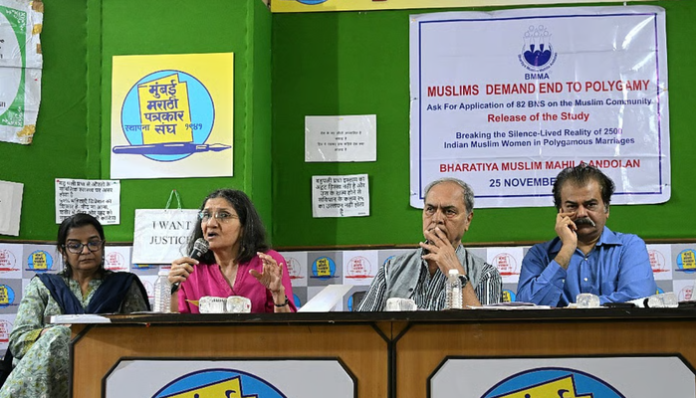
A recent survey conducted by the Bharatiya Muslim Mahila Andolan (BMMA) highlighted growing anger among Muslim women against polygamy practised by Muslim men. The findings of the study, conducted on around 2500 Sunni Muslim women in polygamous marriages, were released by the BMMA on Tuesday (25th November) in Mumbai during a press briefing. The study titled ‘Breaking the Silence: Lived Reality of 2500 Muslim Women in Polygamous Marriages’ revealed that about 85% of the women participants wanted the regressive practice to be abolished, while around 87% of them wanted polygamy among Muslims to be criminalised under Section 82 of the Bharatiya Nyay Samhita. Around 93% of women said they wanted a legal ban on child marriage.
It is notable here that marriage of girls under 18 is banned under Indian law, but Islamic law allows marriage for girls after the girl has attained puberty.
Muslim women in polygamous marriages face mental and physical health issues
The survey found that polygamous marriages adversely affected the mental and physical health of the Muslim women and children involved, with the first wives suffering more. Around 36% of first wives and about 22% of second wives were found to be dealing with stress and anxiety. Many women in polygamous marriages had health issues, including menstrual problems and thyroid complications.
The study highlighted that nearly one-fifth of the polygamous relationships had women who were married before the age of 18. Nearly 20% of these women married before they turned 18. This indicates that a large chunk of polygamous marriages are child marriages.
Most of the victims of polygamous marriages are women from low-income and low-education backgrounds
Most of these women came from low-income and low-education backgrounds, due to which they remained stuck in their polygamous marriages. As per the survey, one in five women involved in polygamous marriages never went to school, and about 59% of Muslim women in polygamous marriages have an education at or below the secondary school level. Nearly 60% of Muslim men in polygamous marriages had a formal education of 10 years or less.
Since the survey was conducted on women coming from the low-education and under-employed sections of the Muslim community, the BMMA said it was suggestive of the fact that polygamy was more prevalent in this section. However, Zakia Soman, BMMA founder, who co-authored the study along with Noorjehan Safia Naaz, co-founder of the organisation, stated that based on examples, it is possible to deduce that women from economically well-off families are caught in similar situations. As per the survey findings, 79% of Muslim women in polygamous marriages had no income at the time of marriage, and 84% of first wives had no income after marriage.
Role of religion in polygamous marriages
The survey also highlighted the role of religion in the prevalence of polygamous marriages among Muslims. It showed that 30% of Muslim men in polygamous marriages justified their second marriage in the name of Islam. Over 36% of the first wives in such marriages said that they did not receive any financial support from their husbands after they married again. Ironically, about 61% of first wives did not receive Mehr, a payment mandated under Islam, but 32% paid dowry, a practice not mentioned in the religion.
Around 94% of the Muslim women taking part in the survey said that they did sign the nikahnama, but around 83% said that they did not read the document, while nearly 38% said that they are not aware of the whereabouts of the document. In 88% of the cases, husbands did not seek the permission of their first wives before contracting a second marriage. About 20% of Muslim men remarried within 3 to 5 years of their first marriage, and 54% of Muslim men did not live with their first wives after performing second marriages. Moreover, around 40% of first wives were getting financial support from their parents.
Testimonies of victims of polygamous marriages
One of the participants of the survey, named Tasneem, was also present during the media briefing. Tasneem, a victim of triple talaq, broke down while narrating her ordeal. She said that she was forced to leave her matrimonial home after her husband divorced her unilaterally, while she was pregnant with a third child. “My husband called me back from my parents’ home, and after one year of peace, I was physically abused and called mad,” said Tasneem.
Another participant, named Husna, said that her husband forged a divorce document and threw her out of her matrimonial home along with her three children. She now works as a domestic help. “I want a law that prohibits a man from having multiple marriages. A woman should not be forced to live with the husband’s second wife,” said Husna.
The BMMA said that during the survey, they came across men earning as much as ₹10,000 a month and living with two wives and children from both women. “Those who take recourse to religion to justify polygamy do not know that the book also says that couples do not have to live together if there is no compatibility,” said a BMMA volunteer. “One man, with his limited understanding of religion, is abusing several women,” said Nargis, who works with the BMMA. She added that even the police are hesitant to help in cases of polygamous marriages, and they tell the victims that it is allowed in their religion.
Polygamy not encouraged by religion: Zakia Soman
Explaining the concept of polygamy, Zakia Soman said that the practice may have been common in an era when mortality among men was high due to frequent wars. “Though the custom is allowed by religious texts, it is not encouraged. We are asked: why cannot a man have several wives if he is financially capable of doing so? Our answer is: we have a problem with this because men and women are equal. Data show that there is a similar prevalence of polygamy among Hindus. However, while Hindu women have recourse to law, Muslim women do not,” said Soman.
Indian Muslims for Secular Democracy member, Firoze Mithiborwala, said that the call for ending polygamy is coming from within the Muslim community and not from a fringe group.
