

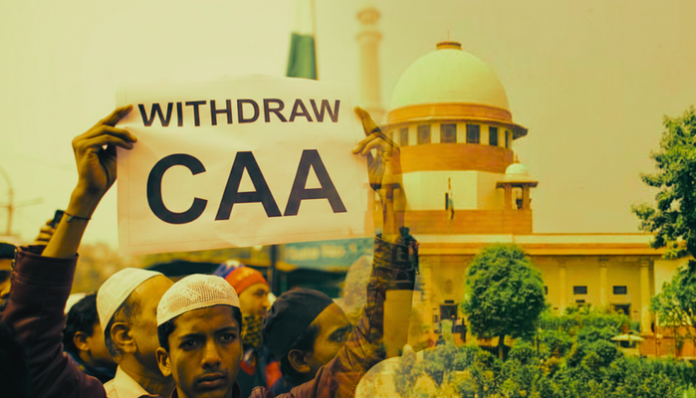
The Supreme Court on Thursday (19th February) fixed May 5, 2026, as the date for the commencement of the final hearing in the petitions challenging the Citizenship Amendment Act (CAA) and Rules. A bench of Chief Justice of India (CJI) Surya Kant and Justices Joymalya Bagchi and Vipul M Pancholi set the date, which means the hearing would begin after the assembly elections in the poll-bound states of Assam, West Bengal, Kerala and Tamil Nadu and the Union Territory of Puducherry.
The bench categorised the petitions filed against the CAA into two groups- those filed from Assam-Tripura and those filed from the rest of the country. It, then, fixed May 6 and May 6 for hearing the petitioners, May 7 for respondents and May 12 for rejoinder. “There are two sets of cases assailing CAA 2019. These matters were categorised into two groups: Assam-Tripura and the rest of the country. The nodal counsels appointed will identify the matters falling in the first and second group, and the list shall be submitted to the registry in two weeks. Registry shall thereafter segregate into two categories, and the same shall be listed on seriatum for final hearing in the week commencing May 5, 2026. Petitioners shall be heard on the first half of May 5, and then another half on May 6 for petitioners and then half a day on May 7 for respondents and rejoinder on May 12,” the court noted in its order.
The proceedings in the petitions have been pending before the Supreme Court for nearly years, since 2019–2020. 243 petitions have been filed before the Apex Court challenging the CAA, which aims to grant citizenship to Hindus, Jains, Christians, Sikhs, Buddhists, and Parsis who arrived in India on or before December 31, 2014, from Bangladesh, Pakistan, and Afghanistan. The law was passed by the Parliament on December 11, 2019 and was granted assent by the President the next day. On December 12, 2019, the Indian Union Muslim League (IUML) moved the Supreme Court against the law, following which a slew of petitions were filed.
The CAA amended Section 2 of the Citizenship Act of 1955, which defines “illegal migrants”, and added a provisio to Section 2(1)(b) of the Act. It provided that persons belonging to Hindu, Sikh, Buddhist, Jain, Parsi or Christian communities from Afghanistan, Bangladesh or Pakistan, and who have been exempted by the Central government under the Passport (Entry into India) Act, 1920, or the Foreigners Act, 1946, shall not be treated as “illegal migrant”. As a result, the said persons became eligible to apply for citizenship under the 1955 Act. The law was passed with the aim of protecting minorities facing persecution in the three Islamic countries.
However, since the law did not include the Muslim community, it outraged certain vested groups as well as opposition leaders. As a result, massive protests were organised across the country, and several petitions were filed in the Supreme Court. The petitioners claimed that the CAA discriminated against the Muslim community on the basis of religion and violated the right to equality under Article 14 of the Constitution.
