

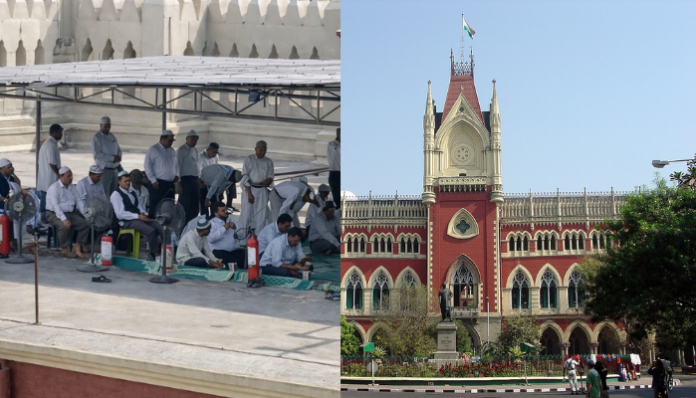
A small room on the rooftop of the Calcutta High Court was found to contain Islamic religious books, reading material, mattresses, chairs and other belongings during an inspection ordered by the court. The keys to the locked room were held by advocate Ezaz Hossain, raising questions as to why they were not in the custody of the High Court administration.
The court has now directed Hossain to explain how the keys to the room came into his possession. It also asked its Security Committee to review the security arrangements and the system for keeping keys to rooms and other parts of the High Court building.
Images shared by journalist Swati Goel Sharma show Muslims in skull caps offering Namaz on the rooftop of the Calcutta High Court.
The court ordered an inspection to check if prayers were held on rooftop
The matter came up before a Division Bench of Chief Justice Ravindra V. Ghuge and Justice Om Narayan Rai while hearing a public interest litigation (PIL) filed by Sanjay Ghosh. The petition raised concerns about the use of the rooftop of the Calcutta High Court building.
In an order dated September 30, the Bench had asked the High Court Registry to inspect the rooftop and find out whether Muslims persons professing the Mohammedan religion were offering prayers at the location and, if so, how frequently prayers were held during the daytime.
Following the court’s directions, the Registry carried out an inspection and submitted a report with colour photographs. The report stated that there was a small room containing Islamic religious books and literature.
Islamic religious books and other belongings found inside room
According to the inspection report, the room had two wooden gates, both of which were locked. When the Registry asked about the keys, it found that they were with advocate Ezaz Hossain, who occupies Bar Association Room No. 12.
Hossain later reached the spot along with three other advocates, after which the locked room was opened for inspection.
Inside, the officials found religious literature related to Islam, along with mattresses, plastic chairs, stand fans, a cupboard and other belongings. Buckets, tubs, water pitchers and a basket containing slippers were also found in the room.
The presence of religious books and other items led the court to take note of the room’s use. However, the Registry’s report did not confirm that a mosque existed on the rooftop or establish whether regular prayers were being held there.
Court questions how advocate got custody of keys
The Bench expressed surprise that the keys to the locked room were being kept by a practising advocate rather than the High Court administration.
The court pointed out that the keys to rooms, doors, court halls, staircases and other parts of the court premises should remain in the custody of the High Court administration.
It also noted that security arrangements for the court premises, buildings and tower were managed under the supervision and directions of the administration. A Security Committee consisting of serving High Court judges had also been formed to look into such matters.
The court has directed the petitioner to provide a copy of its order to Hossain. He will have to explain how the keys to both locked doors of the rooftop room came into his possession.
Security committee asked to review arrangements
The Bench also directed the High Court Registry to place copies of the latest order and the September 30 order before the High Court’s Security Committee.
The committee has been asked to provide guidance on security measures for the court premises, including the custody of keys to the rooftop room and other parts of the building.
The court’s inquiry concerns the use of the rooftop room, the religious literature and other belongings found inside it, and why the keys were held by an advocate rather than the High Court administration.
