

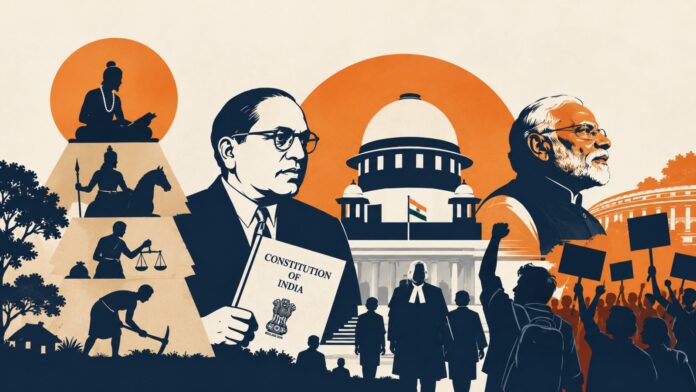
Few issues have shaped India’s political and social landscape as persistently as caste-based reservation. What began as an effort to address unequal access to education and employment has evolved into a complex debate over historical injustice, representation, constitutional rights and political power.
Understanding this journey requires looking beyond independent India and B.R. Ambedkar to the social transformations of the nineteenth century, the policies of British colonial rule and the pioneering reforms of India’s princely states, because caste-based reservations started there, not in Independent India. Reservations are older than our constitution.
The roots of social inequality obviously lie in the varna-jati system, which historically linked social identity and occupations to birth. Yet its evolution was neither uniform nor unchanging. Birth-based occupations were not unique to ancient India either. In an age with no industries as we know today and no economic system as evolved as today’s, societies everywhere chose a system that was birth-based. It was probably the simplest way to give people a role and a livelihood. India was no exception, where it was doing something particularly atrocious. Different regions, religious traditions and historical periods developed different practices. Caste discrimination and exclusion became serious realities, but the relationship between religious prescriptions, economic opportunities and social inequality remains contested. Colonialism introduced another powerful force, reshaping institutions and determining which communities could access emerging opportunities.
Jyotirao Phule, a wealthy contractor, builder and merchant, became one of the earliest influential critics of caste inequality in nineteenth-century Maharashtra. Appearing before the Hunter Education Commission in 1882, he challenged Brahmin dominance in government employment and modern education. He demanded greater educational opportunities and official appointments for non-Brahmin communities, arguing that if the British educated the Shudras instead of the Brahmins and put them in important jobs, those communities would remain loyal to the Raj.
Employment data from that period does show Brahmin dominance, especially in the Bombay and Madras Presidencies. In the Bombay Presidency in 1886, Brahmins occupied 211 of 328 judicial and executive positions available to Indians. They also constituted approximately 66% of college students in 1875. Yet the pattern differed across regions, with Kayasthas occupying prominent positions in Bengal. But was it the whole truth? Far from it.
An alternative perspective emerges from Dharampal’s research into indigenous education, which documents substantial non-Brahmin participation in several early nineteenth-century schools. In the indigenous schools across almost every part of India, children of all castes, including jatis belonging to the Shudra varna, studied together. In nearly all these schools, students from non-Brahmin castes were found to be in the majority. No Brahmin monopoly is reflected in the data captured by this book.
Reservation first became official in 1902, when Chhatrapati Shahu Maharaj of Kolhapur introduced 50% reservation for backward communities in government employment. The reform followed the Vedokta controversy, in which a palace priest refused to recognise Shahu’s Kshatriya status for Vedic rituals. His confrontation with caste privilege helped transform demands for social recognition into government policy.
Reservation subsequently spread to Mysore and the Madras Presidency. Krishnaraja Wadiyar IV introduced measures for non-Brahmin representation in Mysore in 1921, while the Justice Party government implemented communal reservations in Madras. These developments established precedents involving public employment, education, hostels and promotions decades before independence.
British governance, meanwhile, presented striking contradictions. The Criminal Tribes Act of 1871 subjected numerous communities to hereditary criminalisation and surveillance. The communities that took this blow are today almost all in the SC, ST or OBC lists — Nat, Bawariya, Madari, Khatik, Pasi, Dom, Mehtar, Valmiki, and many others. That brings a question: Why did Phule, Shahu, and later Ambedkar not attack the Criminal Tribes Act or such policies of the British with the same energy they reserved for the Brahmins? This is just one of the uncomfortable questions that is never asked.
B.R. Ambedkar carried his demand for reservations into national constitutional politics. The 1932 Communal Award proposed separate electorates for the Depressed Classes, prompting Gandhi’s opposition and the Poona Pact, which substituted reserved legislative seats within joint electorates. Ambedkar continued pressing for representation in government services. In 1943, pressurised by the ongoing World War and needing support from leaders like Ambedkar, the colonial administration finally introduced an 8.33% quota for Scheduled Castes in central employment, alongside concessions involving age limits, examination fees and scholarships.
Independence did not settle the question. In 1951, the Supreme Court’s decision in the Champakam Dorairajan case invalidated communal allocation of educational seats in Madras, prompting the First Constitutional Amendment and Article 15(4), which enabled special provisions for socially and educationally backward classes and Scheduled Castes and Scheduled Tribes.
The history of reservation is therefore considerably older and more complicated than its familiar association with Ambedkar and the Constitution. It involves social hierarchy, colonial institutional change, regional political competition, reform movements and constitutional negotiation. It also raises some uncomfortable questions on the standard atrocity narrative that is so popular. Competing interpretations continue to disagree over the relative responsibility of caste practices and British policies.
That disagreement remains central to contemporary politics. Whether reservation is understood primarily as compensation for inherited discrimination, a means of securing representation or an instrument requiring periodic reform depends heavily on how its origins are interpreted. India’s future debate over reservation cannot be separated from its contested understanding of the past.
Read the complete article by Rahul Roushan here on Chapter One Magazine.


