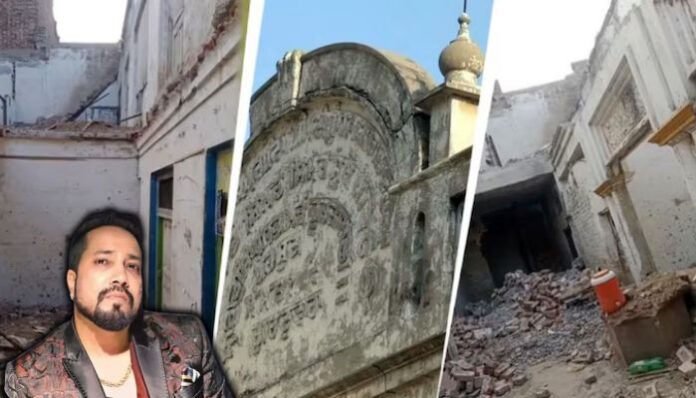
Such is the power of perception and narrative-building that people refuse to see the obvious problems in their country’s adversaries just because their personal experiences were not bitter. Despite having Islamic exclusivity, the narrative game of Pakistan is so strong that it manages to influence even a section of Indian people that Pakistani Muslims are ‘secular and tolerant’. In a podcast with Times Now anchor Navika Kumar, singer Mika Singh said that Pakistani Muslims are good because they ‘maintain Gurudwaras really well’.
Appearing on the Baatein Dil Se podcast released on 2nd October, singer Mika Singh said that he does not understand why Indians view Pakistani Muslims differently while Muslims living in Dubai are viewed positively.
While defending the Pakistani Muslim majority, Mika Singh claimed that they maintain Sikh religious sites very well, and when he visited Pakistan, the Pakistani Muslim “brothers” helped with cleaning the Gurudwaras.
Explaining the reason behind his deep love and admiration for Pakistan, Mika Singh said that it is because three main Sikh religious sites, Gurdwara Janam Asthan in Nankana Sahib, Gurdwara Darbar Sahib in Kartarpur, and Gurdwara Panja Sahib in Hasan Abdal, are situated in Pakistan.
“When I went to Pakistan, many Muslims who are our brothers have served at the gurdwaras and helped with the cleaning,” he said.
The singer elaborated, “Pakistan bura nahin. Pakistan ke log kahin se bure nahin hain. Ye bas pata nahin kyun humein Pakistan ke hi Musalman kharaab lagte hain. Lekin Dubai ke Musalman bahut achhe lagte hain. Ye mujhe aaj tak nahin samajh aaya. (Pakistan isn’t bad. The people of Pakistan aren’t bad at all. I just don’t know why, but for some reason, we seem to dislike Muslims from Pakistan. But we really like Muslims from Dubai. I’ve never understood that),”.
“I like Pakistan because even Muslims brothers in the country maintain the Gurudwaras really well” Sikh population in Pakistan has become extinct due to Islamist onslaught but trust Mika Singh to twist facts so that his music can sell overseas 🤡 https://t.co/KAzp0GEfNz
— Monica Verma (@TrulyMonica) October 7, 2026
“Nankana Sahib and Panja Sahib are there. There are three very important gurdwaras in Pakistan. For me, it is not about money. The first thought is that I can reach the gurdwara through this… “If Pakistanis are giving me respect, we should be happy about it. At least there is someone who is going there and performing,” Singh said.
Mika Singh might have had a good personal experience and accorded warm hospitality since he is a celebrity, and such visits hand Pakistan rare opportunities to present a good image beyond its “Islamic terror-sponsor” disrepute. However, his observation sits against the documented record of demographic collapse, property loss, demolition of Gurudwaras and other minority religious sites, and attacks on Hindus, Sikhs and other non-Muslim communities.
The state of Gurudwaras in Pakistan
In December 2025, Pakistan’s own Parliamentary Committee on Minority Caucus was informed that the country has 1,285 Hindu worship places and 532 Gurudwaras, of which merely 37 are functional. The two main reasons cited were the weak presence of Hindu and Sikh populations, and pathetic maintenance by y the Evacuee Trust Property Board (ETPB).
In fact, a Pakistan-based documentation project on Lahore district alone found 42 historic Sikh shrines, of which only five were functional, one maintained but non-functional, while 14 were standing but occupied by local Muslims, eight lying in ruins, and 14 disappeared, which means they were replaced by other buildings.
There have been numerous incidents of Muslim-orchestrated attacks on Sikh Gurudwaras in recent years alone.
On the night of 24–25 June 2026, a 125-year-old Gurdwara Sri Guru Singh Sabha Sahib in Farooqabad, near Nankana Sahib, connected to the Singh Sabha movement, was demolished by a local businessman without the required clearance. The Indian Ministry of External Affairs called it a “highly deplorable and targeted act of vandalism” and demanded investigation and restoration. Pakistani Sikh representatives said earlier sites, including Gurdwara Chobacha Sahib, had also been lost without meaningful action.
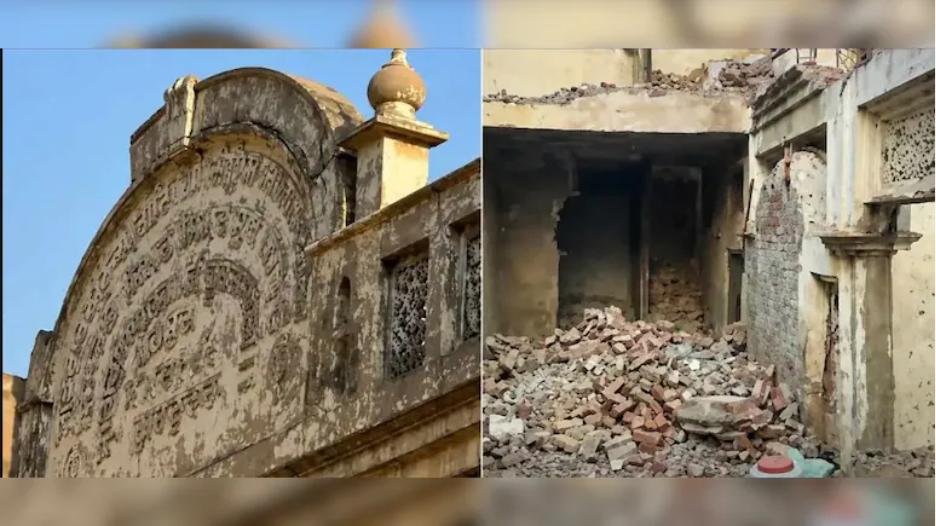
In August 2026, the local Sikhs in Quetta said that the building of Gurdwara Sri Singh Sabha (Archer Road), long used as a school, was razed for a commercial plaza without consultation. The Sikh leaders also lamented that dozens of pre-Partition Gurdwaras in Quetta had already been occupied by Muslims.
In 2019, partial demolition and sale of fittings at Nanak Mahal in Narowal and sale of high-value land associated with Gurdwara Bebe Nanaki near Lahore’s Gurdwara Dehra Sahib were reported.
While Mika Singh claimed that Pakistani authorities protect Nankana Sahib and other historical Sikh religious sites, in January 2020, a Muslim mob led by Mohammed Imran, the brother of Mohammed Hassan, a man who abducted and forcibly married a Sikh girl. The attack was carried out by the Muslim mob after the Sikh girl’s brother filed a police complaint.
Even the Kartarpur Corridor had encountered furious objections from within the country. Late Maulana Khadim Hussain Rizvi, the founder of radical Tehreek-e-Labbaik Pakistan, expressed that the Islamic nation was not founded to create Sikh universities or to provide a corridor for them, and those who love this minority community should move to Amritsar.
In April 2020, five domes of the Kartarpur Sahib Gurudwara collapsed due to strong winds.
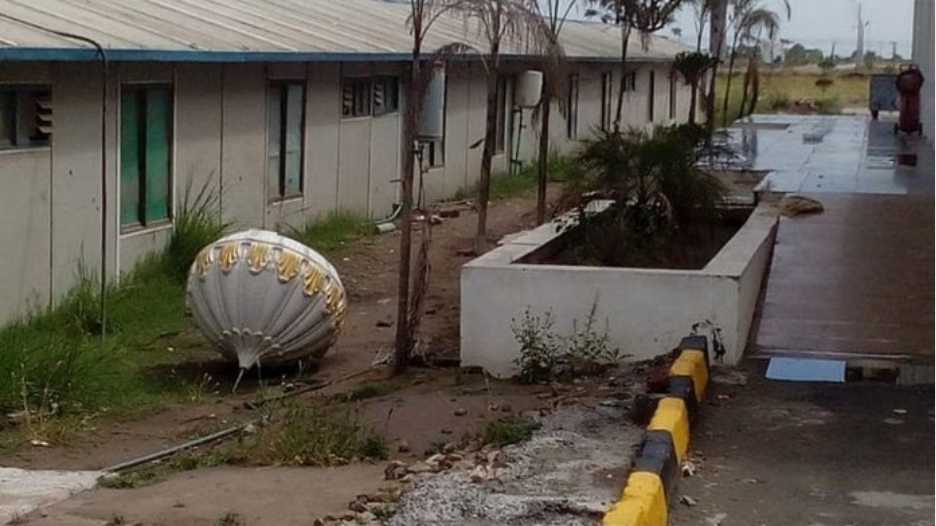
A 9-foot bronze statue of Maharaja Ranjit Singh, the founder of the Sikh Empire whose reign stretched from Afghanistan to the outskirts of Delhi, had been defaced on three occasions. It is located in Lahore Fort and was first attacked in 2019 shortly after the abrogation of Article 370 in Jammu and Kashmir. A man named Zaheer then broke the statue’s arm in 2020 as he was influenced by Khadim Hussain Rizvi’s sermons, while the artwork was completely vandalised in 2021, sparing only the horse.
Pakistan, a cultureless Islamic Republic suffering from an identity crisis, long dismissed its pre-Islamic, essentially Hindu past as an age of Jahiliyyah or the era of spiritual darkness that achieved redemption only after the arrival of Islam through Mohammad Bin Qasim.
The Islamic Republic of Pakistan’s institutionalized intolerance for Hindu and Sikh religions and history also reflects in its negligence in the maintenance of the region’s pre-Islamic, essentially the historical sites of Ancient India or Ancient Bharat.
In July 2026, the United Nations Educational, Scientific and Cultural Organisation (UNESCO) formally asked Pakistan to reverse recent ‘reconstructions’ and “unnecessary interventions” at Mohra Moradu, a Buddhist monastery and stupa complex from the Kushan era, and Sirkap, the Indo-Greek city layer. Both these sites are located in the Taxila (Takshashila) archaeological complex in present-day Pakistan’s Rawalpindi district. These sites are UNESCO-recognised World Heritage Sites from the post-Indus Valley Civilisation period (around 2nd century BCE to 5th century CE).
In October 2009, the 7th-century CE rock-carved Buddha statue was dynamited and defaced by Pakistan Army-harboured Taliban Jihadis, who also attacked many Kushan-era stupas. The Taliban terrorists drilled holes into the face, shoulders, and feet of the statue, filled them with explosives, and detonated them, destroying the statue’s face and upper body, in an apparent emulation of the 2001 Bamiyan Buddhas destruction in Afghanistan.
It must be recalled that in 2023, Pakistan, in its bid to erase the region’s Hindu past, demolished the Hinglaj Mata Mandir (temple) in Sindh province.
Pakistan also destroyed the Sharda Peeth Mandir, which is another Hindu shrine along the Line of Control (LoC). Ironically, the ancient Hindu temple was recognised as a UNESCO heritage site, although that status could not save it from Pakistani hatred for Hinduism.
A historically significant Hindu temple in Pakistan’s Khyber Pakhtunkhwa province, close to the Pakistan-Afghanistan border, was destroyed last year. The property, which had been abandoned since 1947 when the initial inhabitants moved to India, became the site of a commercial complex. Once located in the Khyber district’s border town of Landi Kotal Bazaar, the “Khyber Temple” had gradually deteriorated over time as the Islamic state neglected its maintenance.
In 2023, two Hindu temples in Pakistan’s Sindh region were violated and desecrated in a single day. A group of criminals used rocket launchers to attack a Hindu temple in the Kashmore area of Sindh. According to reports, the attackers targeted the temple and the Hindu houses nearby, aiming at Hindu believers. They fired randomly at the temple and the residences next to it.
A Hindu temple in Karachi’s Soldier Bazaar that was more than 150 years old was destroyed. The local administration dismantled the ancient Mari Mata Temple.
Panj Tirath, a 1000-year-old Hindu cultural monument in Peshawar, had been involved in a court dispute for more than three years. The Hindu heritage monument, which the Pakistani government designated a National Heritage site in 2019, was illicitly occupied and utilized as an amusement park warehouse, according to reports from 2023.
If we include the temples demolished in the 1990s and before, this compilation will become too exhaustive and emotionally overwhelming, and would stoke the feeling that we know that not too far from India, Hindu and Sikh history is undergoing systematic humiliation, erasure, and even appropriation, but there is no end to this helplessness.
As per an estimate by the Movement for Solidarity and Peace (MSP), as many as 1,000 Christian and Hindu girls, aged between 12 and 25 years, are abducted annually in Pakistan. In most cases, the police refuse to act against the perpetrators or are found to be helping the Islamists.
As per an October 2024 report by human rights group Jubilee Campaign, the modus operandi of perpetrators of such crimes rarely deviates from the following pattern: an adult Muslim man (in some cases married with children of their own) identifies a young Christian or Hindu girl (often a neighbour or acquaintance) whom he wishes to make his wife. The perpetrator exploits Sharia legal loopholes; the climate of police disinclination to investigate offenses against faith minorities; and the willingness of some radical Muslim leaders and entities to fabricate documentation regarding the victim’s age, religious affiliation, and marital status.
In May 2023, a Christian girl named Muskan was kidnapped at gunpoint by Mohammad Adnan and his father, after which the minor was forced to convert to Islam. The minor was declared Adnan’s ‘wife’. Muskan was repeatedly subjected to sexual abuse. In June, 14-year-old Muskan Liyaqat of Muridke in Punjab’s Sheikhpura district escaped from captivity after nearly two years. After escaping captivity, Muskan said that she was beaten with an iron rod and insulting words were used for Christians. She had a miscarriage after torture during forced pregnancy.
As per a Jubilee Campaign report, in the case of the forced conversion and marriage of a Christian girl named Shifa, the police officer told the 14-year-old victim’s father, “Your daughter will never return to you, inshallah [if Allah wills].” During the court hearing, her 48-year-old Muslim ‘husband’ Syed Shabbar Ali Gillani presented fake conversion and marriage documents to claim that Shifa was 18 years old even though she was 14. Shifa was abducted by her neighbour Najma Liaquat.
In February 2023, a 17-year-old Hindu girl in Pakistan’s Sindh was kidnapped and converted to Islam.
Notably, Mirpur Khas is notorious for the big conversion rackets operating there. Reports say that not only Hindu girls but entire families are targeted for forced conversions and then kept in mosque-cum-training centres to properly ‘Islamise’ them. In May 2023, around 50 Hindus were converted to Islam and were subjected to four months of Islamic training.
In March 2025, Pakistan’s Human Rights Commission of Pakistan (HRCP) released its report on the human rights situation in the country. The report, “Under Siege: Freedom of Religion or Belief in 2023/24,” gave a dark account of increasing violence, forced conversions, and institutionalised discrimination against Pakistan’s Hindus, particularly in Sindh province.
Violence against Hindus in Pakistan includes mob violence, temple desecration, targeted kidnappings, and forced conversion of Hindu girls. The report highlights how the judicial process in Pakistan, extremist elements, and inaction of government officials have placed Hindus in a seriously vulnerable position with little chance of justice.
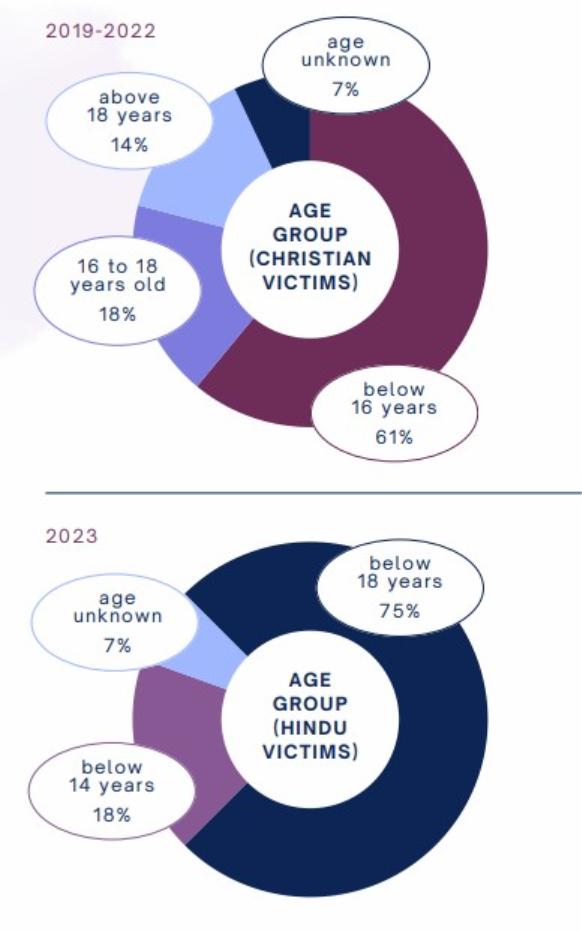
In the year 2022 alone, 124 including 81 Hindu women forcefully converted to Islam with 58% of them being minors. A Human Rights Observer 2023 fact sheet revealed 81 Hindu, 42 Christian, and one Sikh girl were forcibly converted to Islam. The fact sheet revealed that 23 per cent of girls were below 14 years of age, 36 per cent of them were between the ages of 14 and 18 years, and only 12 per cent of the victims were adults, while the age of 28 per cent of the victims was not reported.
Notably, besides being forced to convert to Islam, Hindus in Pakistan are subjected to religious discrimination, humiliation, and killings over the false accusations of ‘blasphemy’ by Islamists. Hatred against Hindus is indoctrinated in educational institutes in the country.
In August 2025, Pakistan’s own National Commission on the Rights of the Child (NCRC) exposed the serious and long-standing discrimination faced by children from minority religions, especially Sikhs, Christians and Hindus in the country.
While Mika Singh lives in this delusion that Pakistan and Pakistani Muslims hold Sikhs and their religious site in high regard and protect them out of sheer respect, the reality of the ‘Sikh love’ is that during the May 2025 conflict, Pakistan launched drones and missiles toward the Harimandir Sahib, or the Golden Temple in Amritsar, on the night of 7-8 May. Their attacks, driven by religious hatred and the deliberate design of stoking ‘Khalistani’ sentiments in India, were foiled by Indian air defence systems, and the sacred shrine was protected from any damage. In Poonch, however, Pakistan attacked a Gurudwara and killed four Sikhs.
Pakistan’s deceitful ‘love’ for Sikhs and why it ‘maintains’ major Sikh pilgrimage sites
In recent times, there have been two parallel image makeovers going on in Pakistan. The first calculated manoeuvre is about establishing Pakistan as a civilisational state by appropriating ancient India or undivided India’s Hindu history, apparently, to build a favourable narrative that can be useful for the Indus Waters Treaty issue. Although OpIndia reported earlier how even this pretentious embrace of the pre-Islamic history of the region is not taking place without de-Hinduising the past, as seen with Basant returning to Lahore not as a festival honouring Maa Saraswati but as a ‘cultural’ kite-flying festival.
The second is about building an apocryphal ‘Pakistan is pro-Sikh’ narrative.
Pakistan protects, to some extent, the three main religious sites of Sikhs, is for controlled pilgrimage and tourism revenue, for its covert ISI operations as these sites attracted tourists mainly from India until the May 2025 conflict, and for maintaining the chimera of religious tolerance and cultural heritage preservation at global forums.
Ironically, these concerted efforts are ongoing while Pakistan’s madrasa-bred de facto ruler, Field Marshal Asim Munir, intermittently reminds his country’s Muslim populace about the Islamic exclusivity and delusional superiority propagated by the bigoted and divisive Two-Nation Theory. “We are different from the Hindus”, this is what Munir said a few days before the Pakistan-orchestrated Pahalgam Islamic terror attack in April 2025.
From sympathising with Khalistani terrorists and the ISI, even backing them, to pushing a narrative that they are pro-Sikhs and support even Indian Sikhs. Pakistan has banned the release of Indian movies in the country, and yet it allowed a film featuring Indian Sikh actor Diljit Dosanjh and Pakistani actress Hania Aamir to be released in Pakistani theatres last year.
Pakistan, which officially banned Adita Dhar’s blockbuster Dhurandar series for exposing how it is a safe haven for Islamic terrorists, wanted to showcase Honey Trehan-directed Satluj, due to the film’s biased narrative against India, which completely fails to address the Khalistan movement and its numerous victims, particularly Hindus.
Mika Singh doesn’t understand why Indians like Dubai Muslims but not Pakistani Muslims: Here’s why this is the case to some extent
While singer Mika Singh did not very explicitly say who exactly did, he meant by ‘Dubai Muslims’, who are liked, or rather not hated, by Indians, primarily non-Muslim Indians; let’s address the case of both the local Emirati Muslims and the migrant Pakistani Muslims in Dubai or the UAE.
Except for the bigoted and Islamically radicalised minority, Emirati Muslims are tolerant, peace-loving, and largely secular-minded. In fact, the UAE administration gets hate for allowing the construction of a Hindu temple in Abu Dhabi. The Emirati ruling dispensation is often labelled ‘Murtad’ by Islamic fanatics from other countries for their religious tolerance. This itself explains why ‘Dubai Muslims’ are not disliked by Indians as such.
Regarding Dubai Muslim, who might be Pakistani migrants, exposure to the world beyond the bigoted Pakistani hellhole accompanies a change in thought process, to some extent de-radicalisation, and the development of religious tolerance.
Since the UAE demonstrates a high degree of societal and state-level tolerance toward other religions, compared to other Islamic countries, including Pakistan, local laws also play an important role in keeping bigotry and intolerance of Pakistani Muslims in check.
This does not mean each and every Pakistani Muslim is inherently anti-Hindu or bigoted; however, the deplorable state of Pakistani religious minorities, and even Ahmadiyya and Shia Muslims, does not allow any sane person’s conscience to accept this sweeping assertion that Pakistani Muslims are an outright secular, liberal, and tolerant community.