

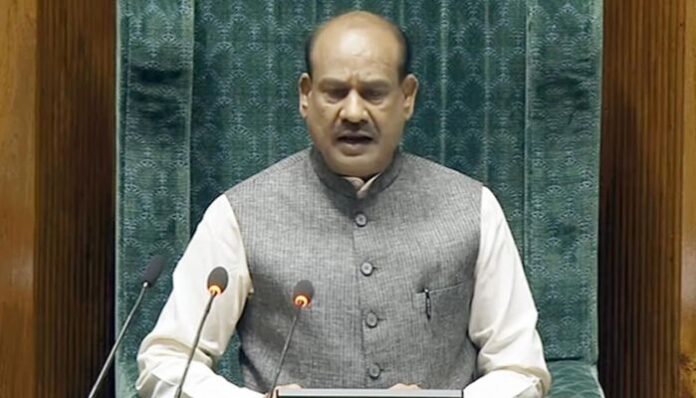
The Lok Sabha on Monday, 9th March, failed to take up a resolution seeking the removal of Speaker Om Birla after the House witnessed repeated adjournments due to protests by opposition members demanding a discussion on the situation in West Asia. The House was adjourned for the day shortly after it reconvened at 3 pm, following an earlier disruption caused by continuous sloganeering from opposition MPs.
When proceedings resumed, opposition members continued raising slogans, preventing the House from conducting normal business. BJP MP Jagadambika Pal, who was chairing the proceedings, urged members to maintain decorum and allow the House to function so that the resolution against the Speaker could be taken up.
Pal reminded the opposition that the no-confidence resolution against Speaker Om Birla was already listed on the House agenda. However, he said their adjournment notice seeking a discussion on the West Asia crisis could not be taken up at that stage.
During the heated exchanges, Pal criticised the opposition for repeatedly disrupting proceedings. He said such disruptions were wasting public money, noting that around ₹9 crore is spent every day to run the Lok Sabha. According to him, the opposition was holding the House “hostage” to its demands and preventing it from taking up scheduled business.
He described the conduct of the protesting MPs as “immature and irresponsible”, alleging that they were working with a political agenda to disrupt the House and block the discussion on the resolution against Birla. Pal also said that the government and the Chair were ready to take up the resolution, but the opposition itself was creating obstacles.
He added that Speaker Om Birla was not presiding over the House while the no-confidence motion against him was pending.
Political confrontation intensifies over no-confidence motion
The developments come against the backdrop of opposition parties moving a no-confidence motion against Speaker Om Birla on 9th February, accusing him of partisan conduct during the heated proceedings of the recent Budget Session.
The notice for the motion has been signed by 118 Members of Parliament, indicating a coordinated effort by several opposition parties. However, the proposal must first clear an important procedural step before it can be taken up for discussion. When the notice is called in the Lok Sabha, at least 50 MPs must support it in the House for it to be formally admitted.
If the motion is admitted, the Lok Sabha will hold a debate on the issue, followed by a vote. For the motion to pass, it will require the support of at least 272 MPs, which is a majority of the House’s total strength of 543 members.
At present, the numbers appear to favour the ruling alliance. The NDA has around 293 MPs, while the opposition bloc has roughly 238 members. Even though the opposition may not have the numbers to pass the motion, the development is expected to trigger strong political exchanges in Parliament in the coming days.
The move is seen as an escalation of the confrontation between the opposition and the treasury benches in the Budget Session of Parliament.
Congress submits notice under Rule 94C of Lok Sabha
The Congress leaders said that the no-confidence notice against the Speaker was submitted by Congress MP Gaurav Gogoi under Rule 94C of the Rules of Procedure and Conduct of Business in the Lok Sabha.
According to Gogoi, the notice was formally submitted at 1:14 pm on Monday, 9th March, and contains the signatures of approximately 118 members of Parliament from various opposition parties.
Leaders of the opposition parties have accused that they were not allowed to speak in the House, raise issues of public importance, and contribute to debates during the session. It is because of these issues that the opposition parties moved the motion against the Speaker of the House.
However, Congress sources clarified that Leader of the Opposition Rahul Gandhi has not signed the notice. According to party sources, it would not be appropriate for the Leader of the Opposition to sign a no-confidence motion against the Speaker, as such a move could affect the dignity of parliamentary institutions.
They said the decision was taken keeping institutional propriety and parliamentary traditions in mind, even though the opposition had decided to raise concerns about the functioning of the House.
