

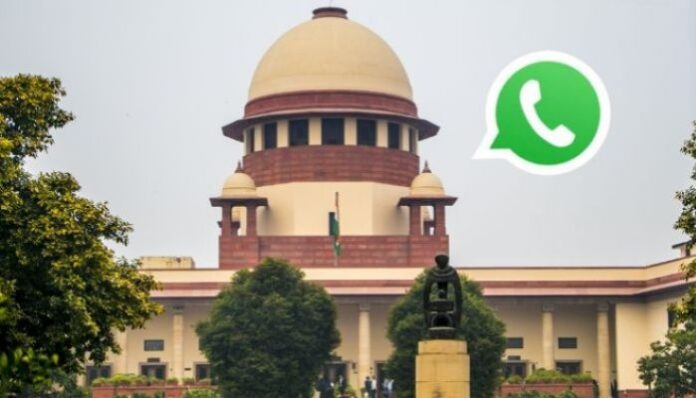
The Supreme Court on Tuesday, 3rd February, issued a strong warning to US tech giant Meta and its messaging platform WhatsApp, making it clear that no company can operate in India without following the country’s laws and protecting citizens’ privacy. The court warned that if Indian laws are not followed, such companies are free to leave the country.
#BREAKING | "Exit India If You Cant": Chief Justice Warns Meta Over WhatsApp Policy
— NDTV (@ndtv) February 3, 2026
NDTV's @nupurdogra reports#Meta pic.twitter.com/ZhbTyzykLS
A bench led by Chief Justice Surya Kant made sharp observations while hearing a case linked to WhatsApp’s 2021 privacy policy. “You can’t play with the privacy of our country. We will not allow you to share a single digit of our data,” the Chief Justice said, adding that the Constitution cannot be compromised for commercial interests.
The hearing relates to an order of the Competition Commission of India, which had imposed a penalty of Rs 213 crore on WhatsApp in November 2024. The regulator had said that WhatsApp used its dominant position to force users to accept the updated privacy policy, which allowed data sharing with other Meta platforms.
It had objected to WhatsApp telling users that they could continue using the app only if they agreed to the new data-sharing terms.
The company law tribunal later upheld the penalty but removed a five-year restriction on WhatsApp sharing data. Both Meta and WhatsApp challenged the CCI order in January 2025. The tribunal’s ruling in November 2025 set the stage for the current proceedings before the Supreme Court.
There is also a cross-appeal by the Competition Commission of India on the issue of data sharing for advertising purposes. The tribunal had earlier allowed data sharing after holding that there was no abuse of power, a finding now under the court’s scrutiny.
Appearing for the government, Solicitor General Tushar Mehta criticised WhatsApp’s policy as exploitative and driven by commercial gain.
The Chief Justice expressed concern and questioned whether ordinary users could even understand such policies. He asked whether poor users, street vendors, or people who speak only regional languages would be able to make sense of complex privacy terms.
The court also expressed concern over how personal information could be misused. Sharing a personal health message with a doctor on WhatsApp and then seeing related advertisements, the Chief Justice said, showed how private data could be monetised.
Senior advocates Mukul Rohatgi and Akhil Sibal, appearing for Meta and WhatsApp, told the court that messages on WhatsApp are end-to-end encrypted and cannot be read by the company.
The Supreme Court said user privacy is non-negotiable and made it clear that technology companies must respect Indian law and the Constitution while operating in the country.
